





Four Nordic countries – Sweden, Denmark, Finland and Norway – have called on Thailand to reform its lèse-majesté law during a United Nations human rights review in Geneva on 9 November 2026. Sweden specifically recommended removing mandatory minimum prison sentences and excluding children and juveniles from criminal responsibility under Section 112 of Thailand’s Criminal Code.
The recommendations were made during Thailand’s fourth Universal Periodic Review (UPR) at the UN Human Rights Council, where 106 countries participated in examining Thailand’s human rights record.
Sweden’s representative called on Thailand to amend the legislation to remove “mandatory minimum prison terms for violations” and exclude children and juveniles from criminal responsibility under the provision.
Denmark’s representative similarly recommended that Thailand amend Section 112 to comply with international human rights standards, including the International Covenant on Civil and Political Rights and the Convention on the Rights of the Child.
Finland called for the removal of disproportionate mandatory minimum penalties and stronger guarantees of judicial independence and fair trials.
Norway’s representative, Marita Sørheim-Rensvik, recommended reviewing the lèse-majesté law and other legislation affecting freedom of expression and peaceful assembly to ensure compliance with international human rights law.
Norway also recommended discontinuing criminal proceedings against individuals for peacefully exercising these rights.
The Nordic countries were not alone in raising concerns about the legislation.
Germany recommended amending Section 112 to protect freedom of opinion and expression, while Canada called for revising or repealing legislation used to criminalise freedom of expression, explicitly including Sections 112 and 116 of the Criminal Code.
Austria and Australia also raised concerns about the legislation and prosecutions involving minors.
Among those imprisoned under Section 112 is prominent human rights lawyer Arnon Nampa, who has been detained since September 2023. On 30 October 2026, he received another sentence of two years and eight months in connection with a speech at a demonstration in 2020. His lawyer told Khaosod English that the latest conviction brought his cumulative prison sentences to 38 years.
Thailand defends the legislation
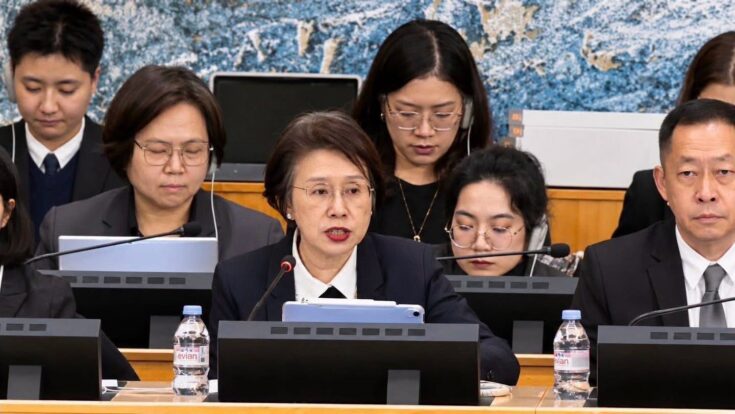
Thailand defended Section 112 during the review, arguing that the law protects not only members of the royal family but also the institution of the monarchy.
Pimsida Chayana, Director-General of the Department of International Organizations at Thailand’s Ministry of Foreign Affairs, explained that the monarchy is regarded as one of the country’s national pillars.
She said the legislation was therefore intended to uphold public order and national security, referring to provisions of international human rights law that permit certain restrictions on freedom of expression.
The Thai representative also maintained that judicial proceedings provide safeguards, including the rights to fair trials and appeals.
Section 112 currently carries prison sentences of between three and fifteen years per offence.
According to a September 2026 report by the International Federation for Human Rights and Thai Lawyers for Human Rights, 461 people were prosecuted under the law between May 2014 and July 2026, including 21 children. The youngest was 14 years old.
Following the UN review, a coalition of Thai civil society organisations, including Amnesty International Thailand, urged the government to translate the recommendations into concrete reforms.
The organisations welcomed Thailand’s commitments concerning legislation against abusive lawsuits and discrimination but expressed concern over the government’s continued defence of Section 112.
Thailand received 297 recommendations during the review, covering freedom of expression, refugee protection, children’s rights and other human rights issues.
The UN working group is scheduled to consider the recommendations on 13 November. Thailand’s formal response will form part of the continuing review process.
Sources: This article is based primarily on the United Nations recording and transcript of Thailand’s Universal Periodic Review on 9 November 2026, including statements by the Nordic representatives and the Thai delegation. The automatically generated transcript was supplemented by Norway’s official written statement, information from Thailand’s Ministry of Foreign Affairs, and the joint statement by Thai civil society organisations.
