


Tom moved from Prachinburi in Thailand to Denmark when he was 12 years old. His mother had married a Danish man and, after two years of living in Denmark, she was granted permission to bring over her three sons — Tom, his older brother, and his younger brother.
The family settled in Tikøb, a small town in North Zealand. For his first year in Denmark, Tom had to attend a special class for immigrant children in Helsingør, where students still couldn’t speak, read and write enough Danish to attend regular school. After that year, he transferred to Tikøb Skole. Later, when his mother divorced and remarried, the family moved again — this time to Espergærde, still in the same northern region outside Copenhagen.
“I had an OK relationship with my stepfather. Unlike my brothers, we got along fine,” Tom recalls.
After completing 9th grade, Tom moved to Jutland to attend Technical College in Skive, where he trained to become a *værktøjsmager*—a toolmaker. The program included learning to build molds for the plastic industry and other precision work.
All through his school years, Tom had a strong passion for sports, especially handball. He eventually rose to play in Denmark’s 2nd division. But his athletic career was cut short by a serious shoulder injury that required surgery. During his recovery, Tom returned to Zealand and settled in Nørrebro, Copenhagen. There, he pursued further studies to become a production technician with a specialty in machine construction.
But something was missing.
Tom began to feel disconnected from his Thai roots. His Thai language skills were fading, and he missed the sense of community. So he started frequenting Thai music clubs in Copenhagen — places like Bangkok Café on Vesterbro and ThaiByNight.
“One of the things I like about the Thai places is that the guys there don’t want to fight all the time,” Tom says.
“Whenever I went to Danish bars, there would always be some Danish idiot who wanted to fight me. They usually ended up regretting it,” he laughs.
With his education completed, Tom began applying for jobs. Lots of them.
“I wrote more than 80 applications for jobs and not once was I called in for an interview,” he says. Even when he applied for a basic machine operator job — far below his qualifications — he was rejected.
Meanwhile, his younger brother, who was educated as a painter, and his older brother, a carpenter, had no trouble finding work. “They had plenty of jobs. I had two educations and couldn’t get anything!”
So Tom started helping his brothers out. He worked hard — never calling in sick, putting in weekend shifts when needed — and soon he was earning more than the regular staff, even without formal qualifications in the field.
But his nights were still spent in the Thai clubs — and the crowd he began to associate with led him into deeper trouble.
“I was hanging out with the wrong kind of guys. I started taking cocaine, and then I started helping sell it too. It was ten crazy years in the fast lane.”
The turning point came when one of his Thai friends was caught. It turned out the friend had far more drugs at home than Tom had realized. He was sentenced to six years and deported to Thailand.
“That really shook me. I knew I had to get out.”
Tom signed up for a taxi driver’s license and started working night shifts. Around that time, a Thai friend asked for help repairing an apartment. Thanks to the experience he had working alongside his brothers, Tom was able to do a professional job.
Then, one day, a Thai woman passed by while he was working. She told him about her unusual job — clearing out homes in Copenhagen after people had died. Some of the furniture that she salvaged, she sent back to Thailand to sell.
A week later, she called him again. She needed help modifying a built-in kitchen unit.
“We got to talking,” Tom says. “I told her I had applied for so many jobs but was now just driving a taxi.”
She explained how she’d taken over the furniture clearing business after her husband nearly died and went into a coma. Then she handed him the key to her mini-truck.
“I need a driver,” she said. “You can start tomorrow.”
Tom was stunned.
“In respect for her and that trust she placed in me, I went straight home and flushed the last of my drugs down the toilet.”
At that time, Tom was carrying a personal debt of nearly 400,000 Danish kroner—unpaid bills, alimony, collection letters he hadn’t dared open. He co-owned a summerhouse with his mother, and together they sold it to clear the debt. There was even a little left over.
Now clean and debt-free, Tom began collecting used furniture himself. He didn’t have storage space, but a Danish friend let him stack items in his apartment. Some items he picked up for free, others he bought. Inspired by his mentor, Tom filled a container and shipped it to Pathum Thani, where a relative lived.
But the business didn’t go as planned.
“It was hard to sell. The furniture started to deteriorate in the humid storage, and I couldn’t move the pieces like that woman could.”
He relocated the items to Saraburi, where conditions were better, but sales still didn’t take off. Eventually, he moved the remaining furniture to a townhouse in Udon Thani. He carried everything up to the second floor, decorating part of the space as a showroom above a neighbor’s noodle shop.
“One day, a lawyer friend brought a woman who ended up buying everything — at a bargain price. I was just happy to get rid of it.”
Tom returned to Denmark to work again. But soon, he was collecting for another shipment. This time the container went to Prachin Buri, to a half-finished building originally meant to be a B-Quick garage.
He sold that stock, returned to Denmark, and filled yet another container. But then COVID-19 hit.
“It got complicated,” Tom says. “Every time I traveled between Denmark and Thailand, I had to do 15 days of quarantine.”
By then, he had moved his operations to a double townhouse in Chonburi. He had also learned a key lesson: furniture wasn’t the most profitable cargo.
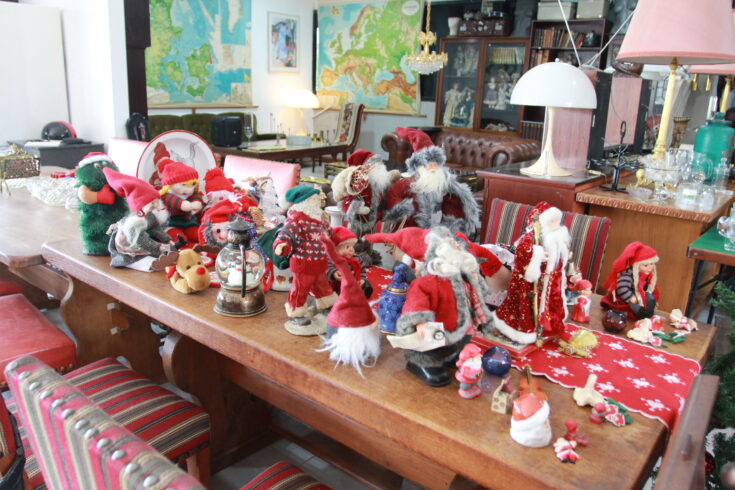
“I realized I could make more selling a box of kitchen tools, glasses, plates, even used workshop tools — than a big old table that took up the same space in the container.”
That was when he found his niche.
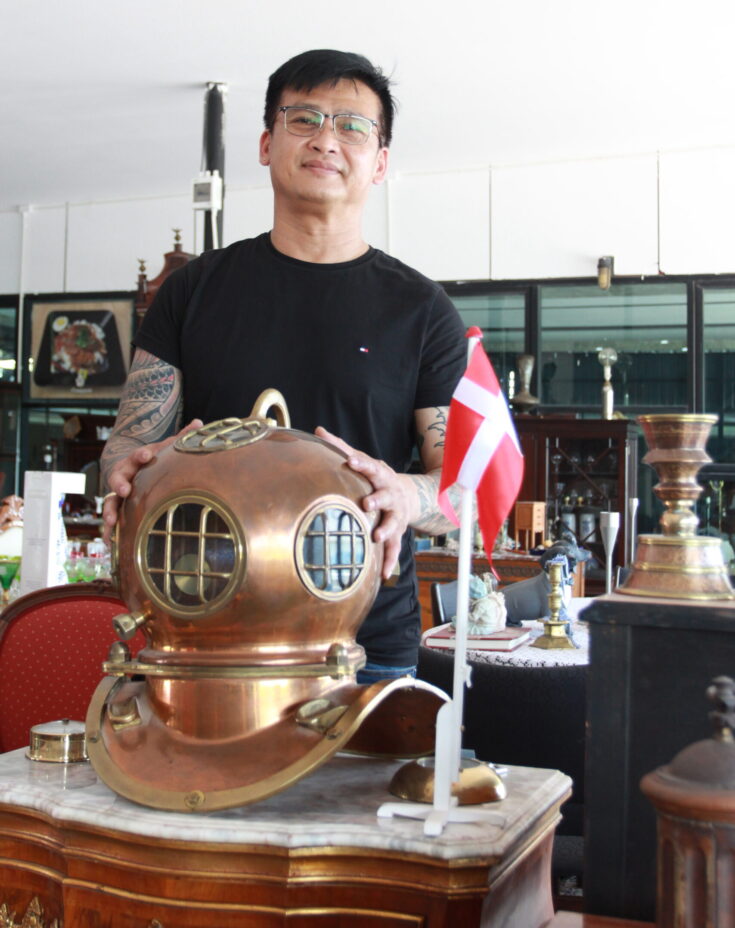
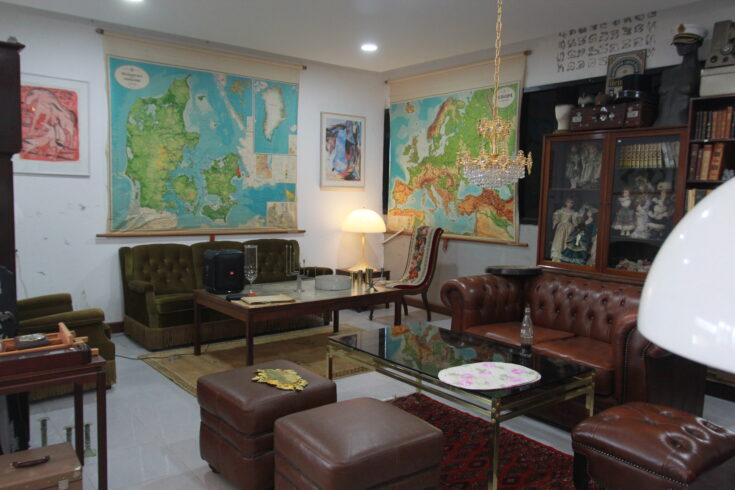
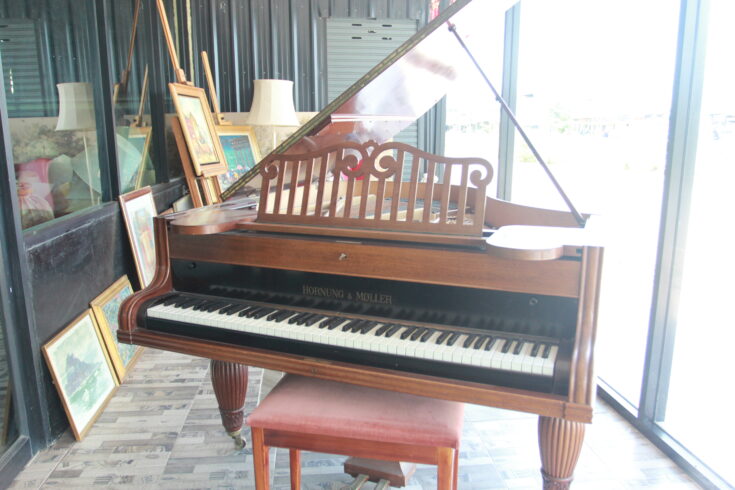
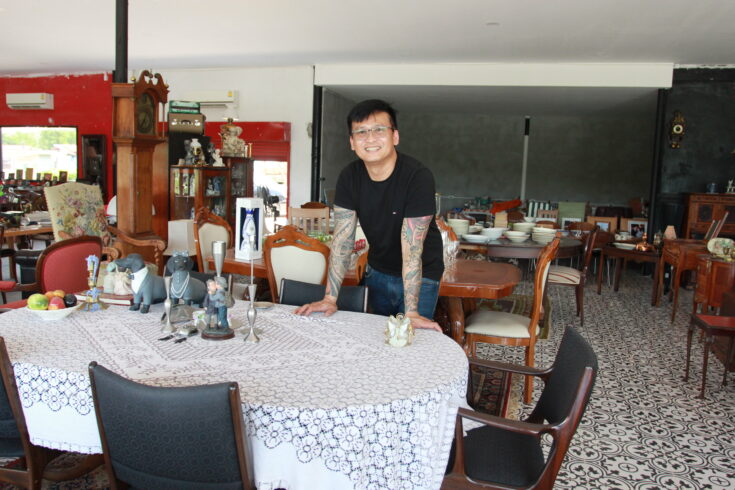
Today, Tom rents a large warehouse and showroom in Chum Phae, Khon Kaen. Next door is Tandawaen, a music restaurant managed by his parents-in-law. That connection also helps with charity.
“They know people who need crutches, walkers, wheelchairs — we can fit them in the container. We even use old clothes as padding and donate them for charity later.”
His showroom is now fully stocked with items moved from his Chonburi location. On 1 June, his next container will arrive, and he expects buyers from shops all over the region to come and sift through all the wonderful stuff he has collected back in Denmark.
“It doesn’t matter that I’m based in Chum Phae. By now I know a good many buyers and they will come to me because I have what they need,” Tom says confidently.
The furniture cannot be from anywhere in Europe, Tom explains.
“It has a special value, that they are Danish, that they are well known Danish designer names,” he says, mentioning quickly the ten most prominent Danish furniture designers and designers of Danish interior design items like lamps, glassware, etc.
“I don’t see myself as an entrepreneur. When I start thinking about setting something up properly, it tires me. But this — being a sort of wholesaler — this works for me.”
Tom has established a registered company in Denmark that pays taxes there. In Thailand, the containers are officially imported by his wife.
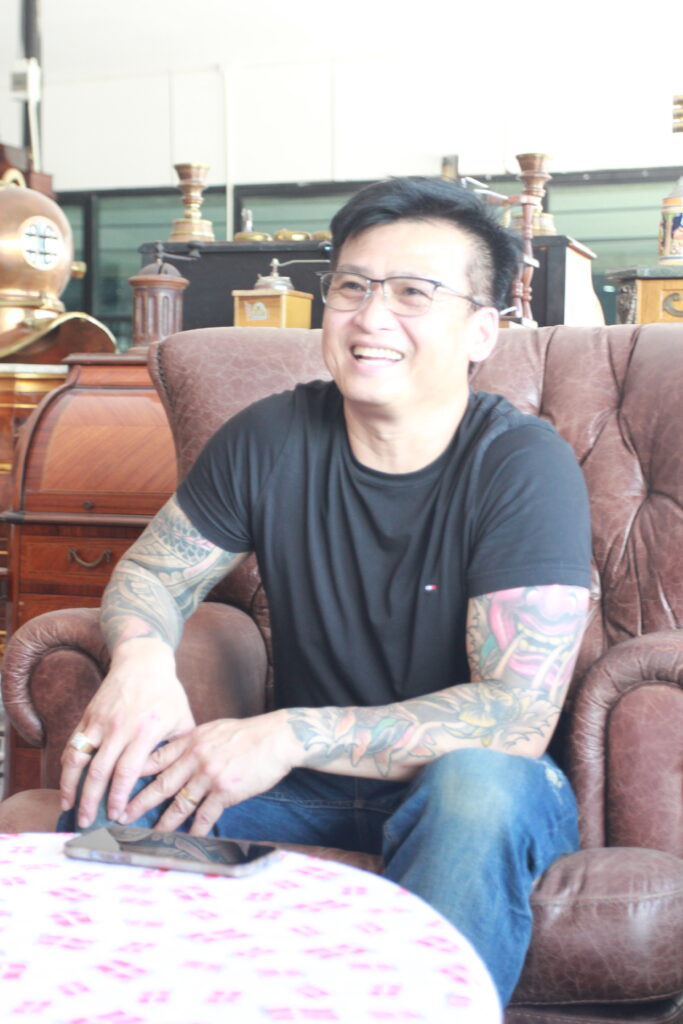
And so, after a long and winding journey — through rejection, risk, and recovery — Tom, today 48 years old, has found a business that fits his life with roots in his two cultures. Denmark and Thailand.
“I always make sure that I am in Denmark a minimum 180 days per year. I would never risk my permanent residency in Denmark.”