




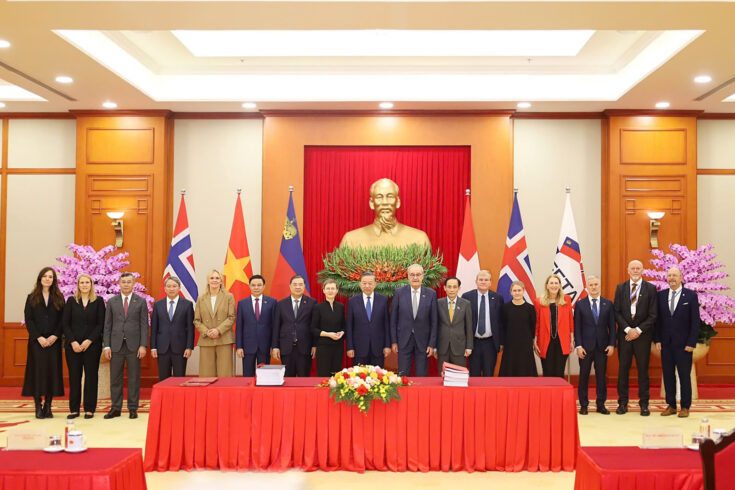
Norway and Iceland have joined Switzerland and Liechtenstein in signing a free trade agreement with Vietnam, opening the way for lower tariffs and improved market access for Nordic exporters. Norwegian salmon and mackerel producers are among the businesses expected to benefit.
The agreement between Vietnam and the four members of the European Free Trade Association (EFTA) was signed in Hanoi on Sunday, 18 October 2026, following negotiations that began in 2012.
It gives Norway and Iceland their own trade framework with Vietnam, six years after the European Union’s free trade agreement with the country entered into force in August 2020.
Norway’s Ministry of Foreign Affairs says approximately half of Norwegian goods exports to Vietnam will become tariff-free when the new agreement enters into force. Within seven years, more than 98 percent will be covered by zero tariffs.
The agreement has been signed but has not yet entered into force.
Norwegian salmon to benefit
Seafood is among the clearest beneficiaries of the agreement.
Vietnam currently imposes import duties of up to 15 percent on Norwegian salmon and mackerel. Under the new agreement, tariffs on salmon will be eliminated when it enters into force, while tariffs on mackerel will be phased out over three years.
Norwegian Minister of Fisheries and Ocean Policy Marianne Sivertsen Næss said the agreement would give Norwegian seafood exporters trading conditions comparable to those enjoyed by important competitors and create opportunities for increased exports to Vietnam.
The Norwegian Seafood Council has already been expanding its promotional activities in Vietnam, where demand for Norwegian salmon is growing. The new tariff arrangements could strengthen the product’s competitiveness against seafood imports benefiting from existing trade agreements.
Norwegian Foreign Minister Espen Barth Eide welcomed the signing as an opportunity to diversify Norway’s international trade relationships.
“In a more unpredictable world, Norway needs to diversify its trade relations,” he said, adding that the agreement would open new opportunities for Norwegian businesses.
According to the Norwegian government, bilateral trade in goods between Norway and Vietnam amounted to approximately NOK 19 billion in 2025.
Opportunities beyond seafood
Norwegian business organisation SMB Norge also welcomed the agreement, highlighting opportunities for smaller companies in machinery, industrial products, chemicals, food production, technology and services.
The organisation said improved market access could help Norwegian companies develop new customer relationships in Vietnam, while also increasing competition and providing better access to imported products in Norway.
The agreement covers more than customs duties. Its provisions include trade in services, investment, intellectual property, government procurement, technical trade barriers and sustainable development.
For Iceland, the agreement similarly establishes a new preferential trade relationship with Vietnam, although the immediate commercial opportunities will depend on the products and services exported by Icelandic businesses.
According to EFTA, total trade between its four member countries and Vietnam reached approximately EUR 4.8 billion in 2025.
Iceland sees opportunities for seafood and investment
Iceland also expects to benefit from the new agreement, particularly through improved access to Vietnam’s market for seafood and other products.
According to Iceland’s Ministry for Foreign Affairs, bilateral goods trade exceeded ISK 10 billion in 2025. Icelandic exports amounted to approximately ISK 452 million and consisted mainly of seafood, particularly mackerel. Imports from Vietnam reached almost ISK 9.8 billion, primarily electronics, footwear and clothing.
Icelandic Foreign Minister Þorgerður Katrín Gunnarsdóttir, who signed the agreement in Hanoi, met Vietnamese Foreign Minister Le Hoai Trung on 18 October to discuss closer bilateral cooperation.
During the meeting, Gunnarsdóttir expressed Iceland’s interest in expanding cooperation in trade, investment and energy infrastructure. She said Icelandic businesses had high expectations for the opportunities arising from the agreement.
The Icelandic government has also highlighted improved market access for Icelandic companies and new opportunities for trade in goods and services, as well as investment.
The agreement’s entry into force remains subject to the necessary approval procedures in the participating countries.
The EFTA agreement was signed on behalf of Norway by State Secretary Astrid Bergmål and on behalf of Iceland by Foreign Minister Þorgerður Katrín Gunnarsdóttir.
Sources: Norwegian Ministry of Foreign Affairs, EFTA, SMB Norge,


