



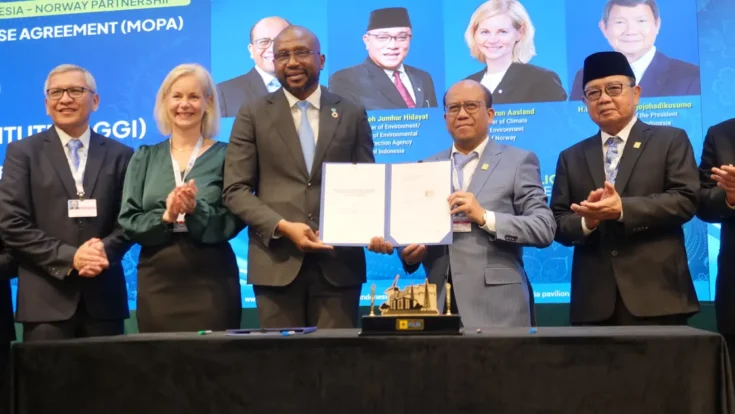
Norway and Indonesia have signed an agreement allowing Norway to purchase up to 12 million tonnes of verified carbon emission reductions from renewable energy projects in Indonesia over the next ten years. The agreement was signed on 11 November 2026 during the COP31 climate summit in Antalya, Türkiye.
According to Norway’s Ministry of Climate and Environment, the agreement will help finance new renewable electricity projects that might otherwise not be commercially viable. The Norwegian government will pay for emissions reductions only after they have been achieved, independently verified and delivered.
The agreement was signed by the Global Green Growth Institute (GGGI), acting on behalf of Norway, and Indonesia’s state-owned electricity company PT PLN. The signing was witnessed by Norwegian Minister of Climate and Environment Sigrun Aasland and Indonesian Environment Minister Moh Jumhur Hidayat.
“Indonesia’s emissions are growing rapidly. Norway’s cooperation with Indonesia is helping ensure that more of the country’s electricity comes from solar power rather than coal,” Aasland said.
Indonesia’s Environment Minister Moh Jumhur Hidayat welcomed the agreement as an example of international cooperation.
“I think this is proof that countries and businesses can collaborate to reduce emissions,” he told Indonesia’s Antara news agency after the signing ceremony.
Hidayat also praised Norway for its longstanding commitment to addressing climate change and expressed hope that other countries would follow its example.
The agreement operates under Article 6.2 of the Paris Agreement, which allows countries to cooperate on reducing greenhouse gas emissions through internationally transferred carbon credits.
Under the programme, Indonesia can generate carbon credits by replacing electricity from fossil fuels with additional renewable power. Norway can then purchase verified emission reductions and count the transferred credits towards its climate commitments, subject to international accounting rules designed to prevent double counting.
The initial focus will be on floating solar power plants, supported by battery storage systems that can supply electricity during peak demand and evening hours.
Indonesia remains heavily dependent on coal, which accounts for more than 70 percent of its electricity generation. Solar and wind power together currently contribute less than one percent, according to the Norwegian government.
The agreement is expected to become one of the largest transactions so far under Article 6.2 of the Paris Agreement.
Indonesian officials have indicated an expected carbon credit price of between USD 20 and USD 40 per tonne. At those prices, the full potential purchase volume would represent USD 240–480 million, although the final transaction value has not been confirmed.
The agreement builds on a framework signed by the two countries during COP30 in Brazil in November 2025. Norway and Indonesia have previously cooperated on forest protection and reducing deforestation, but the latest agreement extends their climate partnership into renewable electricity generation.
GGGI will now work with the Indonesian and Norwegian authorities and PLN to finalise the operational arrangements for implementing the programme.