



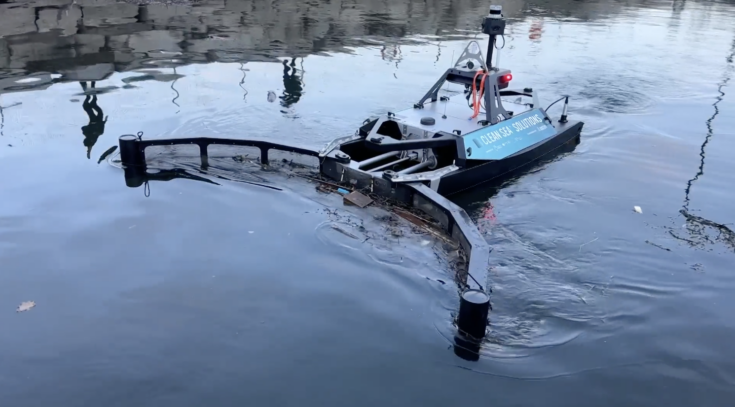
A new Norwegian innovation, the “Aquadrone,” is making waves in the fight against marine pollution. Recently deployed in Trondheim’s harbor, this cutting-edge drone can navigate the water and collect waste, amplifying efforts to maintain clean and safe environments. The Aquadrone has already found success in Singapore, showcasing its potential as a global solution to a rapidly growing environmental issue.
Bjørnar Horsgård, the maritime leader at Trondheim Harbor, expressed enthusiasm for this forward-thinking technology. “This is the future, without a doubt,” he stated, highlighting how the drone operates similarly to a robotic lawn mower or vacuum cleaner, meticulously gathering litter such as plastic and food wrappers from the water’s surface.
Once the Aquadrone completes its cleaning mission, it delivers the collected waste to an accompanying robot, the “Aquapod,” which manages the disposal process. Gulleik Olsen, the operations manager at Clean Sea Solutions—responsible for both the Aquadrone and Aquapod—explained that their initiative aims to combat marine pollution, which the UN has identified as one of the fastest-growing environmental challenges. “We are stopping waste in the harbor from advancing into the ocean,” he said.
The company recently collaborated with NTNU (Norwegian University of Science and Technology) on a research project to enhance the drone’s capabilities. Olsen noted that the goal is to allow the Aquadrone to operate autonomously, from locating debris to delivering it for disposal. Currently, human operators are required for navigation, but Olsen emphasizes that the technology is evolving rapidly.
Plastic pollution crisis
Karoline Andaur, Secretary General of WWF Norway, praised initiatives like the Aquadrone, recognizing them as vital in addressing the urgent plastic pollution crisis. According to the UN Environment Program, approximately 9 to 14 million tons of plastic end up in the oceans every year, and research suggests that plastic pollution could triple by 2040 without immediate intervention. “We applaud all efforts to clean up litter and reduce plastic in the ocean, whether from volunteers or businesses utilizing new technology,” Andaur stated.
Trondheim’s project is just the beginning; if successful, plans are in place for wider implementation of the Aquadrone in multiple harbor locations. Horsgård noted that while litter is not currently a significant issue in Trondheim Harbor, the drone provides an innovative solution to manage smaller debris effectively. The technology’s reach extends beyond Norway, as Clean Sea Solutions has already successfully implemented the Aquadrone in Singapore.
Source: NRK Norwegian Aquadrone marine