




Buttons rise from the desk like skyscrapers in a city landscape. The jog wheels rotate in rhythm with the volume. Lights glimmer, drinks spill, and people crowd the dance floors. A typical night out in Taipei. Swedish DJ Martin Ferm presses a button and starts his set.
Making music
Music has always run in Martin Ferm’s family. His grandfather was a musician who performed concerts. His mother was also a singer. As a kid, Martin played both the flute and trombone, and as a teenager, he picked up the guitar.
When he was younger, heavy metal was his preferred genre.
“Heavy metal is very wild—not necessarily angry, but very powerful and energizing. It was about community: everyone being together, headbanging, jumping. I enjoyed that very much.”
In 2009, a young Martin wanted to see the world, so he went to Japan to study Japanese.
“Living in Japan gave me a whole new outlook on life—so many new things to learn and see,” Martin remembers.
During his time in Japan, Martin made many friends, some of whom came from Taiwan and spoke highly of the island. This piqued Martin’s interest.
“I moved to Taipei to learn Chinese. I didn’t know much—just that it was a tropical island. But when I got here, I didn’t see palms and beaches. I saw bustling cities and busy streets,” he recalls. “I loved it.”
Almost a decade and a half later, Martin still lives in Taipei. Despite the time gone by, he still enjoys exploring the city.
“My friends and I will go for a stroll, typically around the Ximen district, and we’ll spot a little alley. It might lead us to cool street art or gardens with lush plant life. It’s always exciting.”

Discovering music
His friends in Taiwan introduced Martin to electronic music and its many genres: techno, minimal, and house. This eventually led to Martin’s current career.
His interest in DJing started with a friend.
“I had a friend who taught DJ classes, and one day he asked me if I would be interested. I had seen DJs perform before, but I had no idea what they actually did, so I became interested in learning,” Martin says.
“Being a DJ is being a musician. The sound system has all the songs that I enjoy, and I get to play around with them and make something that I enjoy. DJ equipment is my instrument,” Martin says.
Working with music
That one class became the start of a successful DJ career. Martin has played at almost all of the major nightclubs in Taipei, as well as in other cities in Taiwan, like Taichung and Tainan, under the artist name “Mr. Tone”. He played at the festival ULTRA Taiwan in November 2025—a big personal milestone.

In addition to nightclubs and big parties, Martin also works daytime events for brand launches and high-end parties, sometimes very exclusive ones.
“I played at a private launch party for Chanel. They invited four or five VIP guests on a yacht, with a Michelin chef making a private dinner while we sailed along the coast of northern Taiwan. It gave me a unique look into the life of the rich and famous.”
As a DJ, Martin has found a way to express his musicality.
“Music can evoke feelings. I love the creative process—playing around, getting an idea into a sound, and seeing it go from a spark to an actual piece of music.”
One of the best things about being a DJ is that he gets to share his favorite songs with his audience.
“I want people to love music as much as I do. When I play, I jump around and dance—I can’t stop myself. It might make me look silly, but the music makes me feel happy. Sharing my love for music, I think it’s infectious.”
But a career as a DJ is not as straightforward as some might think.

When music becomes work
“DJing is very easy to get started with, but it becomes tougher and tougher. A lot of time and work goes into preparation. I don’t think people realize that. Only 5% of the job is spent playing gigs; the rest is searching for new music, working and reworking a set, to make it perfect,” he explains.
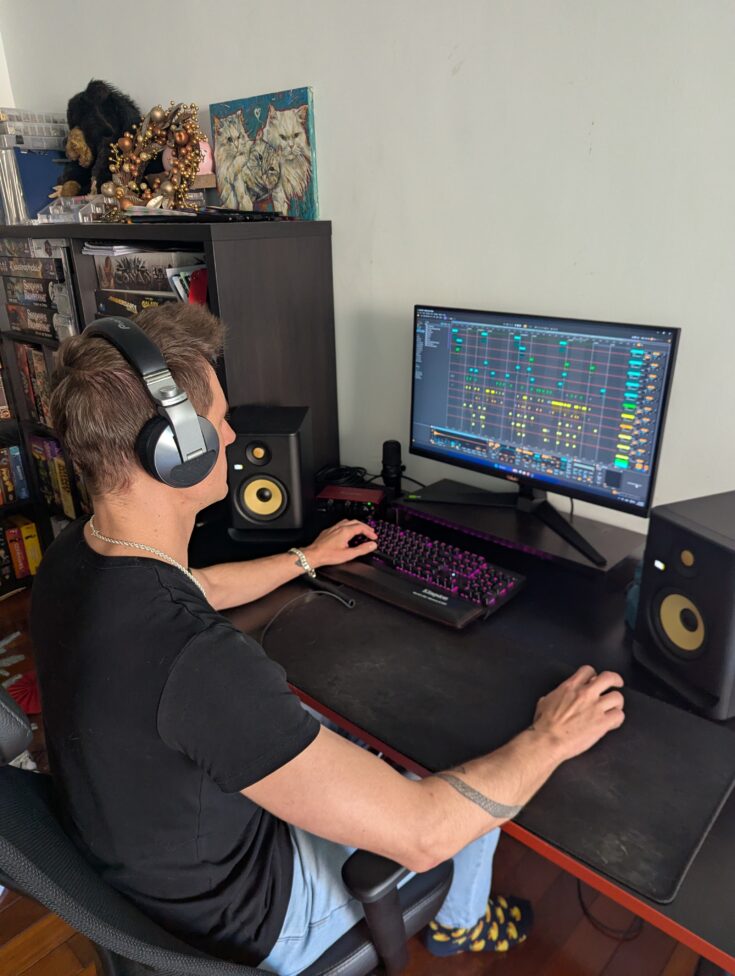
Music is Martin’s passion, and it is always with him. When biking around Taipei, when cooking breakfast, and before going to bed, he either has music in his headphones or playing out loud.
However, Martin is acutely aware that there has to be a balance between music for work and music as a passion.
“Whenever you take something you love and try to make it a career, it is very easy for it to become work and feel tedious. You end up doing it because you have to, and by overdoing it, you can start to lose that passion,” he says.
“But I haven’t gotten to that stage yet. I still love music. I always have, and hopefully I always will.”