




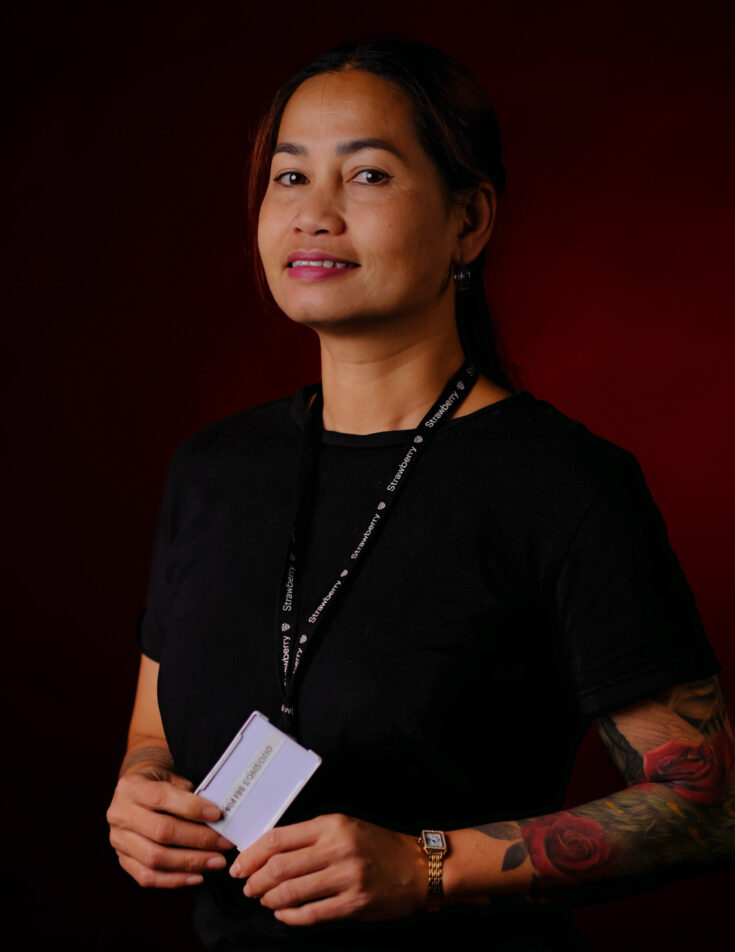
When Somsong “Noon” Saraban talks about her life in Sweden, it does not sound like the result of a carefully laid-out plan. Her path from northeastern Thailand to Sweden has instead been shaped by a series of decisions made whenever something no longer felt right.
She left home young. She left a promising first job when qualifications on paper began to count more than what she had already proved she could do. She moved into the golf business despite considering golf a ridiculous waste of land. She moved to Sweden because of a relationship, but later ended it when they realised they wanted different things from their future.
Years later, when she felt she had learned everything her restaurant job could teach her, she went back to school – this time studying hotel management entirely in Swedish.
Today, after more than two decades in Sweden, Noon has a Swedish husband, Peter, two sons, Melvin and Luke, and a career in the hotel industry. Sweden, she says without hesitation, is home.
Her story, however, begins in Nong Khai.
Leaving home at 13
Noon was born into a family of eight children in Nong Khai province in northeastern Thailand. Her father died when she was only two, and Noon was number seven among the siblings. She attended the local primary school until, at the age of 13, she moved to Samut Prakan near Bangkok to live with her eldest sister and help care for her four-year-old nephew.
There was another, more personal reason why the teenage Noon was ready to leave. Her mother was receiving attention from men, and Noon remembers feeling hurt and jealous. In the mind of a 13-year-old girl, it became a question of whether her mother still loved her.
Today, Noon sees it differently. Her relationship with her mother is good, and she knows that what she felt then belonged to a child trying to make sense of an adult world.
Life with her older sister was strict. There was little freedom to go out, she had to be home on time, and dating was certainly not encouraged. After lower secondary school, Noon followed her sister’s practical advice and studied accounting and Chinese for two years.
Her first job was with Hi-Tech Apparel. Although still very young, Noon was soon given responsibilities well beyond routine accounting. She became assistant head of the packing department, dealt with suppliers and was entrusted with larger projects.
“They could see that I had potential and that I could take responsibility for big projects,” she recalls.
Then the company began recruiting university graduates for supervisory positions. Noon found herself being judged not only on what she could do, but on what she lacked: a bachelor’s degree. After almost three years, the job stopped being enjoyable and she left.
At another company, her vocational qualification resulted in an offer to work making photocopies. Noon knew she was capable of more.
Then a friend suggested she become a caddie.
The woman who didn’t like golf
The friend told Noon that the income was good and that the many foreign customers would give her a chance to improve her English. Noon applied, but instead of becoming a caddie, Eastern Star Country Club & Resort hired her as a golf receptionist, collecting green fees.
There was one irony: Noon was strongly anti-golf. She thought it was a rather pointless sport that occupied enormous areas of land at a time when so many people had neither homes nor land of their own.
Then one of the golf instructors offered free lessons to employees, and Noon decided to give it a try.
“It was actually fun!” she admits.
Golf would change her life in another way. One of the customers was a Swedish man visiting Thailand on a temporary job assignment. Noon was 23 and knew little about foreigners. She worried that she might be deceived; he, on his first visit to Thailand, apparently had similar concerns about being deceived by a Thai woman.
But he was polite and simply invited her to dinner. Noon took the chance. They enjoyed each other’s company, she got to practise her English, and soon they travelled together to Phuket, Hua Hin and Chiang Mai.
After he returned to Sweden, they kept in contact by email. He told her he would come back to Thailand in about two months.
Two weeks later, he was back.
He wanted Noon to come to Sweden and Noon brough him to see her older sister to ask permission to bring her with him. The visa application went through without difficulty.
Having never travelled abroad before, the now 23 year old Noon boarded a plane alone for Sweden.
Finding her feet in Sweden
The beginning was difficult. Noon felt lonely and homesick, but gradually she adapted and decided that learning the language was the way forward.
When her visa expired, she returned temporarily to Thailand, stayed with her mother and studied more English. Back in Sweden, she obtained the necessary documentation, enrolled in Swedish language studies and found work at a Thai restaurant as a cashier.
Sweden was becoming less foreign. At the same time, Noon and the man who had brought her there were beginning to realise that they wanted different things from life.
There was a significant age difference between them, but more importantly, their ideas about the future were moving in different directions. Noon wanted children and wanted to establish her life in Sweden. He imagined a freer life in Thailand.
Time, Noon says, eventually answers the question of whether two people are together because of love or because one is simply a good person. In their case, the differences between the lives they wanted eventually led them to separate.
His response became part of what Noon came to appreciate about Swedish culture. If one person no longer wants a relationship, she says, the other may be hurt, but ultimately respects the decision and the other person’s right to choose how to live.
Looking for someone serious
Noon remained single for almost four years, still working at the Thai restaurant. Then a friend suggested her to join a dating site. Noon took the challenge, specifying strictly what she wanted if she was going to meet someone: a serious relationship with a kind man who had stable employment and no children.
Then she received a message from Peter asking her to dinner.
Before the date, Peter apparently decided to conduct a little reconnaissance. He sent a friend to the Thai restaurant where Noon worked. The friend came in, asked to see the menu and sat watching Noon — without ordering anything.
When Noon finally met Peter herself, she was not particularly impressed. He was too tall and too quiet, almost excessively gentle and well behaved. She even wondered privately whether he was manly enough.
But as they talked, something changed. She liked the way he spoke to her and the respect he showed her. She also liked his intelligence and the fact that his way of thinking could challenge her.
“This man can take care of me. And he can take care of me for the rest of my life.”
They decided to continue the relationship.
Starting a family
Noon moved into Peter’s home – the same home where they live today.
After almost two years together, Noon began raising the question of children. She was 31 and wanted her first child before 35. Peter wanted children too, but at the time his work involved extensive travel. He asked her to wait while he reorganised his work and moved into a position that required less travelling. He wanted to be present during the pregnancy and did not want Noon left to manage everything alone while he was constantly on aeroplanes.
They also decided to postpone their wedding for an unusual reason: they wanted their child to be in their wedding photographs.
Noon was 32 when Melvin was born. Initially, she thought one child would be enough, but she began to worry that an only child would have fewer opportunities to learn about giving, sharing and sacrificing for someone else. She also wanted Melvin to have a companion, so two years later they had Luke.
After 15 years together, Noon says she and Peter have never had a fight serious enough for either of them to contemplate separation. She attributes much of that to mutual respect and freedom. Neither is particularly jealous, and they give each other space to live their own lives.
Choosing Swedish
One of Noon’s more difficult decisions as a mother was not to insist that her sons learn Thai.
She knew the advantages of teaching children their mother’s language while they were young. Thai could connect Melvin and Luke to Thailand and might be useful if they later chose to spend more time there. But Noon herself was still working hard to master Swedish and believed she first needed to establish herself fully in the country where the family lived.
Peter also wanted the four members of the family to share one language that everyone understood. If Noon spoke Thai with the boys, he would be excluded; English was not practical while the children were small. Swedish therefore became the family language, with the added benefit that Noon was forced to use it every day.
When the boys were seven or eight, she offered to teach them Thai. They declined, saying they could not see who they would use it with.
Noon did not force them. That reflects her broader approach to motherhood. She does not require her children to be the best at school. She wants them to enjoy school, become good people and learn how to take care of themselves.
“If my child is gay or lesbian, no problem,” she says. “The most important thing for me is that my child is happy in life and can take care of himself in the path he chooses and as the person he is.”
Starting again in Swedish
After having children, Noon no longer wanted to return indefinitely to restaurant work. The issue was not status or money. She simply felt she had learned what the job could teach her.
Peter suggested hotel service. Noon already understood restaurants and hospitality, but a hotel would offer a larger and more varied working environment. She enrolled in a one-year hotel course and made another deliberate choice: she did not want to work in cleaning.
“Not because cleaning is low-status or badly paid,” she explains. “I wanted a job where I had to use Swedish every day.”
The course had 21 students, including six Swedes, with Noon the only Thai. She found herself thriving in an educational environment where problems did not necessarily have one correct answer. What mattered was how students interpreted the problem and argued for a solution.
She also discovered how far her Swedish had come. Exams could involve three hours of writing in Swedish, and Noon remembers often being the last to finish, shaking her hand afterwards because it was exhausted.
She received an A in every subject.
For her internship, Noon chose Quality Hotel Winn close to home so she could combine work with taking the children to and from school. The internship was supposed to last eight weeks, but after six the general manager offered her a job. Her teacher advised her to accept: she could earn a salary while completing her qualification.
The working hours suited family life. Noon finished at 1 pm and could collect the children and take part in their activities. She stayed for three years until Covid-19 shut down much of the hotel industry.
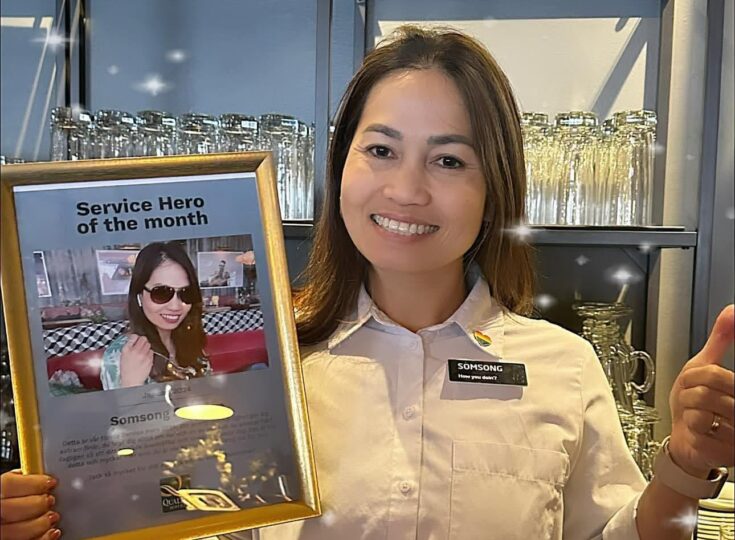
When operations resumed, Noon returned. She later moved to Quality Hotel 11 as Breakfast and Conference Supervisor and subsequently applied to become Culture Ambassador, a role centred as much on the hotel’s employees as on its guests. It can involve anything from preparing meetings and arranging small celebrations for colleagues to listening to personal problems and contributing to employee engagement.
It is a role that draws on qualities Noon has carried through very different jobs: organisation, service, curiosity and an interest in people.
Thai in a Swedish workplace
Asked how much of being Thai she brings into her work in Sweden, Noon says it happens automatically. She associates being Thai with sociability, friendliness and smiling, but also with taking work seriously and working hard.
During more than two decades in Sweden, Noon says she has never personally felt discriminated against because she is Thai or Asian. She values Swedish labour protections and a workplace culture in which foreign employees work under the same standards as their Swedish colleagues. Her children, she says, have likewise not experienced bullying at school.
There is, however, one question she has been asked repeatedly and does not particularly like:
“How did you come here?”
She understands the curiosity, but for a Thai woman in Sweden the question can carry assumptions before she has even begun to answer.
And Noon’s answer is hardly simple. There was a golf course and a Swedish boyfriend, loneliness and a breakup, a Thai restaurant and then Peter, children, Swedish language classes, three-hour examinations and an internship that became a career.
Noon did not simply “come to Sweden”. Over more than two decades, she built a life there.
Where is home?
Ask Noon today where home is and the answer comes immediately: Sweden.
Her family is there, and she does not imagine retiring to Thailand. Instead, she and Peter talk about travelling when the boys are fully independent, perhaps buying a motorhome and driving through Europe, stopping wherever they feel like staying for a while.
Her mother remains in Thailand, and the childhood hurt that helped propel Noon away from home at 13 has long since disappeared. She now understands that her mother did love her; the feeling that she did not belonged to a child who could not yet understand the adult world.
Cultural differences still occasionally surface at home. Peter, for instance, likes to plan — tomorrow, next week, next month. When something unexpected disrupts those plans, he can become stressed.
Noon’s advice is simple: plan half as much. Decide what really matters and concentrate on that. Then you can enjoy what you accomplished instead of worrying about everything you did not have time to do.
It could almost serve as a description of Noon’s own journey: know what matters, but leave room for life to change the plan.
A life that belongs to her
Noon has quite a few tattoos. She had wanted one since she was around 18 in Thailand, perhaps partly as a reaction to growing up under her older sister’s strict rules. A tattoo on a woman seemed to her a small declaration of independence.
In Sweden, nobody was there to forbid it.
“My life is mine. My body is mine.”
She is talking about her tattoos, but the words fit much of what came before. The girl who left Nong Khai at 13 could not have known that an unsatisfying job would eventually lead her to a golf course, or that a sport she considered a waste of land would help bring her to Sweden. The young Thai woman struggling to find her feet in Sweden could not have known that Sweden would one day become home, any more than the restaurant cashier could have imagined herself sitting three-hour examinations in Swedish and receiving an A in every subject.
So when Noon is asked at the end of the interview what advice she would give others, her answer sounds less like a slogan than something she has tested herself.
“Do what you are best at and what you enjoy most. Then you will be happy with it, and the result will be excellent. And never stop developing yourself.”
That is, in many ways, how Noon found her way.


Thank you so much kha🤩🙏