



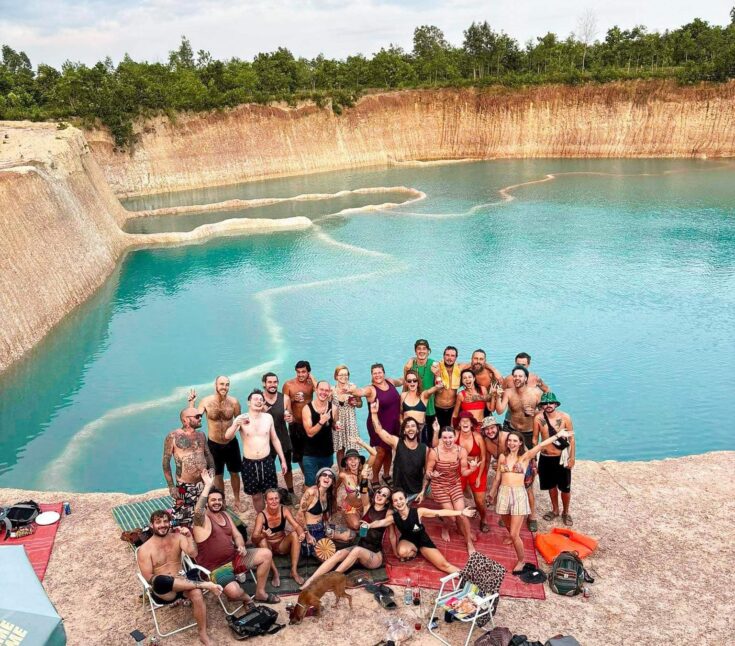
Southeast Asia attracts tens of millions of backpackers and tourists every year, and new destinations come and go. For years, Otres Beach was a popular destination. That was until Chinese investors moved in and turned the South Cambodian shoreline into a hub for casinos, pushing out the expat community in the process. This is a story about community strength. About how a community threatened and under pressure moved into the dense Cambodian jungle to rebuild their home. They named it Nesat, and they wish to share their village with backpackers flocking to Southeast Asia.
Otres
Otres Beach was a haven for backpackers. White sandy beaches stretched as far as the eye could see. Colorful, fruity cocktails made their way over bar counters at beach bars as sleepy tourists basked on sunbeds, soaking in the ocean breeze. Otres was a hotspot for expats. People from all over the world had made their way to this remote part of Cambodia. From Kazakhstan and Canada, from Sweden and Singapore, all of them resided in guesthouses and rental apartments in the tropical paradise about 10 kilometers south of Sihanoukville.
“It was the place to be truly free,” Aneliya “Nelly” Schultz remembers.
She and her Danish husband Niclas “Nic” Schultz ran a guesthouse with 9 bungalows, a restaurant and a beach bar in Otres.
It was a place where all those who didn’t necessarily fit in could gather and live together. An untouched gem far from the reach of the rest of the world. But dark clouds were looming on the horizon for the Otres residents.
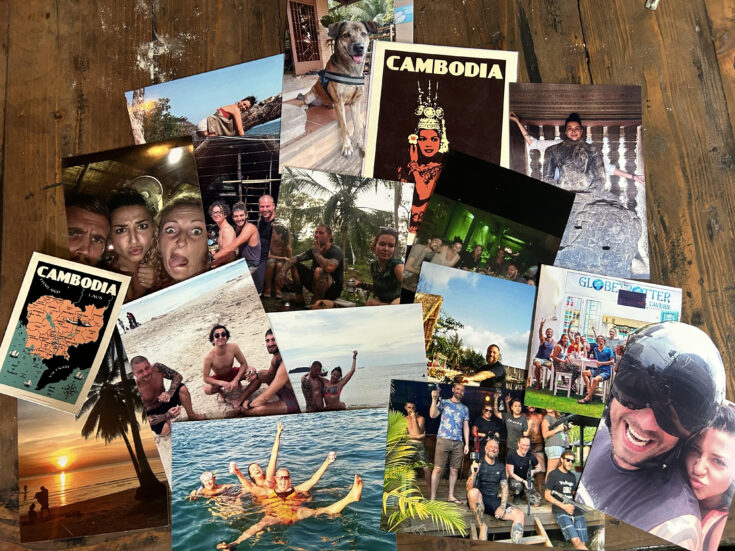
A storm is brewing
1500 kilometers away from Otres Beach lies the island of Macau. Macau has for decades been known as the Las Vegas of Asia. Giant casinos shine in the skyline as millions of yen roll out on the poker tables on a nightly basis. Macau had, like its neighbor Hong Kong, enjoyed almost a century of special administrative status, but in 2019 the Chinese government tightened its grip on Hong Kong.
The crackdown spilled over into Macau and put the casino industry under pressure. Casino owners started looking elsewhere to set up new businesses without the government breathing down their necks. Around the same time, Cambodia changed its laws around casinos and gambling.
All eyes on Sihanoukville
Many Chinese investors set their sights on Cambodia, especially the beautiful shores of Sihanoukville Province.
It all happened so fast. In 2018, Chinese investors started buying up property in Sihanoukville and the surrounding areas. Among the expat community, there were hopes that maybe they would leave Otres Beach alone, but it was not long before land was bought, and Chinese businesses moved in.
At first, the new neighbors and the Otres community didn’t interact much. But the Chinese investors quickly tore down everything on their newly bought land and started building. Skyscrapers and luxury resorts popped up on land where local guesthouses and beach bars had once flourished.
It became unbearable to live in Otres. Deafening screams of heavy machinery rang out from the construction sites late into the night. The construction disrupted power and water supplies, leaving the Otres residents without reliable electricity for hours and sometimes days. And it became dangerous.
It started small. Things would go missing — tools, towels, later bikes and motorcycles, disappeared into thin air, but that was the least of it. Rumors spread of gangsters in downtown Sihanoukville. Wild men on motorcycles with machetes.
In October 2019, local police reported the murder of a Chinese national. The body was found cut up into pieces and wrapped in a blanket. A suspect was caught and convicted. Police and courts were vague, but the motive is suspected to be a personal dispute between two Chinese nationals. To the expat community, it felt too close to home, too close for comfort. At one point gunshots were heard echoing through newly constructed casino parking lots. Otres did not feel safe anymore.
Offers from the Chinese investors were knocking on the door daily. And with all that was happening, many people took the bait. One by one, the community shrank. People were selling everything and leaving – fleeing. By the time the vibrant community of expats had dwindled to around twenty, even those remaining knew that they could not stay. But the thought of giving up and scattering the community to the four winds, was not acceptable.
Three men on a journey
Community had always been at the heart of Otres, and as the core grew tighter and tighter, the idea of leaving together emerged — finding a place where they could all resettle together. Three pillars of the community were chosen: three men, who would set out to find a new place for the community to settle. Among them were Swedish Samuel “Sammy” Salvadores.
These men set out on scooters with the goal of finding a place where their families and friends could live happily. It just so happened that Sammy had a place in mind.
Welcome to the Jungle
Koh Kong Province is covered in dense jungles from the top of the Cardamom Mountains to the bed of the Sre Ambel River. Koh Kong is around the same size as Skåne, Sweden, and is one of Cambodia’s most rural provinces, being home to only around 140,000 people living in sporadic fishing villages and valleys cultivated for rice farming.
Sammy had come here many times. The Cardamom Mountains offer some of the best dirt-bike tracks in the region.
“I had always thought it was a beautiful area, and when we decided to look for a new place to settle, I figured this might be a good one,” he remembers.
After driving around and talking to locals, the three men arrived at a piece of land about one kilometer north of the tiny village of Phumi Chrouy Svay.
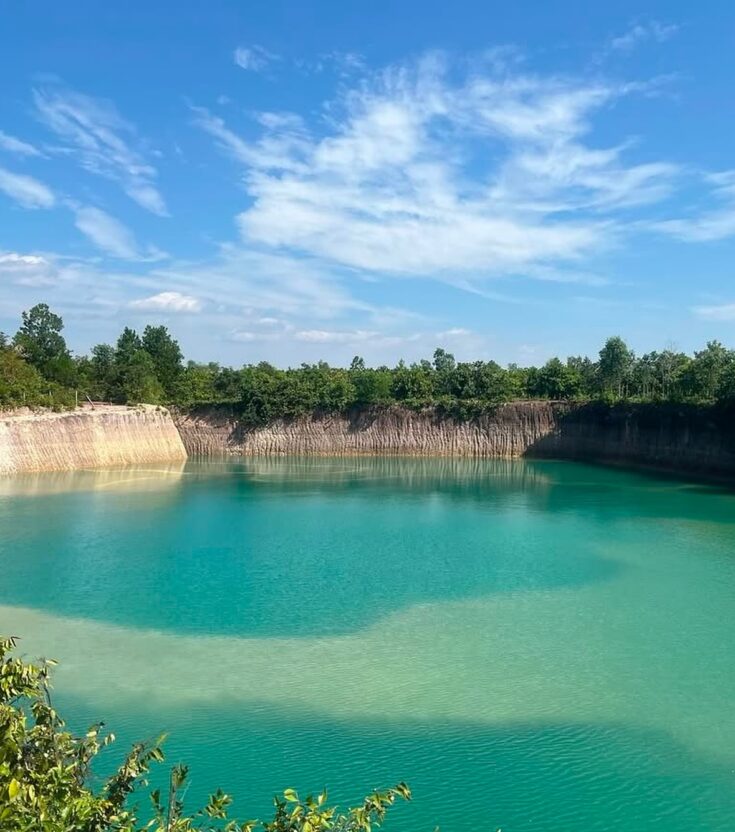
The eight hectares of land were far from perfect. The area was covered in dense forest, with only dirt roads leading to and from it. But it was almost 100 kilomters and hours drive from Sihanoukville and the problems there. The land also had potential. The beach was not too far away, and the area had once been subject to clay-digging projects. The old digging sites had filled up with water and transformed into a picturesque azure lagoon.
Next up Nesat
The three men returned with news of the potential land. Excitement broke out in the community. But just as the Otres residents were about to leave, Covid struck.
Even more Otres residents decided to forego Cambodia and return to their countries of origin. But a small, tight core of the community was dead set on sticking together, so in January 2020 the remaining group of around ten people moved to the area that would come to be known as Nesat Village.
They named the area Nesat Village. Nesat is Khmer and means fishing or fisherman. The villagers named the land, inspired by the main profession of the locals.
The move was not easy. It was Covid-19 times, and the deal with the landowners was taking more time than anticipated, so when the residents arrived, they were not permitted to move into the land yet. The group moved into small available guesthouses and rooms around Phumi Chrouy Svay.
Danish Niclas “Nic” Schultz and his wife, Nelly, were among the small group that moved to the area.
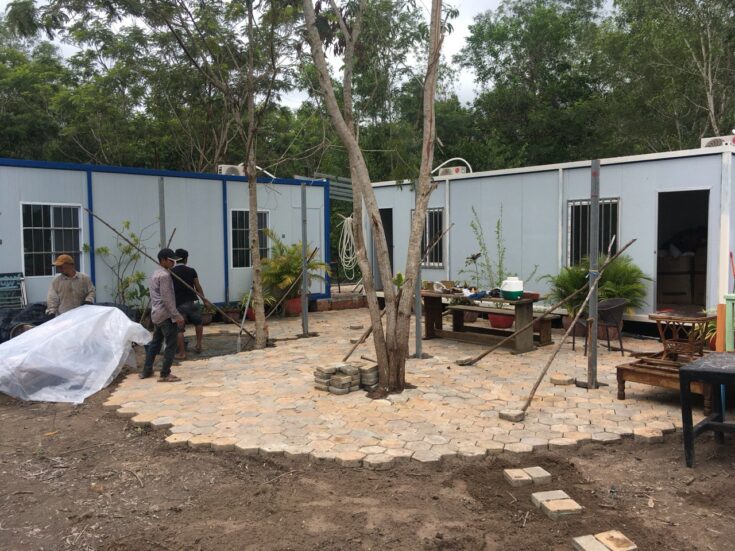
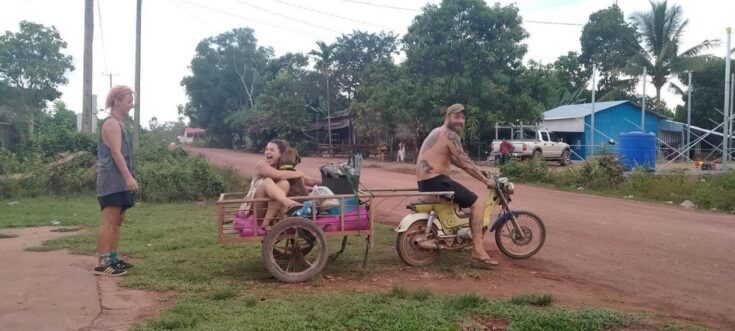
“People were staying around the village and moving from place to place. After about two months, we set up a group of trailers outside our land that we could live in,” Nelly remembers.
Despite the stability that the trailers offered, it was still tough. But the community persisted. They build everything from the ground up. They installed a toilet and a bathroom. They built a small kitchen and ate together at night. They made a small storage unit.
“I was sleeping in a trailer on five stacked mattresses we had brought from Otres, with my giant Danish husband and a huge dog,” Nelly laughs.
Food was not easy to come by either. Phumi Chrouy Svay had one small store, a lady selling a few grocery items in a stall by the side of the dirt road. Anything more required a day trip to the markets in the nearest city of Sre Ambel.
Despite the hardship, Niclas Schultz remembers that time fondly.
“It was the best time of my life. The deal had not finished yet, so we could not start building. Instead, we were just relaxing, hanging out with friends, and going to the beach. I felt so free,” he recalls.
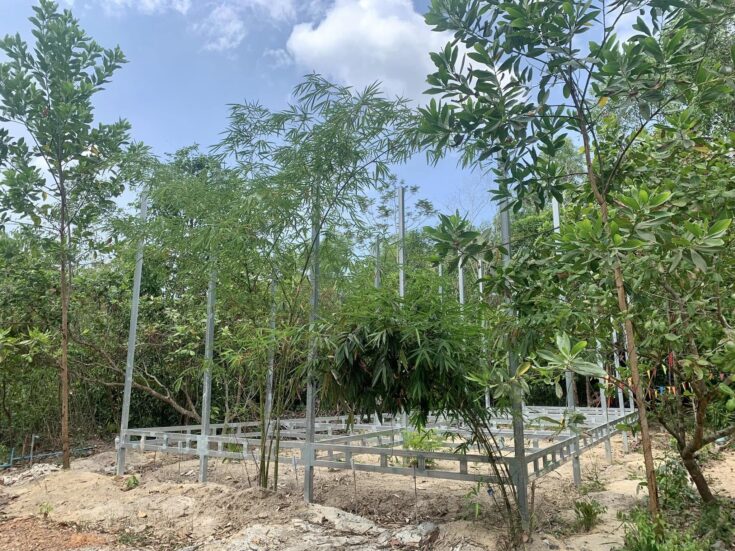
Eventually, the paperwork finished, and construction could start. Days were spent clearing forests together and helping each other putting down foundations for buildings. By early 2021 the first Nesat villagers moved into their newly built house.
Building Nesat
Legally, a foreigner cannot own land in Cambodia, with very few exceptions and loopholes. The land where Nesat is located is owned by a real estate company, Srae Nesat Real Estate. The company is owned 51 % by Cambodian trustees and 49 % by members of the village, ensuring that everything adheres to Cambodian laws.
The real estate company takes care of property taxes as well as the sales of land plots within Nesat.
When the lawyers and landowners were done, the paperwork was signed, and the new Nesat villagers were finally allowed to move in by July 2020. The members of the community had a bit of money from when they sold to the Chinese investors, so it only took two weeks for every plot of the initial land to be sold and distributed among the villagers.
Since then, the area has grown. The original eight hectares have expanded into an area that is now larger. New plots of land are being sold, and the community is growing.
Growing Nesat
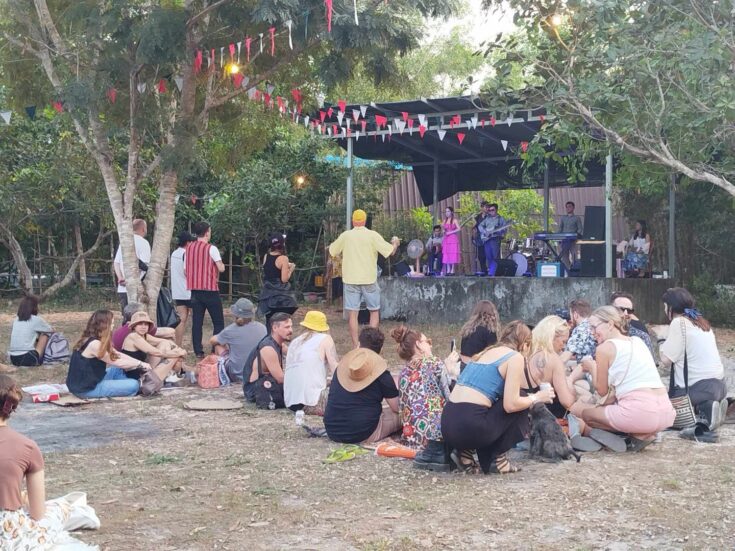
The ten Otres residents who stayed in Phumi Chrouy Svay were the first to move into the new Nesat Village. However, slowly but surely, the community grew as word spread about the new expat village.
The Nesat villagers were even able to bring back many of the previous residents of Otres who originally left when the Chinese investors took over all those years ago. Old friends reunited as people returned to a new home. The once prosperous expat community of Otres Beach was healing in its new home in the middle of the jungle.
As of mid-2025, Nesat had approximately 80 permanent residents, though a clear number is difficult to determine. Expats have a tendency to come and go in accordance with the low and high seasons.
The records of the Nesat real estate company list about 70 different landowners in Nesat from 31 different countries.
In Otres, most of the residents relied on tourism, and that has persisted in Nesat. Tourism has been a success in Nesat, and the villagers hope it is only the beginning. Nesat currently has 15 guesthouses and around 10 individual houses up for long-term renting. In addition the village offers visitors with over 20 different restaurants, cafés, bars, breweries and yoga studies with smoothie options. Many more accommodations are being built and even more are being planned out. The guesthouses combined have the capacity to house 250 tourists all at once, and members of the community estimate, that they welcomed approximately 3000 visitors in the high season of 2024.
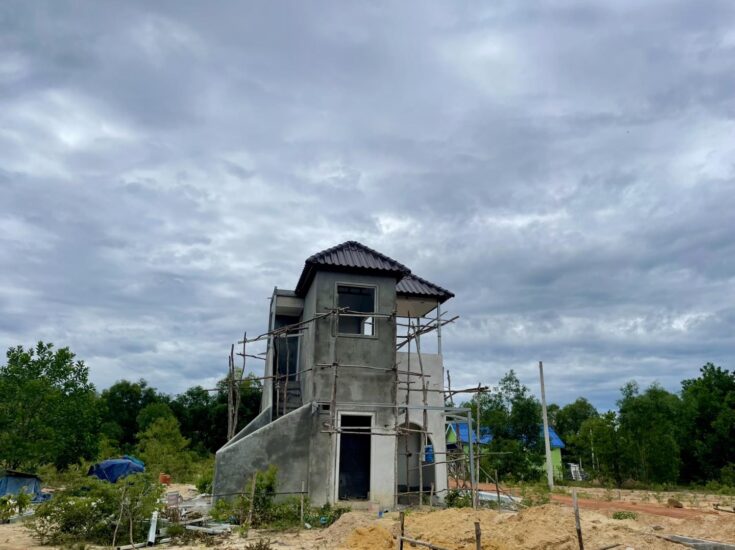
Nesat is expanding into bordering lands and development and construction of new guesthouses, restaurants, and bars have begun. There are talks of building homes for permanent residents and houses for longer-term visitors.
Phumi Chrouy Svay
The arrival of the Nesat villagers has had a big impact on their Cambodian neighbors in Phumi Chrouy Svay. The local Cambodians have nicknamed Nesat “Phumi Barang” which means the village of foreigners.
Phumi Chrouy Svay is growing too. Before the Nesat villagers moved in, the area was home to a couple of thousand people, mainly fishermen and rice farmers. But since Nesat was built, new fellow Cambodians have moved to the village. New professions and businesses have popped up.
Sammy has seen the development firsthand.
“When we first moved here, there was only a single lady selling food by the road, now the road is lined with small local shops — everything from street food to mechanics,” he says.
The main road has changed from dirt to asphalt. Tin shacks housing local families are being replaced with houses built with cement block walls and with tiled roofs.
NGOs tend to follow Westerners, and their presence is being felt. The local schools have received computers for the classrooms, electricity is reaching homes uninterrupted, and sewage systems have been upgraded.
Many locals were hired in the initial construction of the first buildings and continue to be employed as the village grows. Locals are also being hired to work as cleaners in guesthouses, behind bar counters, and in restaurant kitchens, bringing home larger salaries than they could earn in their traditional occupations as fishermen and rice farmers.
To Sammy, it is great to see the change.
“They have been welcoming since we arrived, and it is nice to see how we can improve life for them.”
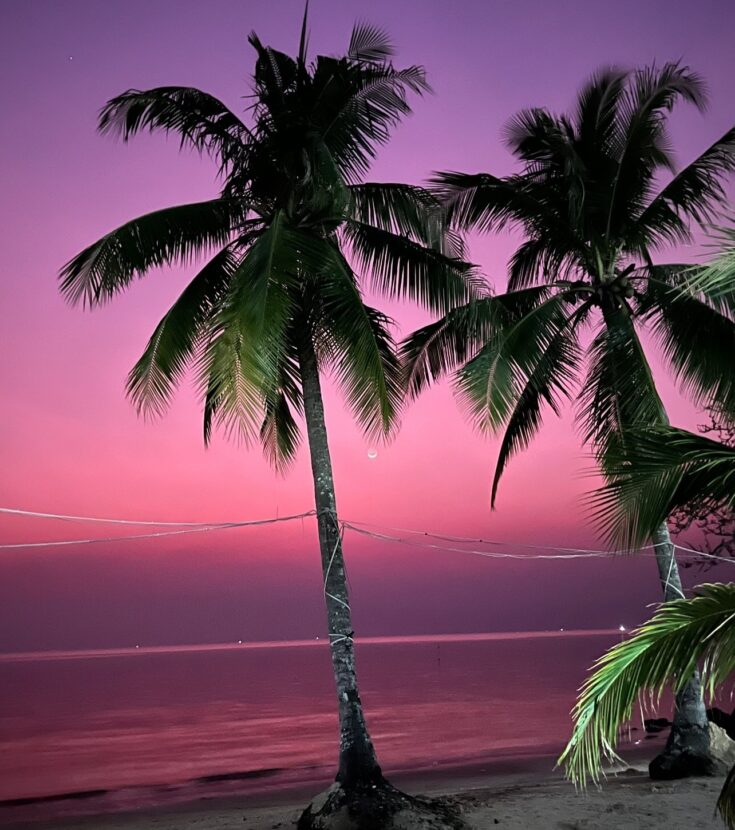
Sunset in Paradise
The sun sets over Kampong Som Bay. The last rays color the September sky in a delicate mix of orange and pink. Cicadas sing in the jungle as the Nesat villagers make their way to Klub Haus, the local wooden dive bar hidden between low palms and fruit trees. It is open even outside the high season and serves as a place for the community to gather. Laughter and inside jokes almost drown out the speakers playing a wide array of music from all over the world. Friends catch up under the yellow lights around the pool table or on benches. The mood is high, even in the low season. But the tourists will come; the villagers are hopeful. Their community has overcome hardships and challenges; this is their paradise.