


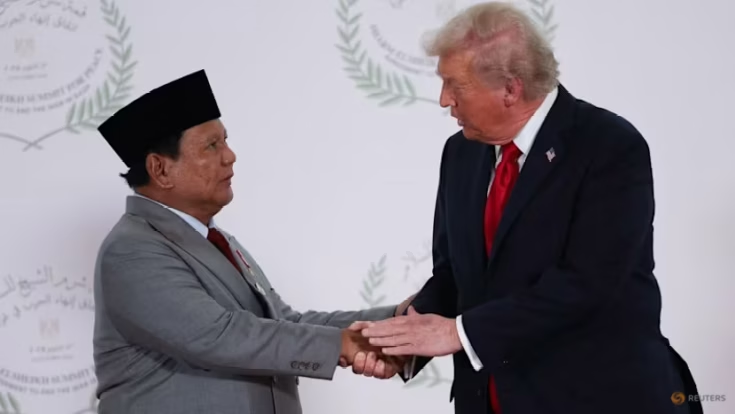
Indonesia and Vietnam have confirmed that they will accept an invitation from United States President Donald Trump to join his newly established Board of Peace, a move that has sparked debate among foreign policy observers.
The Board of Peace will be chaired by Trump. Trump has also appointed members of the executive board to be US Secretary of State Marco Rubio, White House envoy Steve Witkoff, his son-in-law Jared Kushner, and former British prime minister Tony Blair.
According to reports as of 24 January, 50 to 60 countries have been invited.
In Europe, France, Norway and Sweden have declined the invitation. Denmark and Finland have not been invited. Canada was at first invited, but the invitatioin was later withdrawn.
European countries that have accepted the invitations are Hungary, Kosovo, Azerbaijan, Armenia, Belarus, Kazakhstan, Uzbekistan, Bulgaria.
Still considering their positions are, among others, traditionally close American allies United Kingdom, Germany, and Japan. Also considering are India, China, Singapore and Russia.
Trump has reportedly asked participating countries to contribute USD 1 billion in the first year to secure a permanent seat on the board. Without payment, membership would be limited to a three-year term.
The decision has prompted mixed reactions among Indonesian analysts. Some have warned that participation could draw Indonesia closer to a US-led political agenda. Initially designed to oversee the Gaza peace agreement, Trump has since talked about expanding its activity to include issues previously handled by the Security Council of the United Nations.
“Indonesia will be trapped in a mechanism where it is unfamiliar with the actors involved. Their intentions differ from Indonesia’s,” said Teuku Rezasyah, a lecturer in international relations at Padjadjaran University and President University.
Others argue that the move could provide Indonesia with a platform to shape discussions on global peace and conflict resolution.