


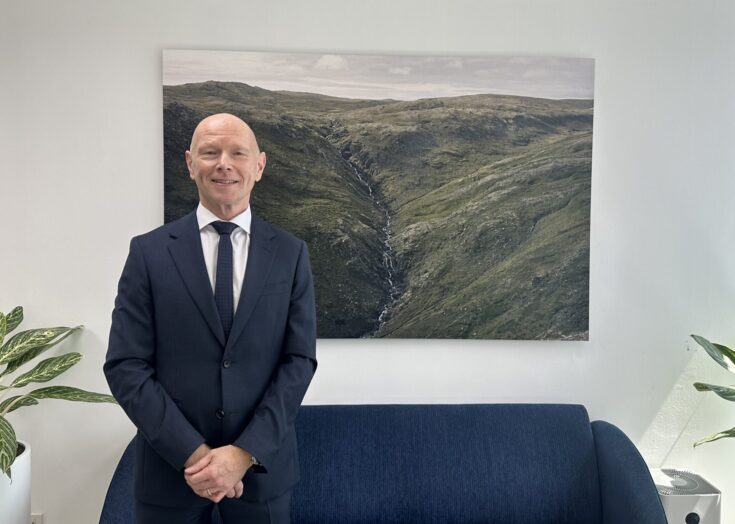
In an exclusive interview with ScandAsia, Norway’s new ambassador to Thailand, Frode Solberg, shares his ambitions to strengthen trade and economic cooperation between the two countries.
After more than 30 years in diplomacy, with postings in countries including the United Arab Emirates, Sweden, Austria, Germany and latest, South Korea, Frode Solberg was eager to return to Asia when the opportunity arose.
So on 23 September 2026, when he assumed his duties as Norway’s new ambassador to Thailand, it was with a sense of excitement and privilege to get the posting he wanted the most.
“I think it’s a very interesting part of the world to work in. I like the culture, I like the approach to people, I like the friendliness. It’s beyond doubt. That’s why I wanted to come back to Asia,” he says.
Although Solberg had visited Thailand before taking up his new position, he is still discovering life in Bangkok. What stands out to him is the city’s energy, a striking contrast to life in Oslo.
“It’s very different than Oslo. Much bigger, of course. And there’s something happening everywhere. It’s a kind of energy that really appeals to me, because I think you don’t get tired in a way. It sort of gives you energy.” Solberg says.
Now based in Bangkok, Solberg has a clear ambition for his new posting: to strengthen the ties between Norway and Thailand, particularly through closer economic cooperation, increased trade and investment. By the time he leaves, he hopes to see tangible progress in the relationship between the two countries.
Strengthening economic ties in a changing world
For Solberg, one of the most exciting parts of his new role is the opportunity to get to know Thailand beyond Bangkok. He is also interested in the country’s position in Southeast Asia and the role it can play in an increasingly uncertain global environment.
“I’m looking forward to getting to know the country,” he says. “But it’s also, I think, to experience Thailand’s role in Southeast Asia, an important hub in many ways.”
Understanding Thailand’s position in the region goes hand in hand with strengthening the relationship between the two countries, Solberg explains. He believes closer cooperation is increasingly important in a changing international landscape, where countries need reliable partners and greater stability.
“I think it’s getting more and more important to understand to work together with countries and people that are the same and have the same approach as we do. We need to work together, otherwise, we won’t succeed in continuing a world where rules exist and we can, in small and big countries, have the same possibility to raise our voice and say something.”
When it comes to Norway and Thailand specifically, Solberg sees economic cooperation as one of the areas with the greatest potential for development. The two countries already have established trade relations, with Norwegian businesses operating in Thailand and Thai goods finding their way to the Norwegian market.
In 2024, bilateral trade in goods between Norway and Thailand reached approximately NOK 12.2 billion. Norway exported goods worth NOK 5.6 billion to Thailand, primarily seafood, fertilisers, wood pulp, iron and steel products. Imports from Thailand totalled NOK 6.6 billion, including machinery, vehicles, agricultural products, and iron and steel goods. According to Norway’s parliamentary trade committee, trade between the two countries has grown in recent years. (Source: Norwegian Parliament)
Against this backdrop, Solberg believes there is room to expand the existing relationship.
“I do think there is a potential for closer economic cooperation. There are investments, there are companies for both sides in respective countries, and I think if I can contribute in increasing that cooperation, I think that’s good for Thailand, I think it’s good for Norway.”
A free trade agreement could open new opportunities
One development that could help advance these ambitions is the free trade agreement between Thailand and the European Free Trade Association (EFTA), which includes Norway, Switzerland, Iceland and Liechtenstein.
The agreement was signed on 23 January 2025 and covers trade in goods and services, investment and other areas of economic cooperation. However, its entry into force is still pending, according to EFTA.
Solberg hopes the agreement will create new opportunities for businesses in both countries and make it easier to expand their commercial relationships.
“We have a free trade agreement that will enter into force hopefully quite soon. That will open new possibilities both ways,” he says.
The agreement is expected to reduce tariffs on a significant share of Norwegian exports to Thailand. According to Norway’s Ministry of Foreign Affairs, 83 per cent of Norwegian exports to Thailand are set to become tariff-free when the agreement enters into force, rising to 99.8 per cent after 15 years.
For Solberg, the aim is not simply to increase Norwegian business activity in Thailand, but to strengthen economic ties in both directions. He sees closer trade relations as a way to bring the two countries closer together more broadly, creating a stronger foundation for cooperation beyond the economic sphere.
Looking towards the next four years
Beyond trade, Solberg also sees potential for closer cooperation on green energy and climate issues. He recognises that such initiatives can take years to develop, but believes that building relationships and opening discussions now can help lay the groundwork for future progress.
Ultimately, he hopes his time in Bangkok will leave a lasting mark on the relationship between Norway and Thailand. While some developments may take longer than his diplomatic posting, he believes closer economic ties are an achievable goal.
“We have plane connection that goes every day. There’s lots of tourists going. We have steady trade relations. But I think there’s room for more. So that’s going to be one of my main objectives over the next years.”
For Solberg, success will mean leaving Thailand with a stronger economic partnership than the one he inherited. He hopes that, by the end of his posting, the two countries will have moved beyond their existing trade relations towards a closer and more diversified partnership.
As he puts it, there is already a good foundation to build on. The challenge now is to turn that potential into tangible results.