



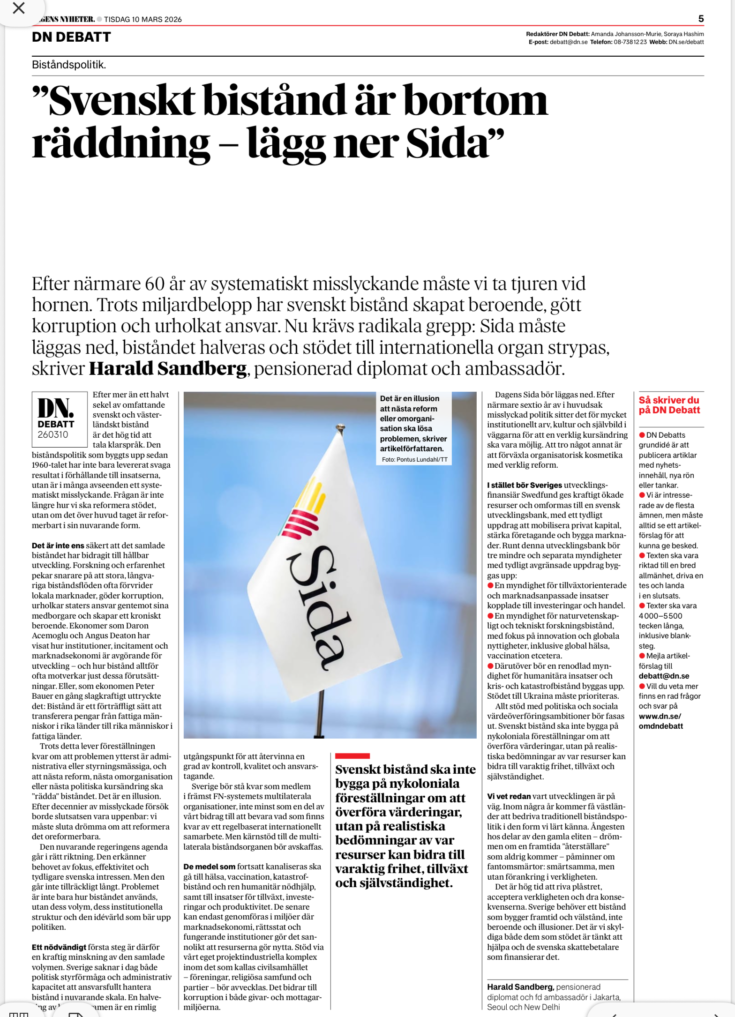
Former Swedish Ambassador Harald Sandberg, with postings in a.o. Jakarta, Seoul and New Delhi, has argued that Sweden’s current development aid system has failed and should be radically restructured.
In a debate article published in Dagens Nyheter on Tuesday 10 March 2026, ambassador Sandberg writes that Swedish aid is “beyond rescue” and calls for the country’s development agency Sida to be closed.
According to Sandberg, nearly 60 years of Swedish development aid policy has produced poor results despite large financial commitments.
“After closer to 60 years of systematic failure we must face reality. Despite billions, Swedish aid has created dependency, encouraged corruption and weakened responsibility,” he writes in the article.
Sandberg argues that the existing aid model should be replaced with a smaller and more targeted system. He proposes halving Sweden’s aid budget and reducing support to international organisations.
He also suggests dismantling Sida and redistributing its functions to a smaller number of specialised agencies with clearly defined mandates.
In his article, Sandberg proposes that development financing instead be channelled through organisations such as Swedfund and through institutions focused on private investment, infrastructure and innovation partnerships.
“Swedish aid should not be based on neo-colonial ideas of transferring values, but on realistic assessments of where resources can contribute to lasting freedom, growth and independence,” he writes.
Sandberg also argues that future Swedish assistance should focus on areas such as health care, humanitarian aid, disaster relief and Ukraine, while reducing funding for what he describes as politically driven programmes.
The debate article was published in the opinion section of Dagens Nyheter and reflects Sandberg’s personal views on Swedish aid policy.
Sida, Sweden’s International Development Cooperation Agency, manages a large share of the country’s development assistance and operates programmes in Asia, Africa and other regions.
Sida had not publicly responded to the debate article at the time of publication.