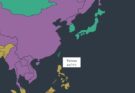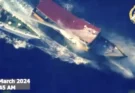



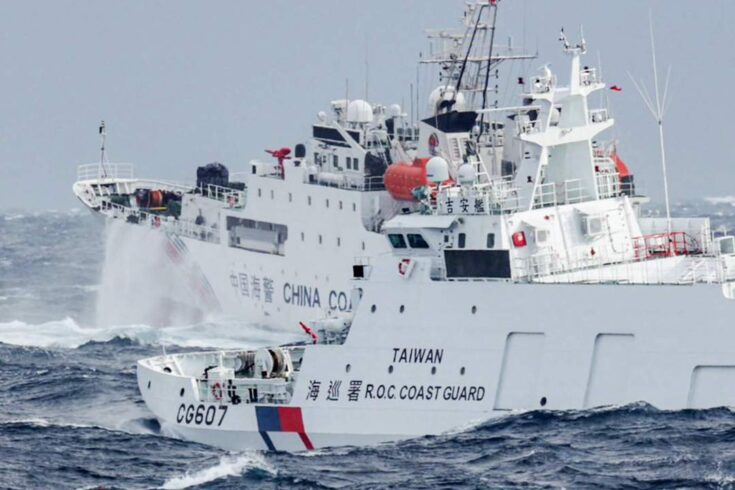
When Chinese Coast Guard vessels recently began patrolling the waters east of Taiwan, many Europeans saw another incident in the long-running tensions across the Taiwan Strait.
They should have seen something else.
Most Europeans still view Taiwan primarily through the lenses of foreign policy, democracy and human rights. Those remain important considerations. But they no longer tell the whole story.
China’s growing ability to project power around Taiwan threatens the flow of trade on which both Taiwan and Europe and in particular the US increasingly depend. Taiwan has quietly become an economic security issue.
Taiwan understood years ago something that Europe is only beginning to recognise: trade and national security are inseparable. Facing growing pressure from China, Taiwan did not simply turn away from its largest trading partner. Instead, it steadily reduced its strategic dependence while strengthening economic ties with trusted partners.
The shift has been remarkable. At its peak in 2010, more than 83 percent of Taiwan’s annual outward investment flowed to China. During the first five months of this year, the figure was just 0.9 percent.
While much of Taiwan’s new investment has flowed to the United States, Europe has also become part of Taiwan’s diversification strategy. Taiwan’s exports to the European Union grew by more than 12 percent last year, while Taiwanese investment in Europe has accelerated, particularly in semiconductors, electric vehicles, batteries and other advanced technologies.
Taiwan has diversified. Europe has benefited. Now Europe should fully recognise what that means.
European industry today depends on Taiwan in ways that would have seemed unimaginable only a decade ago. Advanced semiconductors manufactured in Taiwan power Europe’s automotive industry, telecommunications networks, industrial automation, medical technology, artificial intelligence and an increasing share of its defence capabilities.
At the same time, Taiwan’s semiconductor industry depends on European technology, from Dutch lithography systems and German precision optics to specialist manufacturing equipment. The relationship has become one of mutual dependence.
Yet Europe’s debate about Taiwan still belongs to an earlier era.
A disruption of Taiwan’s economy would not simply be an Asian crisis. It would ripple through European factories, research laboratories, transport systems and supply chains. The semiconductor shortages during the pandemic offered only a glimpse of how quickly production can be disrupted. A serious crisis around Taiwan would be on an entirely different scale.
This does not mean Europe should abandon its balanced approach towards China or seek confrontation where none is necessary. It simply means it is time to recognise that peace and stability around Taiwan are no longer matters only of foreign policy, democracy and human rights.
It is a matterof European economic security.