


It’s 4 pm at Springleaf MRT station. The sky is grey and gloomy, and I curse myself for forgetting to bring an umbrella. I am supposed to meet Morten Strange. Morten is a Danish bird photographer who has lived in Singapore since 1980. I am excited because today we are going birdwatching.
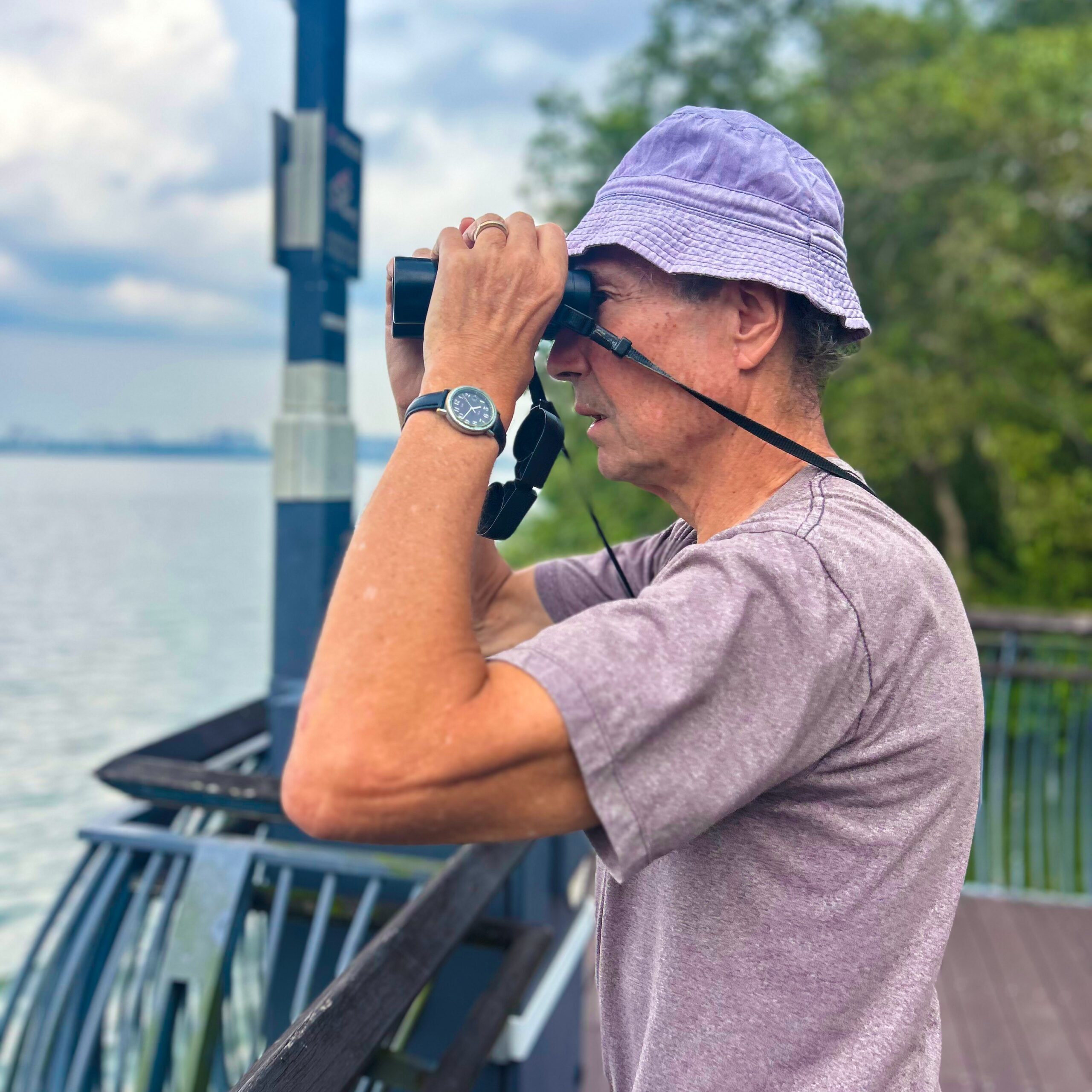
Bee Choo, Morten’s wife, finds me. She leads me to a tiny silver Honda, where Morten is waiting with a warm smile and a purple bucket hat. I am handed a pair of binoculars, and we drive off. Our destination? Sungei Buloh Wetland Reserve in the northwestern corner of Singapore.
Bee Choo and Morten are longtime nature conservationists and met while birdwatching. They both love birds. Bee Choo especially loves hornbills. Hornbills almost went extinct in Singapore, she says. But over the years, the couple have been involved with different organisations working hard to bring them back. One species in particular now has a solid population in Singapore: the Oriental Pied Hornbill. Questionable name aside, Bee Choo tells me she hopes to show me this incredible bird today.
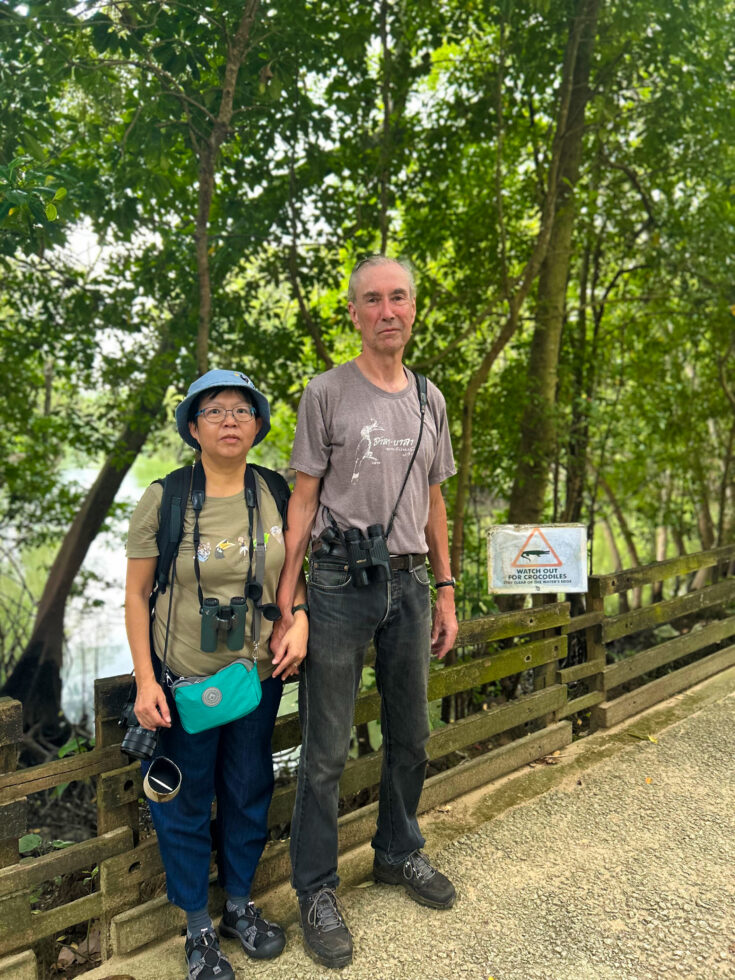
Beware of the crocodiles at Sungei Buloh
Bee Choo drops Morten and me off at the entrance. We’ll catch up to her later, I am told. We walk past the entrance gate and start our journey into the jungle.
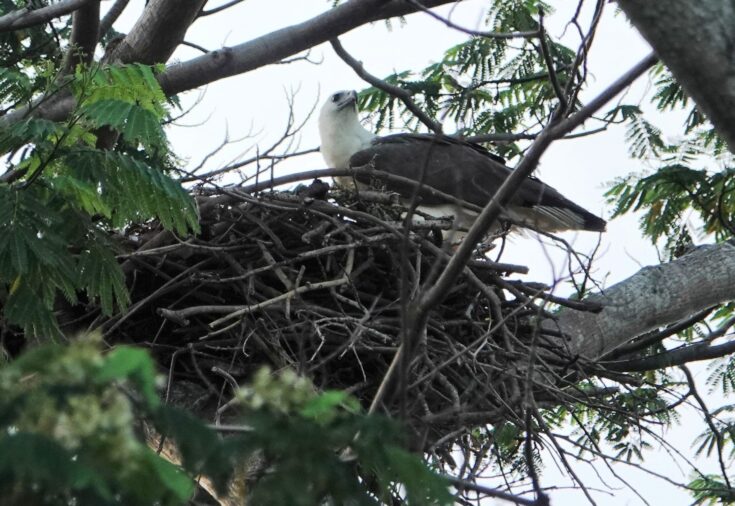
I have barely taken two steps before Morten suddenly stops me and points up in the canopy, where a big bunch of sticks and leaves are woven together into a nest.
“That is a White-bellied Sea Eagle’s nest. I have seen them before, but they are out hunting now,” Morten tells me and keeps walking like nothing happened.
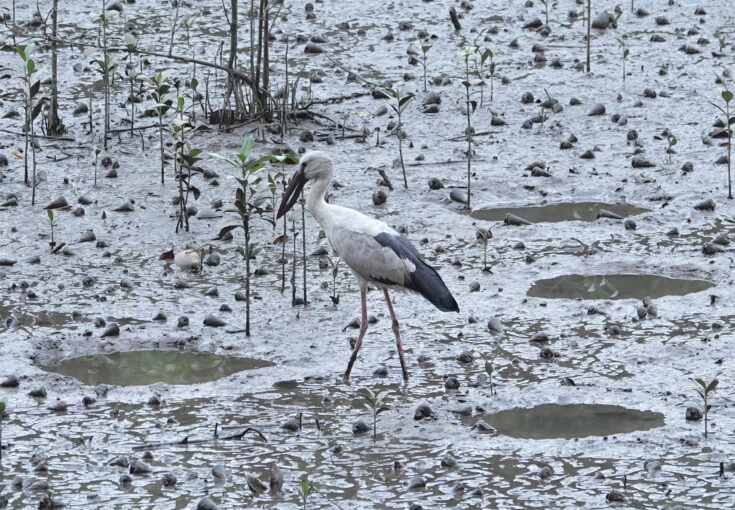
Before I have time to ask any further questions, he points to the edge of the pond, where a grey-and-black stork is fiddling with something in its beak.
“Asian Openbill,” Morten exclaims.
Loud screams rush out from the reeds. White-breasted Waterhens—two males fighting, Morten says. I ask how he can tell, and he just smiles.
“You go out here enough, and you’ll learn each bird has its distinct voice and personality. At my age I have learned them all by heart.”
We follow the path and get to the edge of the jungle, where land meets water and mangrove trees grow freely. My heart sinks. In front of us is a giant red-and-white sign: “Watch out for crocodiles.”
Now, I am not scared per se of crocodiles. But the crocodiles here are Saltwater Crocodiles, which Animal Planet once taught me, are some of the only animals on Earth known to actively hunt humans for food. So I would prefer to keep a respectable distance between myself and those maneaters.
I look to Morten, who seems unbothered by the sign.
“It’s one of the main attractions here,” he laughs. “This is a good area for them to find food.”
I pray that food is strictly pescatarian.
A calling for birds
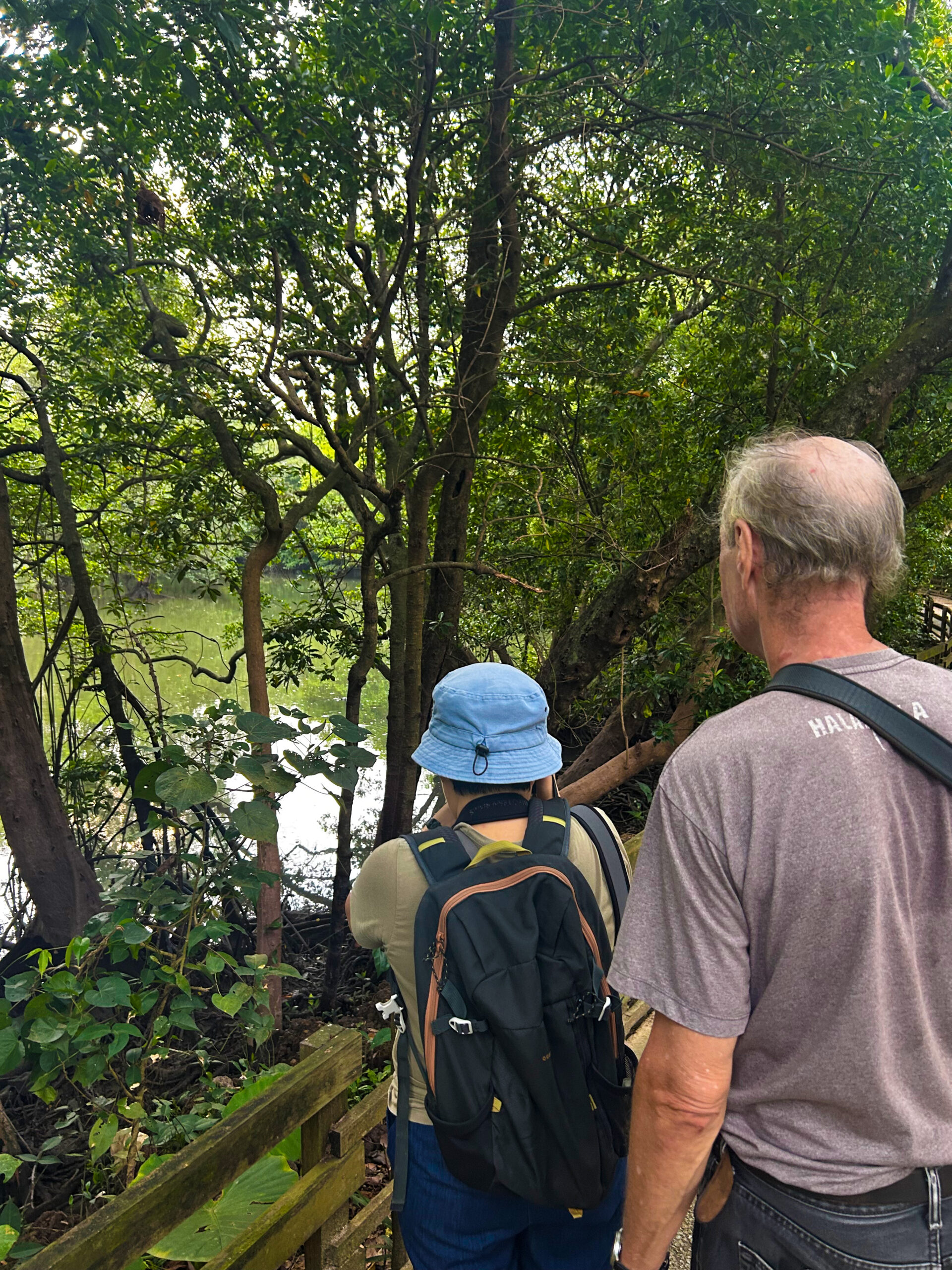
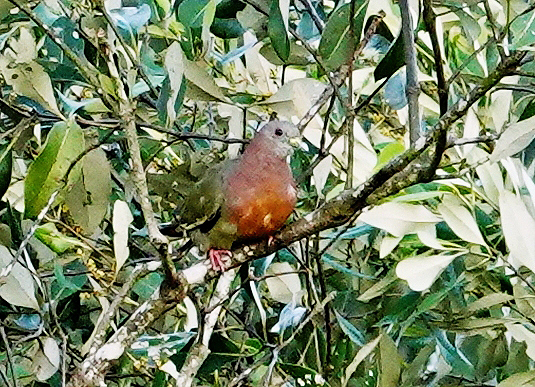
Morten keeps walking, and I hasten behind him, trying to keep up. I am distracted. Every two seconds, a new song, chirp, or call rings out from a bush or the treetops. Pink-necked Green Pigeons, Black-naped Orioles, Lineated barbets. Morten names them all. No hornbills though.
Morten love of birds started back in Denmark. His father was a bird enthusiast too, and passed his interest on to Morten. However, Morten jokes that he has failed to pass the family interest onto his own children.
“They couldn’t care less. They have their own interests. But every once in a while they get a little curious and ask me what bird we are hearing when we are outside, so maybe there is hope yet” he laughs.
Morten first arrived in Singapore in 1980, and minus a small gap in the mid-90s, he has pretty much stayed here ever since. In the early late 1980s, Morten decided to pursue birdwatching and photography full time.
“But why birds?” I can’t help but ask. People have all types of interests—plants, bugs, cars. What makes birds so special?
“Birds are amazing.” Morten simply replies. “No matter where you go, there are birds, but they are always different ones. There are so many kinds all over the world. As a kid I thought there was only one type of kingfisher: the one in Denmark. But Singapore has nine species, and each one is unique. Isn’t that just great?”
Preserving nature
Sungei Buloh Wetland Reserve covers 130 hectares and offers a variety of biomes, from jungle to mangrove swamps to open mudbanks, hosting hundreds of different species. The government originally planned to turn the area into an industrial zone.
“A lot of people, my wife and I included, were very unhappy with that decision. We lobbied politicians and raised awareness of the natural potential of this area,” Morten tells me, although he seems not to want too much of the credit. “I just sent the nature people some photographs I had taken out here of the wildlife. They did all the work.”
The preservation efforts worked, and in 2003, Sungei Buloh Wetland Reserve was listed as an ASEAN Heritage Park.
While walking the path, we meet school classes on nature trips and other fellow bird enthusiasts. But for large stretches, it is just Morten and me—and the birds.
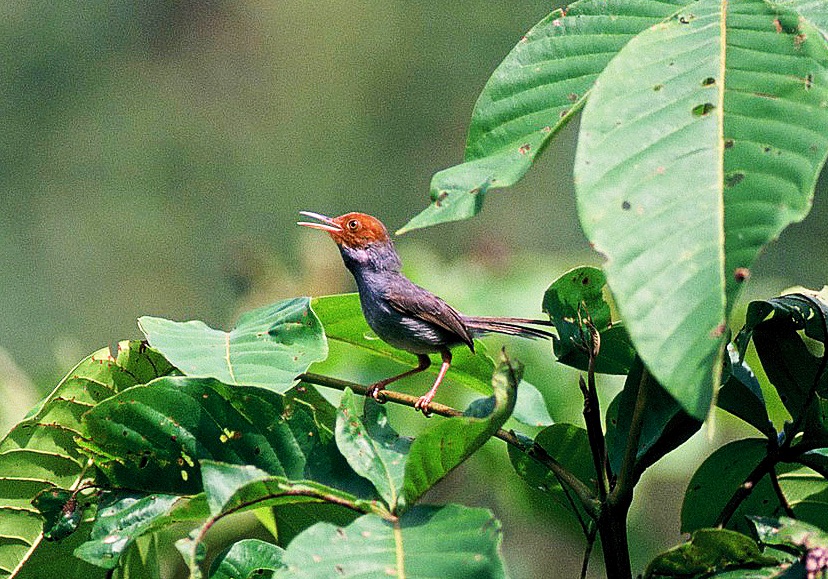
An Asian Koel calls out from the treetops. An Ashy Tailorbird dances from branch to branch on the jungle floor. Swarms of mosquitoes buzz between the mangrove roots. It is 31 degrees, with humidity set to max.
“I come here for hikes multiple times a month. I am getting older; it’s important to stay active,” Morten says.
I am 24 years old, and a lukewarm river is drifting between my shoulder blades. I look with envy to the cheerful retiree in front of me, observing the mangroves through his binoculars.
A lagoon of life
We meet back up with Bee Choo on a bridge across the main river.
“No hornbills yet”, she reports.
The hiking trail is a loop, with a mudbank lagoon in the middle that the tides are slowly exposing. A perfect time to spot wading birds.
We stop at the first lookout spot. Bee Choo and Morten raise their binoculars to see what awaits us. I raise mine too, anxiously scanning the mudbank for cold-blooded reptiles.
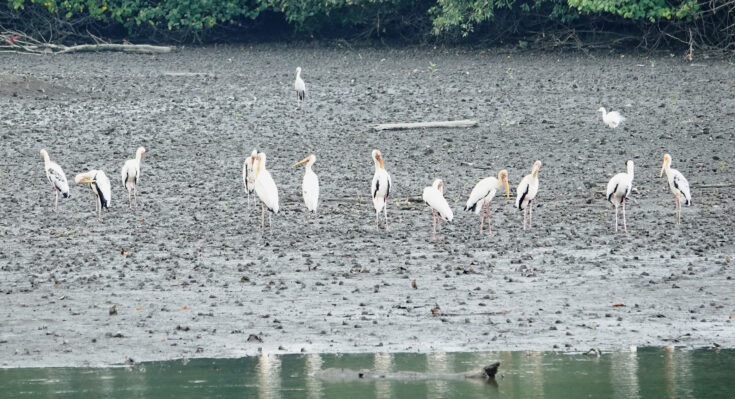
Medium Egrets—17 of them—not to be confused with the Great Egret, of course. Cattle Egrets. Asian Openbills again. Two Little Herons fighting over the best fishing spot. Bee Choo counts 35 Whimbrels on the bank; I only count 33. No monster crocs yet.
A flock of storks lands on the bank. Bee Choo thinks they are Milky Storks. Morten argues they might be Painted Storks.
“Look at the wing. It’s a bit darker,” he says.
I can’t tell the difference.
Their back-and-forth is interrupted by loud squawks from down the road.
“Hornbills,” Bee Choo exclaims excitedly.
We hurry down the path quietly so as not to scare them. We crane our necks, staring into the canopy. We scan every nook, fixate on every branch in the wind, and listen to every rustle in the leaves. But we spot nothing. We must have been too late.
Meeting with a swamp monster
We keep walking the road, stopping at the viewing posts and looking for new birds. Common Redshank. Sandpipers. Golden Plovers.
Morten and I are talking about why he thinks nature areas like Sungei Buloh Wetland Reserve are so important to preserve when suddenly I stop dead in my tracks.
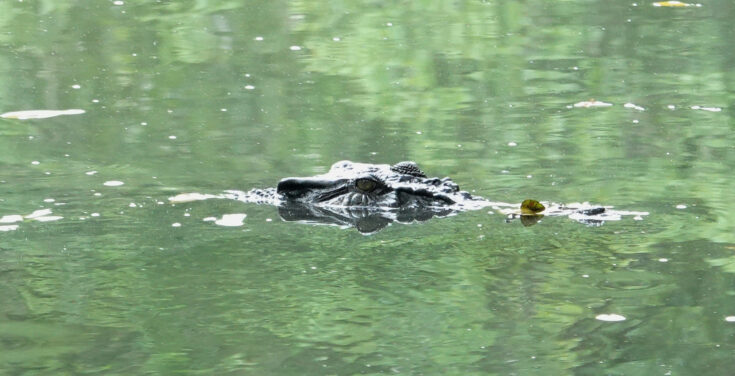
Nestled between the mangrove roots, looking uncannily like driftwood, I spot a pair of scaled nostrils and a set of hungry eyes just at the water’s surface, a mere 15 metres away.
“Wow, you’ve got some good eyes there!” Morten says. “That is a big guy, but not too big—maybe three or four metres? I just thought it was a log. That’s cool.”
At my height of 1.75 metres, I disagree that a four-metre reptile is “not too big,” and I don’t know if I have good eyes or if a deep-rooted, leftover genetic ability to spot danger in the wild took over.
However, the creature is oddly fascinating. We don’t seem to be on his dinner menu, and that eases my tension. Though far away and partly submerged, I can make out the shape of his enormous body: the ridged scales on his back, his powerful tail. Strangely beautiful.
My moment of admiration is interrupted by loud calls. Collared Kingfishers, who like me, might not be completely comfortable with the swamp monster.
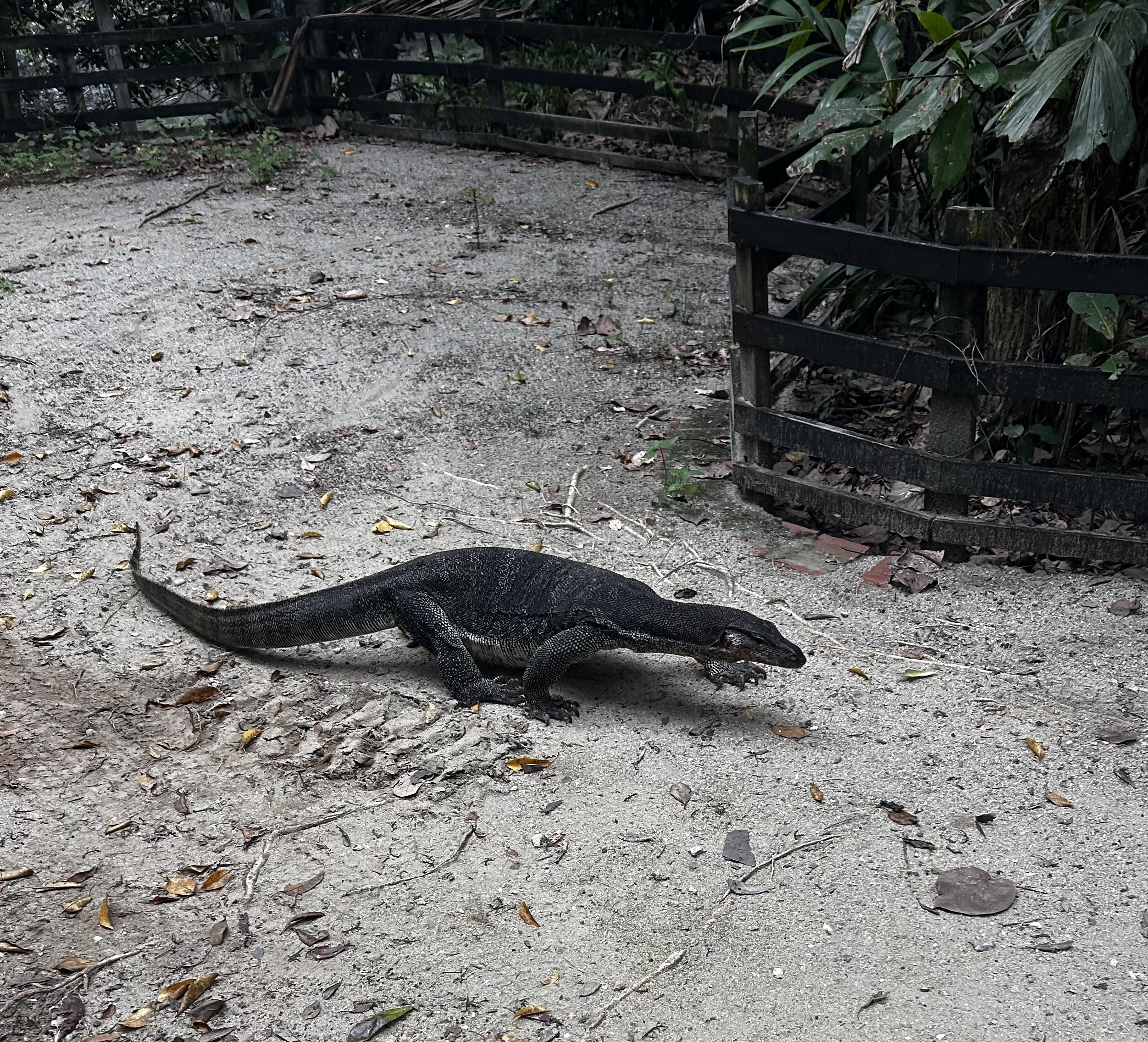
We keep walking down the path, a two-metre-long Malayan water monitor greets us on our way.
“That’s a fat one,” Morten laughs, “she’s probably got eggs in her.”
“It’s incredibly how it doesn’t care about us,” Bee Choo says “Here in Singapore the animals knows humans won’t hurt them, so they can get really close”
The giant lizard is about a metre away from me, well within striking distance, should she choose to attack, yet I feel totally calm.
Tower over the mangrove
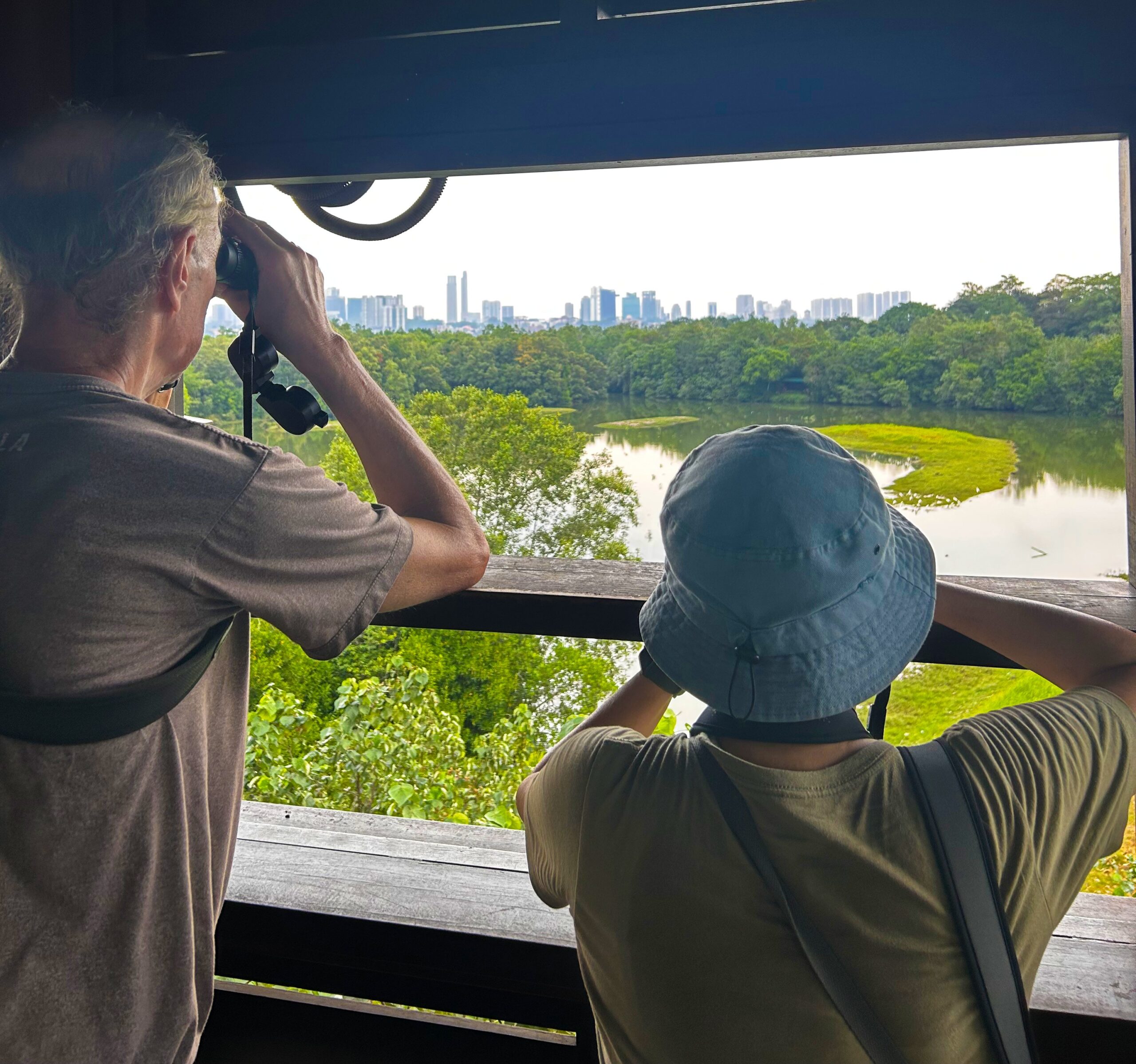
We get to a watchtower. Morten walks up the stairs, in long pants and with a backpack on, and I follow him. At the top, Morten goes to look out over the lagoon. I have to sit down. My head is pounding from the stairs. I am melting in the heat and humidity. Morten looks at me.
“I do this walk and those stairs often,” he laughs. “You get used to the heat”.
We look out over the mangrove. The tide has turned and left the bank exposed. Egrets of all sizes and storks of all shapes dot the lagoon like white pearls. Bee Choo joins us. An Asian Emerald Dove flies across in a flash of green and purple. Sunbirds sing in the trees. It’s getting dark.
Sunset is approaching, and the birds are settling in for the night.
A walk back
We start our walk back to the car. I’m disappointed we didn’t get any hornbills. Bee Choo tells me how recently they had a Rhinoceros Hornbill – one of the biggest hornbill species, staying in the area. Morten entertains the walk back with a story about his younger days as a bird photographer in the early 90s, wading through mud for hours and days to photograph the endangered and elusive Chinese Egret—and how he was one of the first to photograph them in Singapore.
As we cross the bridge over the main river, a giant White-bellied Sea Eagle flies above.
“Probably headed back to its nest,” Morten says.
We get to the visitor centre and start walking to the car. Bee Choo and I are talking about how popular a pastime birdwatching has become in Singapore. Morten is walking in front of us. Suddenly, he holds out his hand and whispers for us to shut up. He points upwards.
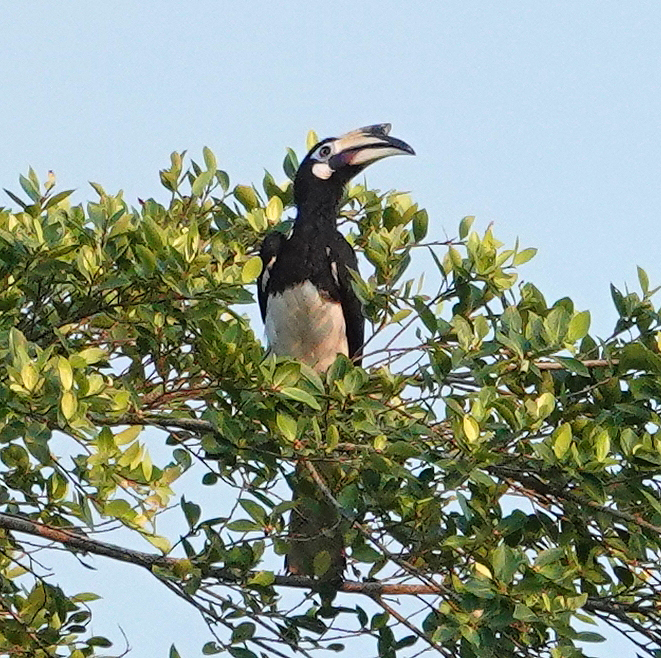
Up there, about five metres above the ground, on a branch, sits a bird. It is a big one. A beautiful shade of blackish blue across its feathers, white plumage on the tips of its wings, and a pied pattern on its chest. A solid power horn sits atop its beige bill. We actually found one: an Oriental Pied Hornbill.