


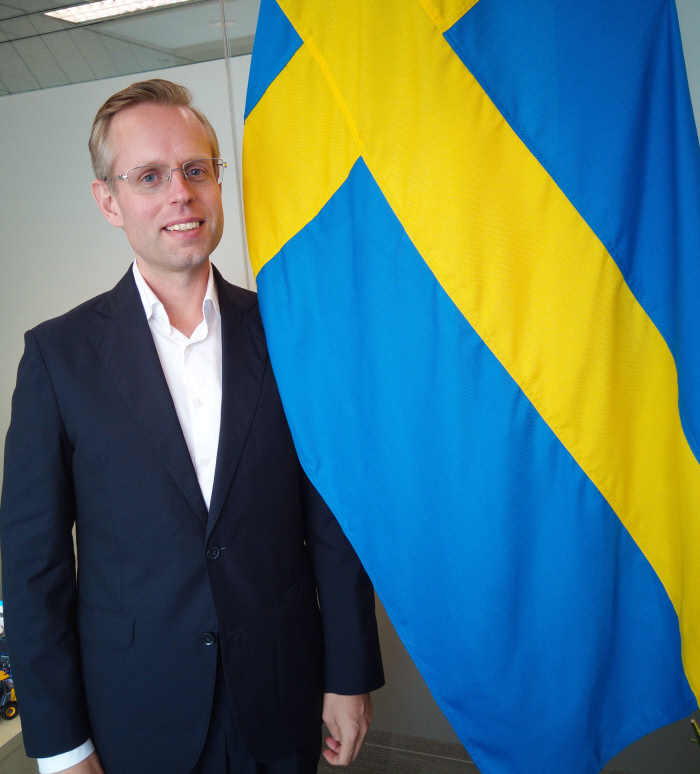
In the region he has already called home for the past decade, Emil Akander was in early 2025 appointed by Business Sweden (BuS) as Vice President and Head of Region for the Asia-Pacific. Emil reflects on this significant career step that keeps him in the region, and elaborates on a number of new and ongoing initiatives conducted by BuS and ‘Team Sweden’ in order to increase Sweden’s export and trade. Sweden’s recent State Visit to Singapore has also brought renewed attention to the region back home, and strengthened the bilateral collaboration.
Aside the VP appointment, the main difference for Emil is the geographic area; having started as Country Manager for Singapore back in 2014, to now being at the helm of the entire Asia-Pacific area. Up to 2025 he had focused mainly on Southeast Asia and South Asia, as VP and Head of Region since 2022.
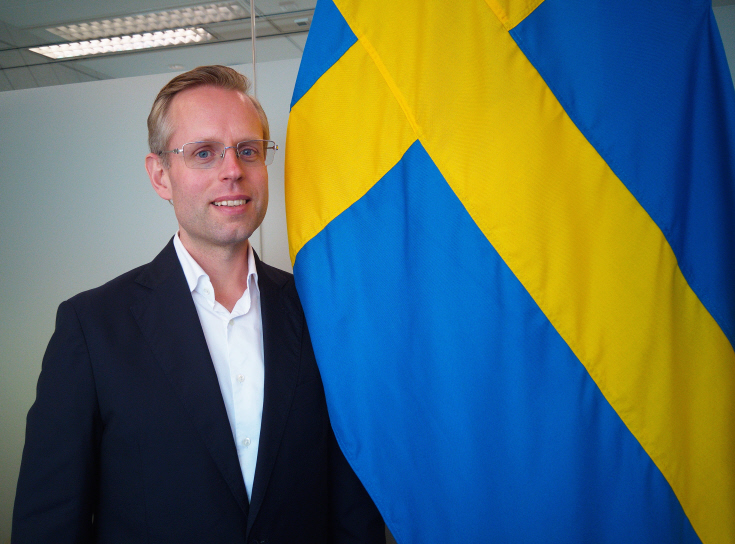
“Now, covering the entire region, and where we have in total 18 offices in 13 of those markets, you need to balance very large markets and economies such as China, India and Japan with emerging and smaller markets for the Swedish industry. So, it’s obviously a more complex region to navigate, but it also opens up for good understanding of how Sweden should trade and invest in it, and be invested in relating to all those different markets,” begins the Head of Region.
“My new appointment was, and still is, an incredible honour – and a huge vote of confidence. My immediate thought was the immense opportunity and responsibility it represented, especially given Asia’s critical role in our global strategy, since it’s by far the biggest region in revenue and headcount.”
“What I appreciate most about being in Asia in this key role is the sheer dynamism and its diversity. Every market brings unique market characteristics, cultures, and challenges, which keeps things incredibly engaging and pushes us to constantly innovate. The pace of growth here is unmatched, and being able to contribute to that, to build strong local teams and drive significant impact across such a vast geographical coverage area – is truly rewarding. It’s a continuous learning journey, and I value the chance to navigate both the rapid growth and the rich complexities that define Asia,” reflects Emil.
In order to manage an intensified focus on the region, BuS also has a new special team of four people at its Singapore nerve centre, called Strategy and Business Development: “In that team we very much focus on delivering on the Swedish government’s ‘Strategy for Sweden’s trade, investment and global competitiveness’, with its special focus on Asia.
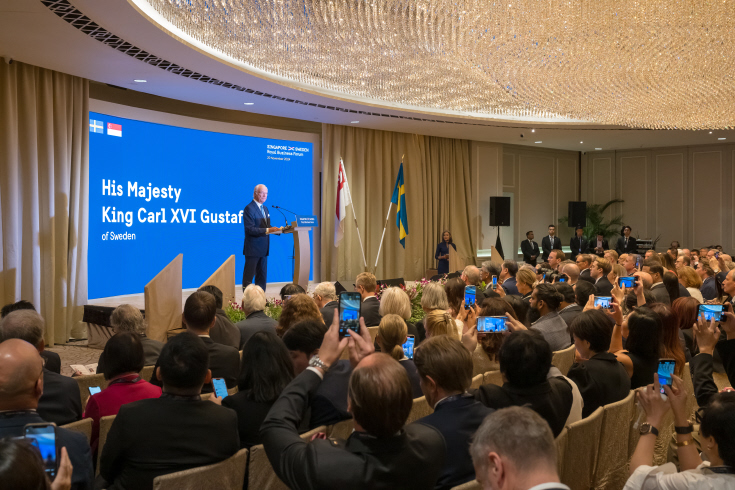
First ever State Visit
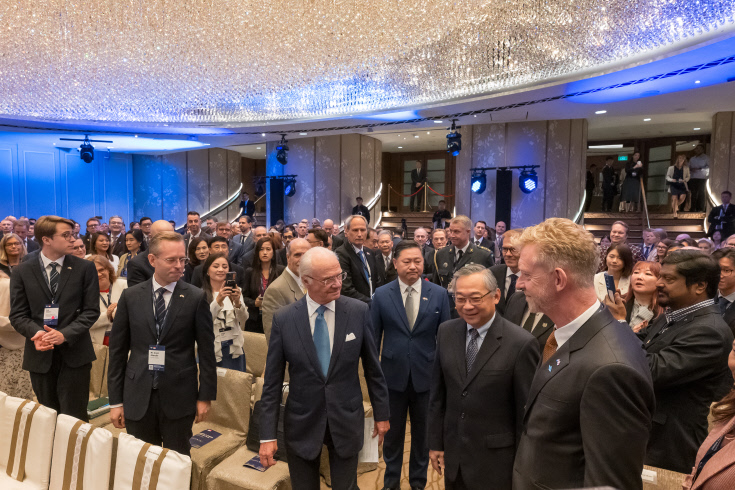
And to advance that strategy the first ever Swedish State Visit to Singapore took place on 19-21 November, 2024 – to strengthen already long-lasting ties but also forge new ones.
“Having had diplomatic relations for over 60 years but never a state visit it was about time, which I think Singapore also recognised,” he says.
His Majesty King Carl XVI Gustaf of Sweden led what he remembered as one of the biggest business delegations ever (of the previous close to 90 he had experienced).
“The depth, seniority and the amount of people in the delegation impressed the King. And I felt that also the local counterparts were present with many ministers, the highest level of their private enterprises and so on, signalling that it was a big thing.”
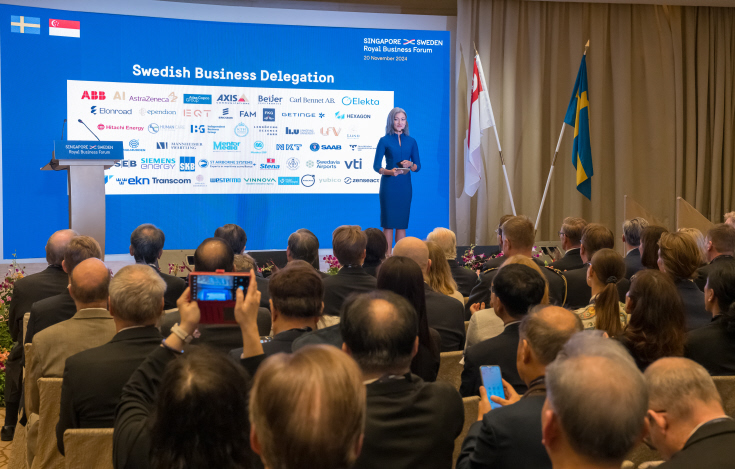
“One of its main aims was to strengthen our bilateral business and trade ties; in addition to the political- and security agendas. We concluded more than ten business MoU:s, with the intention to collaborate and do more in certain areas – many of those being quite concrete also concerning what activities, and – importantly – between active counterparts.”
As a result, they are now working very actively on these MoUs especially within energy, heath care, defence and transport as well as civil aviation.
“For example, within energy, we are engaging very closely with the Swedish ministry back home and our agencies, like the Swedish Energy Agency, who is looking to be more present here as it also funds and facilitates collaborations on projects in Asia within for instance renewables, transmission and distribution. The MOU will also facilitate knowledge exchange on regional interconnectivity, ammonia and hydrogen, nuclear safety, as well as cooperation at multilateral fora to accelerate Singapore’s decarbonisation pathways.”
“The main thing lies in the green transition related to the power generation of electricity. Today Singapore is very dependent on fossil fuel. And we believe that Singapore has the opportunity to import more renewable energy from other ASEAN countries, and where Sweden has a lot of experience in transmitting, distributing and feeding in renewables from long distances.”
And just like in many other countries the need for more electricity keeps on increasing: “Aside people’s consumption, nearly 20% of the GDP is still manufacturing driving up the demand, which the electrification in general is also doing – not the least in the transport sector.
In transportation the opportunities for Sweden connect to land transportation, like electrification and of city buses and relating new technologies as well as investments in the airport expansion and shipping ports.
“So, since the State Visit, we have seen follow-on trips taking place from both sides, including the establishing of new collaborations.”
The positive impact of the event can also be long-lasting, by referring to it not least externally, admits BuS’ regional head: “It’s a good thing that opens new doors, but also expands existing cooperations and partnerships.”
Singapore’s global and regional hub importance
Also, the role of Singapore as one of the world’s leading hubs for international trade, and among the most advanced economies globally in trading, openness, infrastructure, reliability etc. should not be underestimated for foreign entities and bilateral opportunities.
Says the regional head: “It’s really a watchtower to what happens in the global economy. It’s not only home to a very big port, an airport hub, and a strategic location between east and west when it comes to trading – including the infrastructure for both physical and digital trade, as well as all the services needed. But Singapore today also represents one of only a handful of those truly global hubs – hubs that are open for global trade, but that are also kind of at the crossroads of different major economies in the world. It is a safe harbour to expand out from.”
“And today, we see the big majority of at least Swedish companies having their regional headquarters here in Singapore. And some have regional- or headquarters functions in larger markets, such as Thailand or Malaysia, due to the fact that they maybe have manufacturing there or other operations – or find it more cost-efficient to operate from. Hong Kong remains an important hub as well, not the least for China. But also, in areas related to finance, supply chain and services. For Singapore, I think it comes down to its strategic location and openness for trade and talent, but also the fact that you can feel both the east and the west in terms of business and economies,” continues Emil, who also points to its geopolitical relevance for risk diversification or management and as a “strategic footprint in the region and in the world.”
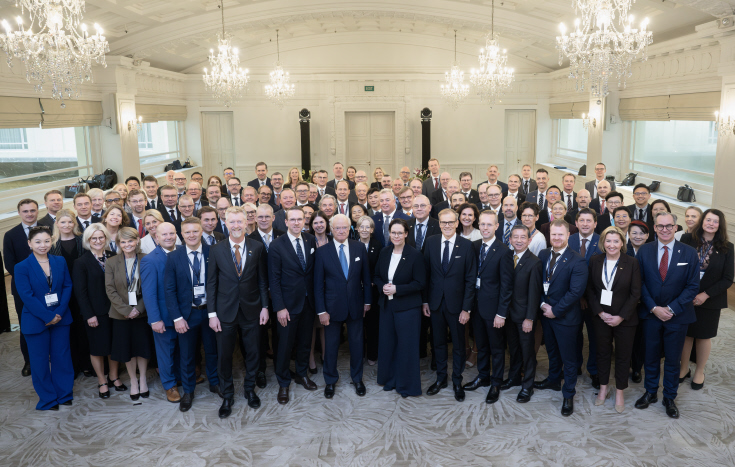
Swedish businesses can leverage Singapore’s role in Asia by having a network in Singapore and learn how to operate, and also partner with such companies to go out in the region, and beyond, says Emil.
“I think you have many entities and companies here who actually covers the region and have a good regional understanding of operating in different larger economies, such as Indonesia, Thailand or Vietnam. For example, Singapore’s government-controlled investment company Temasek has a large portfolio of companies, who actually build and invest a lot in the region. And I think there’s a possibility to partner up with those. And it might be an easier route – than to enter the local countries directly. Quite a few of them are active in infrastructure, transport, energy and so on.”
“Singapore is often also underestimated as a financial hub. You have a lot of capital here to tap into as a Swedish company, being co-founded or co-invested together through different setups and going with different arms relating to Singapore in the region. And if you can get capital from here, it’s also smart capital that can help you operate better in the region with a trusted partner,” he recommends.
Emil also adds that they have a very strong service sector in Singapore on how to trade and conduct business in the region. And having success locally on its market is often also a good reference towards other markets in the region.
“I get the feeling that many of the larger and developing markets in Southeast Asia study what products and services Singapore buys and use.”
Infrastructure Asia vehicle
In the context of Singapore and the region, its government also established ‘Infrastructure Asia’ to support Asia’s social and economic growth through sustainable infrastructure development.
“From Sweden, companies have lots to offer as sub-suppliers to infrastructure and construction, and then obviously within transport, energy and more. So, it’s important for the Swedish industry to identify and collaborate with construction companies. Also, players like Infrastructure Asia offer significant financing – so we often engage with them to see how we can get financial cooperation with Swedish institutions, banks, funds or even government-controlled export financing institutions.”
“Infrastructure Asia plays a crucial role as a key vehicle for facilitation and market access, especially for companies from countries like Sweden that are leaders in sustainable infrastructure. We consistently see Swedish companies at the forefront of discussions for projects we facilitate. Their strong focus on sustainability, innovation, and long-term value creation aligns perfectly with Asia’s evolving infrastructure needs,” continues Emil.
For such opportunities BuS’ role is to ensure that those Swedish firms have the necessary connections and contextual understanding to successfully bid for contracts or make strategic investments in the region.
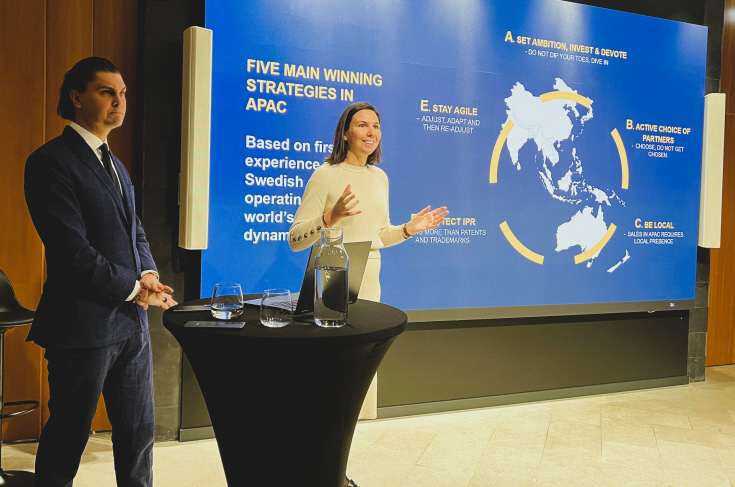
In the example of Thailand BuS also has a new report titled “Unlock opportunities in Thailand’s M&A market’, as a comprehensive overview. It informs that from 2018 to 2023 Thailand averaged 216 M&A deals annually, rebounding strongly in 2023 with 258 deals. “Key sectors such as consumer products, technology, and industrial and materials continue to attract investor interest, offering Swedish businesses promising opportunities.”
“Sweden has a strong invested base in Thailand. We have many companies, but more importantly, we have very high value-add in Thailand. It’s an important hub for Swedish companies and market for us in the region, but one that we feel isn’t growing as much as it should. They have had challenges in Thailand, but they should have all the preconditions to succeed because they have an advanced economy,” states Emil and explains that BuS had looked similarly at several other markets where it believes Sweden, as a successful strategy, can fast-track their establishing by acquiring companies, skill sets, people etc.
Region of great opportunities
Then there is also ‘FocusAsia’ – aiming to assist more Swedish companies in exploring opportunities to increase their exports to the Asia-Pacific region and including several targeted initiatives (such as its ‘Catalyst’ scale-up programme) for small, medium, and large enterprises.
“Within the Swedish economy today we are more in services; with very fast-growing tech companies and start-ups that go global from day one. Hence, we also want to support those.”
A ‘Focus Asia SME Study Trip to Southeast Asia’ took place in March 2025 with at least two representatives each from the over 25 attending companies.
This delegation offered a unique opportunity to explore one of the world’s most dynamic regions and gain practical insights into doing business across its complex and diverse markets.
“We have said that we need to get Swedish SME:s to establish presence and trade with this region. And we want to offer such companies to get to understand this region, and to meet potential clients and partners in order to increase the export. So, we cooperated with our regional export centres and partners back in Sweden to identify and attract such companies to join and meet with investment facilitation bodies etc. The idea is for them to really get a feel for this region, and to be inspired and – in the best case – to establish local presence,” Emil explains.
The next study trip will go to India. And as part of the new initiative BuS also highlights what it calls ‘100 Business Opportunities’ (identified via BuS’ over 150 business developers within the area), spanning across seven industries and 13 markets – on which he comments: “In this region there are a lot of challenges within the developing and emerging economies; relating to sustainability, financing, business conduct and so on. But we wanted to highlight all the great opportunities that we are seeing along with the growth.”
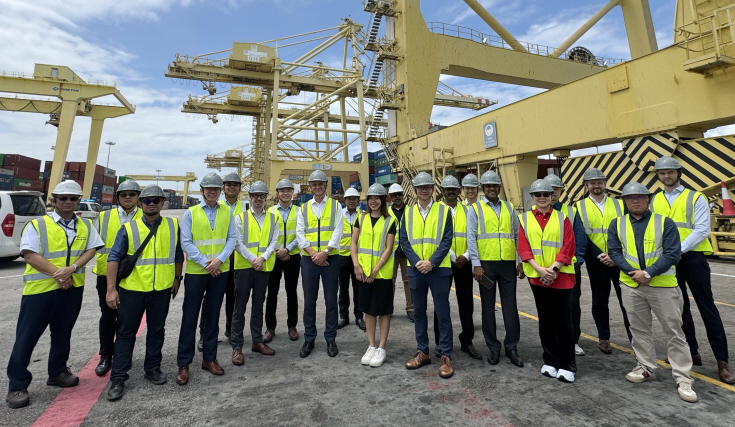
To pick one example, the ‘Malaysian Ports Initiative’ seeks to facilitate workshops between Swedish solution providers and Malaysian port operators, with the goal of identifying opportunities for collaboration in the rapidly expanding ports sector in Malaysia. One is Penang Port, which has an ambitious three-phase expansion plan that offers numerous opportunities for collaboration. Swedish companies, known for their reliability and innovative solutions, are already in discussions with the port.
“Sweden is mainly big on automation, with companies such as ABB, while Bromma is a world leader in container spreading and handling. Also, you have others, such as Axis Communications within surveillance and access control. We’re also looking into Thailand and Vietnam in terms of port terminal operations.”
Another sector is airports, where Sweden has several hundred companies (!) active within terminal building and airport operations.
With Sweden exporting 14 percent to a region that today represents 37% of the world economy but forecasted to grow to 50%, BuS thinks that Sweden needs to grow with the markets.
“To that end, we need to have an even higher ambition; in exporting, investing, trading, and not the least selling, in this region – looking at the economic growth expected to happen,” states Emil.
Produced in collaboration with the Swedish Institute, BuS has also recently initiated a concept for outreach – one with a positive spin: ‘Pioneer the possible’. Its aim: to highlight Sweden as a pioneering and progressive country, inviting other countries to join Sweden in leading the green transition.
“It’s a concept where we want to show how Swedish companies are unique in terms of sustainability in the broad sense. We are competing on not only being innovative, digital and so on, but that we have very sustainable solutions – that are robust, safe, long-lasting, cost-effective and have low life cycle costs, where Sweden therefore contributes to countries’ green transition and sustainability goals.”