



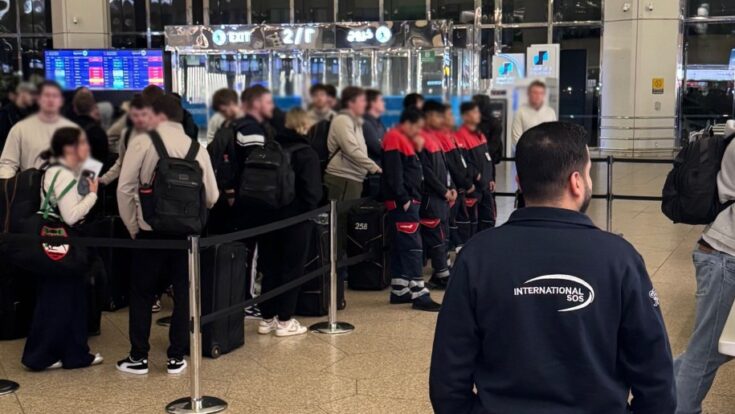
As conflict continues in the Middle East, thousands of foreigners remain stuck in the crossfire, and even more are stranded on either side of the world, with only limited means of getting home. Since the beginning of the conflict on 28 February, International SOS, a company specialized in evacuating people from crisis areas, has been involved in multiple evacuation across the Middle East in the past week.
Press conference
In a press conference on 11 March, International SOS advised the public on how to navigate the still developing situation in the region. Guest speakers included various experts on security and risk management.
“We have never seen a situation quite like this,” said Hany Bakr, Senior Vice President of Aviation & Maritime Security.
“In terms of the aviation outlook, we are not seeing anything to suggest immediate de-escalation. Instead, we are seeing that the situation is likely to transition into what we call a sustained phase of disruption, where we will see different phases, quieter days, busier days.”
Uncertain future
One point was clear throughout the entire press conference; The situation is still ongoing, and uncertainty looms. For aviation operators and passengers there will likely not be a clear way forward for the foreseeable future. It is expected that continued airspace closure across parts of the region will affect travellers. Reopenings and closing will be sporadic and align with the developments in the conflict.
Airlines, regulators, and civil aviation authorities will very likely adopt a very cautious approach, whereby routes will reopen only when risk levels are considered manageable.
Since the beginning of the conflict, Iran has targeted airports and other critical infrastructure in economic powerhouses in the region, such as Saudi Arabia and the UAE. Maritime travel and routes have also been disrupted in the Persian Gulf and Strait of Hormuz. Likewise, the risk extends beyond the immediate conflict zones. Airports and aviation infrastructure beyond the region will continue to be at risk in countries such as Turkey and Cyprus.
“We will likely see limited reopening of routes and airports. It will likely be very tightly controlled and limited to daytime operations only, restricted to predefined flight corridors, strict operational constraints, and only a certain number of flights being allowed to operate, land, and take off,” Hany Bakr said.
Increased delays are expected. Airlines face significant operational challenges, such as longer flight times and major rerouting across airspace, and some routes may involve larger detours as well.
“We are seeing air carriers repositioning their airplanes from the conflict area into neighboring countries to operate their flights from there, and they are moving passengers to those locations. But there remains a risk of spillover outside of the conflict, so it depends on targeting patterns and responses to such incidents.”
What to expect
International SOS made it clear that the conflict is still ongoing and possibly still in its early phase. Travellers stuck in the Middle East should not expect quick or immediate solutions, as airlines, embassies, and other actors scramble to navigate the situation. Flights are taking off and bringing travellers to safety, but delays are imminent and waitlists are long.
“We just can’t anticipate when this is going to end and the impact it’s going to have on the Gulf States,” said James Wood, Regional Security Director, Northern Europe.
The availability of commercial flights and airspace is very volatile and can change very quickly, according to James Wood. International SOS recommends to anyone looking to get a flight out to be prepared to stay put for an extended period of time.
“Even if people might have a flight booking, we won’t know whether the airspace will close. We don’t know if the airlines are going to postpone their flights, and if they do, for how long. To people waiting for a commercial flight, please make sure that you have accommodation booked, and that the accommodation will cover you for a period of time, just in case your flights are cancelled or changed.”

Related posts:
 Danish couple stranded in Thailand as Middle East conflict closes airspace: – It feels unsafe
 TUI brings stranded Danish tourists home from Thailand and Maldives
 Spies flight brings 315 stranded Nordic travellers home from Thailand
 Airspace shutdown: What travellers between Southeast Asia and the Nordics need to know