




Greenland has emerged as the focal point in rising geopolitical tensions between the United States, Europe, Russia and China. As Washington and NATO allies prepare for talks on Arctic security, Beijing is closely watching the strained EU-US relationship and the consequences it may have on its own Artic ambitions.
This week, US President Donald Trump and NATO Secretary General Mark Rutte reportedly reached a verbal understanding on Greenland during a meeting in Davos. According to reporting by CNN, the talks focused on updating the 1951 agreement governing the US military presence on the island and strengthening Arctic security cooperation. Oddly, however, no written document has yet been produced, and several details remain unresolved, reports CNN.

Danish Prime Minister Mette Frederiksen is repeatedly saying that Denmark will not compromise on sovereignty, while Greenland’s Prime Minister Jens-Frederik Nielsen likewise repeats that only Greenland and the Kingdom of Denmark have the mandate to make decisions concerning the territory. Both leaders underlined at their meeting on Friday Greenland’s alignment with NATO and the European Union, while rejecting any arrangement that would bypass Copenhagen or Nuuk.
Although Trump has repeatedly framed Greenland as vulnerable to Chinese or Russian takeover, analysts cited by The Washington Post say Beijing neither has the capacity nor any imminent plan to seize control of the island. Instead, China’s Arctic ambitions are focused on long-term presence through scientific research, shipping routes and cooperation with Russia.
China considers itself a “near-Arctic state,” a designation that has drawn both cooperation and scepticism in Nordic capitals. China has invested heavily in polar research infrastructure, including icebreakers, It has esytablished research stations in Norway and Iceland, including the Yellow River Station in Norway’s Svalbard archipelago and the China-Iceland Arctic Science Observatory in Iceland. These are scientific hubs supporting environmental and atmospheric research, often cited in discussions about Beijing’s long-term Arctic engagement.
As melting ice opens new shipping routes, Chinese vessels have increasingly used the Northern Sea Route along Russia’s Arctic coast as part of what Beijing calls the Polar Silk Road.
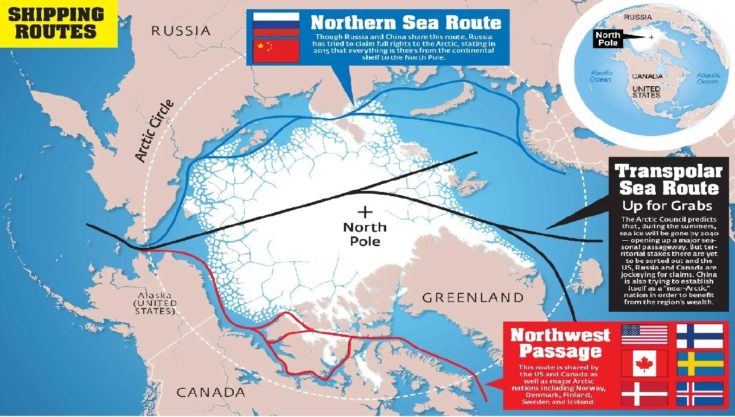
Experts note that China’s expanding Arctic capabilities are closely tied to strategic cooperation with Russia. Chinese and Russian coast guards have conducted joint patrols in polar waters, and the two countries cooperate on Arctic energy projects and shipping infrastructure. This partnership has deepened since Russia’s invasion of Ukraine, which has limited Moscow’s access to Western capital and technology.
China’s official Arctic policy stresses cooperation under existing international rules and rejects narratives that portray its activities as a security threat.
Despite this broader Arctic activity, Greenland remains a notable exception. Chinese investment attempts on the island have repeatedly failed or been blocked. Denmark rejected a Chinese bid to purchase a former naval base in 2017, while proposed Chinese involvement in airport construction and mining projects was later withdrawn or stalled following security reviews by Danish and Greenlandic authorities.
From Beijing’s perspective, the dispute is less about direct involvement in Greenland and more about the wider implications for Western alliances. According to The Guardian, Chinese analysts view tensions between the United States and Europe over Greenland as evidence of a weakening US-led alliance system, which could benefit China strategically without any direct action on the island.
ScandAsia has reported for more than a decade on China’s efforts to gain a role in Arctic governance. Earlier coverage has included Beijing’s push to engage with the Arctic Council during Norway’s chairmanship, its claim to “near-Arctic” status, and growing Nordic concern over China’s cooperation with Russia in the region.
Beyond geopolitics, the controversy has also been reflected in financial markets, where the dispute has had financial repercussions. Market uncertainty following Trump’s Greenland remarks coincided with a strengthening of the Chinese yuan, which reached its strongest level against the US dollar in more than two years. Analysts cited by the South China Morning Post linked the move to weakening confidence in US dollar assets.

At the same time, several European institutional investors announced reductions in their US Treasury holdings. Swedish pension fund Alecta said it had sold most of its US Treasuries, citing concerns about US debt and political unpredictability, while Danish fund Akademiker Pension confirmed a similar move, though it said the decision was unrelated to Greenland. Trump responded by warning of “big retaliation” should European countries attempt to pressure Washington by dumping US government bonds, according to The Jakarta Post.
For now, Greenland’s leadership has sought to reinforce its position within existing alliances. Greenland’s Prime Minister Jens-Frederik Nielsen said Greenland remains open to deeper NATO cooperation, including a permanent NATO presence, provided that any arrangements respect Greenlandic sovereignty.
Related posts:
 U.S. Coastguard considering increasing capability to operate in the Arctic all year round
 EU Commission opens office in Greenland, fears Chinese expansion
 Denmark’s prime minister rejects renewed US talk of acquiring Greenland
 Nordic and European allies back Denmark amid renewed US pressure over Greenland
