




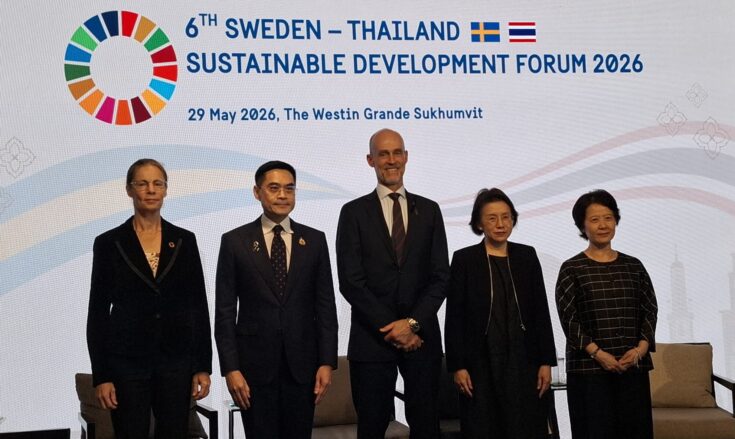
The 6th Sweden–Thailand Sustainable Development Forum brought together government officials, business leaders, academics and sustainability experts in Bangkok on 29 May 2026 to discuss how international cooperation can help Thailand achieve its enhanced climate commitments.
Held at the Westin Grande Sukhumvit, the forum focused on the theme “Achieving the updated Nationally Determined Contributions through collaboration”, highlighting opportunities for Swedish and Thai stakeholders to work together on Thailand’s transition towards net-zero emissions by 2050.
The Sweden–Thailand Sustainable Development Forum has been jointly organised since 2021 by the Royal Thai Embassy in Stockholm and the Embassy of Sweden in Bangkok, alternating between the two countries. The initiative forms part of the Sweden–Thailand Strategic Partnership signed in August 2025 and serves as a platform for government agencies, civil society organisations, academic institutions and private-sector actors to exchange knowledge and develop new forms of cooperation.
The event opened with remarks from H.E. Mr. Mikael Lindvall, Head of Directorate-General for Global Affairs at Sweden’s Ministry for Foreign Affairs, and H.E. Ms. Eksiri Pintaruchi, Permanent Secretary for Foreign Affairs at Thailand’s Ministry of Foreign Affairs.
Mr. Lindvall started out with reminding the participants of the unpredictable times we live in – the closure of the Strait of Hormuz the most recent turbulent event. Ms. Eksiri pointed to the long term problems like rising temperatures, extreme weather, that no country can battle alone.
The two were followed by a keynote address by H.E. Dr. Phirun Saiyasitpanich, Director General of Thailand’s Department of Climate Change and Environment. Dr. Phirun outlined Thailand’s climate policies and the implementation of the country’s updated Nationally Determined Contributions (NDC). Dr. Phirun reminded the participants that the new goal of 2050 for Thailand to achieve net zero green house gas emission moved the goal forward by 15 years from originally 2065 – in itself ambitious, he added.
“Resilience is a national priority for Thailand,” he said, pointing out that Thailand is on the list of the 20 most vulnerable nations in the world to the negative effects of climate change. Sweden is not.
“Thailand stands ready to share our transition experience and learn from Sweden,” he said.
The morning panel session examined the role of private-sector actors in supporting Thailand’s enhanced NDC ambitions. The discussion featured Ambassador Anna Hammargren of Sweden, representatives from the NDC Partnership, Thailand Development Research Institute and Climate Finance Network Thailand.
“I am the layman on this panel,” said Ms. Anna Hammargren, comparing herself to the other experts in the panel. Still, her common sense remarks resonated often well with the audience.
Much of the discussion centered on the newly introduced carbon tax, which has not yet been implemented. The proposal for the carbon tax is very clear, that the revenue from the carbon tax must be accumulated in a fund which will support Thailand’s energy transition, but several of the experts expressed fear that the revenue would be channelled first to the Ministry of Finance from where it was unsure how much would be contributed to the energy transition fund.
Although the focus of the forum was to achieve the NDC goal, the Thai panelists also stressed that Thailands priority regarding energy is not to reduce fossil fuel – it is first and foremost to secure availablity of affordable energy to the Thai people and industry.
After lunch, the programme was divided into two panel discussions. The first focused on energy transition and renewable energy. Speakers from Thailand’s Energy Policy and Planning Office outlined the National Energy Plan and its contribution to achieving Thailand’s climate targets.
One of the key pieces of information was that Thailand recently relaxed its regulations regarding private installation of solar cell panels and in the near future it could be expected that private producers of solar cell energy would be permitted to sell their excess energy back into the general electricity grid.
The second panel session focused on forestry cooperation, since forestry is the main absorber of the very same green house gasses that is to be reduced to zero emission in 2050. Increasing forestry by encouraging sustainable wood-based industries, circular bioeconomy solutions and the role of forests as carbon sinks would contribute to the same goal.
Participants discussed how sustainable forestry and wood-based industries could become both a natural climate solution and an emerging growth sector for Thailand, while contributing to the country’s emissions reduction targets.
The forum concluded with renewed commitments to deepen cooperation between Sweden and Thailand on sustainable development, with particular emphasis on climate action, renewable energy, forestry and green industrial development.
