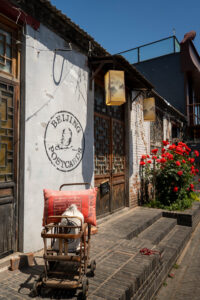



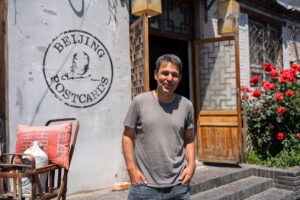
Outside, tourists and electric scooters squeeze through the narrow hutong alleyways of Beijing’s old Dashilar neighbourhood.
Inside a small hidden shop packed with old maps, archive photos and dusty newspapers, Danish historian Lars Ulrik Thom is trying to explain China in a completely different way.
Not through giant skyscrapers. Not through politics. And not through huge numbers.
Instead, he wants people to understand China through forgotten streets, old newspaper stories and conversations with elderly Beijing locals.
So many numbers
For nearly 20 years, Beijing Postcards has explored Beijing’s history through archival research and local storytelling.
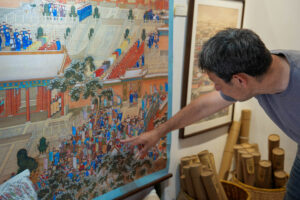
“We collect old photos and maps of Beijing, and then we interview old Beijing locals,” Lars says.
The idea is not to tell the story of China through big numbers or sweeping clichés.
“Everything is so big. So many people, so many cars, so many numbers. But those numbers can be very hard to relate to,” he says.
Instead, the goal is to make people relate to the city through details and personal stories. That is also why Beijing Postcards focuses almost entirely on Beijing rather than trying to explain all of China.
Not satisfied with just happy customers
Lars first arrived in China in 1996 while travelling with a friend.
What was meant to be a temporary stay eventually turned into decades.
He studied Chinese, later worked as a tour guide and gradually became interested in the gap between how China describes itself and how China is often described abroad.
But over time, he became frustrated with how superficial many tours felt.
“As a guide, the most important thing is happy customers,” he says.
“And there’s nothing wrong with that. But I really wanted to understand things more deeply.”
According to Lars, many tours focused on quick impressions rather than genuine curiosity about Chinese history and society.
“I felt like I couldn’t really dig properly into the history,” he says.
“I wanted to go much deeper.”
Not the China many foreigners expect
Lars Ulrik Thom believes many international conversations about China become trapped in extremes – either fascination or fear – without leaving much room for ordinary human stories.
“I often feel there are two parallel histories,” he says.
“There’s the Chinese version and the Western version, and they almost never overlap.”
And despite assumptions many foreigners may have about, for example, censorship in China, many locals are surprisingly open about sharing their experiences.
“People are actually very willing to share their stories,” he says.
“Of course, we don’t ask them to criticise the government. We ask them about their lives in China through the years.”
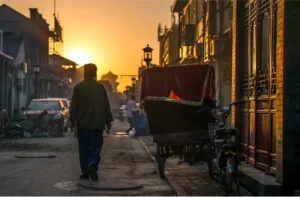
Some of those stories eventually become public walks, exhibitions or research projects. Others become another piece in what Lars describes as a giant puzzle of understanding Beijing from as many different angles as possible.
“It’s a passion project,” he says, adding that the deeper they research a subject, the more aware they become of how complex it really is.
Running through the history – literally
Today, the project attracts a mix of expats, diplomats, students, tourists and increasingly also Chinese visitors curious about Beijing’s history from another perspective.
Every weekend, themed walks take visitors through subjects ranging from the Forbidden City and the Boxer Rebellion to women’s history, old newspapers, opium dens and the transformation of Beijing during the 20th century.
Some of the most popular tours include History of the Hutong and A Crash Course to the Forbidden City.
The project also occasionally organises historical runs through Beijing, where participants quite literally run through the city’s history.
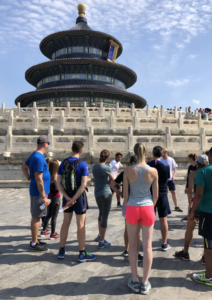
“Moving ignites your brain,” Lars explains.
“When we try to understand something, the physicality of it should not be ignored.”
Building a community around Beijing’s history
Today, Beijing Postcards hosts movie nights, book clubs, archive exhibitions, talks and themed walks exploring subjects ranging from old Beijing newspapers and women’s history to the Boxer Rebellion and the transformation of the city’s hutongs.
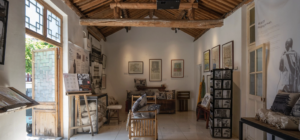
The small Dashilar shop also functions as a public history hub where visitors can browse old maps, historical photographs and souvenirs inspired by Beijing’s past.