




In June 2013, ScandAsia published an article about the restoration of the graves of Carl Christian Hansen and two of his daughters in Lampang, a Danish doctor who later served as an Honorary Vice Consul for America in Siam.
Today, in January 2026, his granddaughter has contacted the editorial team with additional material, personal recollections, and an article based on her family archive.
Below, is her account in full.
– Gregers Moller, Editor-in-Chief
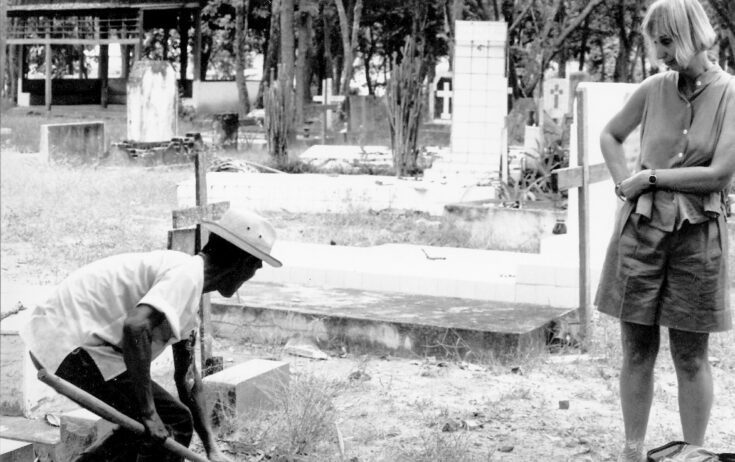
In 1985, during a trip to Thailand to learn more about the country that my Grandfather Dr. Carl Christan Hansen loved, I travelled with my 15-year-old son to Lampang to look for the graves of him and his children. With the help of an elderly man who still knew where they were — though they were almost completely covered — we were able to find them. Before leaving, we gave him money so he could continue caring for the site.
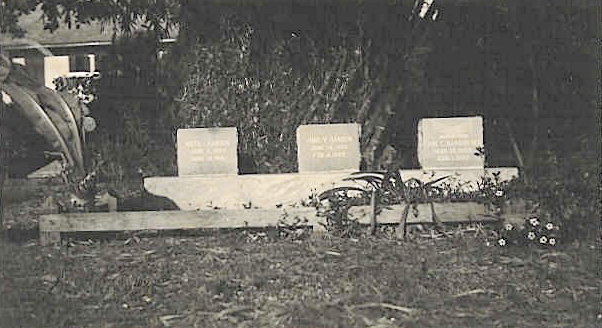
Below is a photo of the graves c. 1929 after my grandfather’s death.
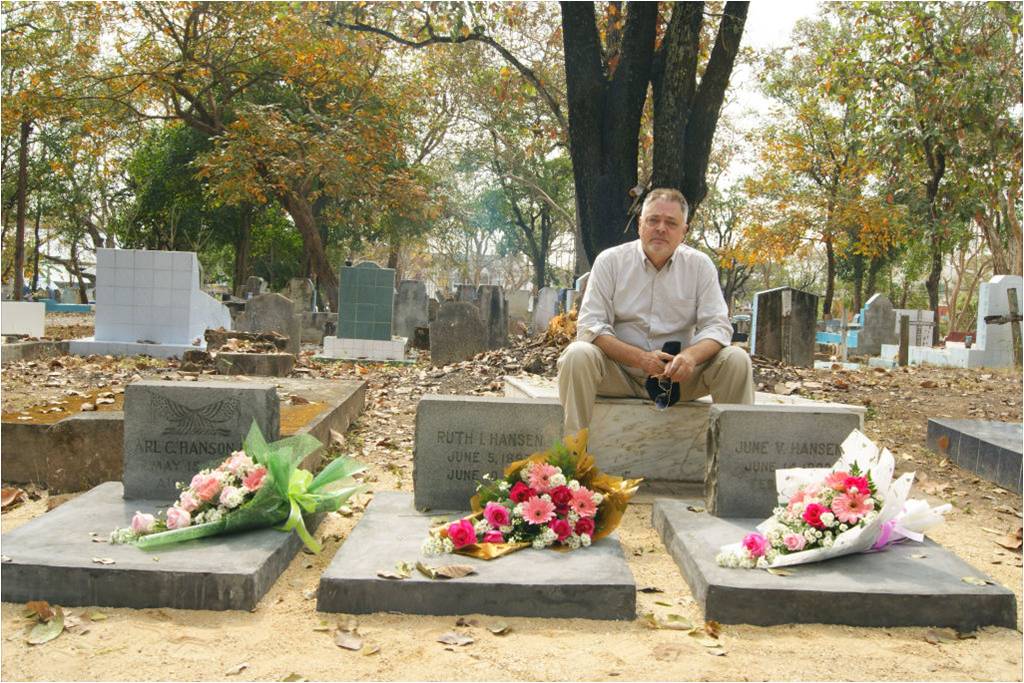
And here is a photo of the graves after a restoration in 2013. It is Flemming Winther Nielsen sitting behind the stones.
After my grandfather’s death, the entire contents of his residence/dispensary were sent by ship to San Francisco, where his collection was sold by Butterfield. His papers (business cards, letters, invitations, old articles , and his own writings and photographs ) are in my possession.
What follows is an article I wrote for genealogy based primarily on these papers
Early life and medical training
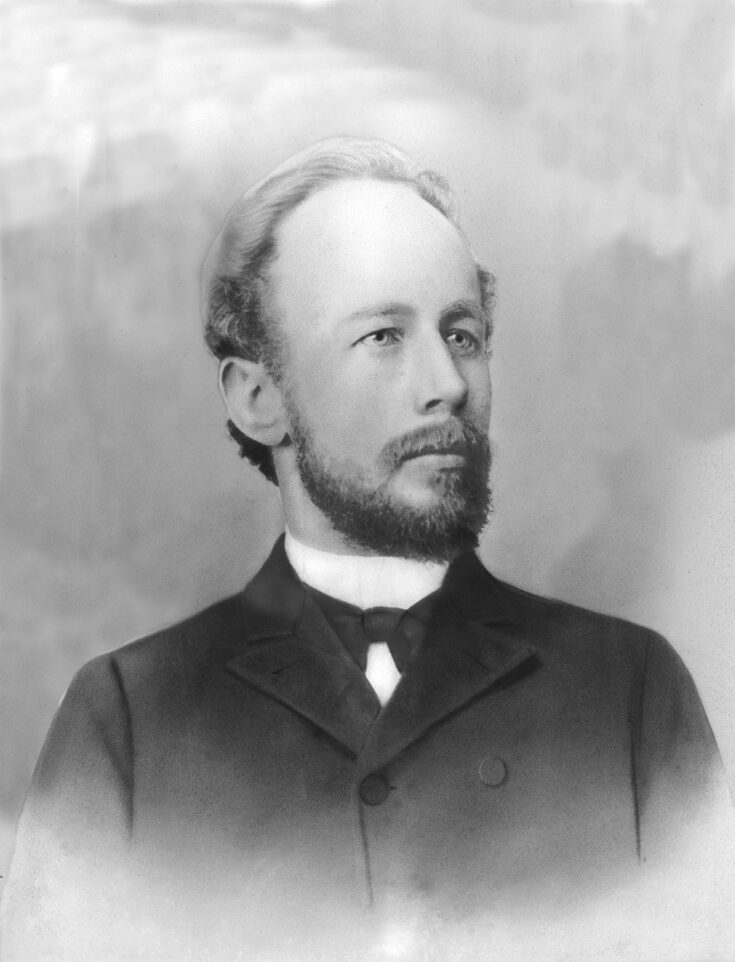
Carl Christian Hansen was born in 1863 in Bornholm, Denmark, and educated in San Francisco, California, at Cooper Medical College, which became the medical school of Stanford University. He was a medical missionary first in Mosul, Persia (appointed to the American Presbyterian Mission in 1895), and then in Lampang, Siam (transferred in 1897).
He met and married Lillian Dale Reinhart (who had been appointed to the Persian mission in 1893). Their marriage announcement gives the place as “Bagdad” and the date as May 8, 1896. The Armenian massacre by Sultan Abdul Hamid II in 1895-6 and the development of English interests in Mosul after the discovery of oil led to the closing of the mission, and they were transferred to the North Siam Mission in Dec. of 1897.
Dr. Hansen’s card from Lampang reads Carl C. Hansen, M.D., L.I.C.M. (Constant.), Resident Physician to Lakawn Hospital. Laos, Siam.
After he and my grandmother resigned from mission work in 1909, she returned to the U.S. so that their daughters Lillian and Aiyuna could be educated here, but he lived in Bangkok until his death, August 1, 1929. He is buried in the Christian cemetery at Lampang beside their daughters Ruth and June, who died in Lampang (at one time called Lakawn).
American Vice Consul in Charge
In Bangkok C.C. Hansen served as an American Consular representative. An undated envelope from the American Consular Service, Singapore, addresses him as “American Vice Consul in Charge.” His own card reads Dr. Carl C. Hansen, Vice and Deputy Consul General of the United States of America.
He first served under Hamilton King in 1909 according to the transcription of his swearing in dated the 18th day of February, A. D., 1909. A clipping from the “Bangkok Daily Mail,” June 28, 1909, reads The American Minister and Lady and Dr. Hansen extend to all their friends a most cordial invitation to a reception at the Legation from five to seven o’clock next Saturday afternoon, July 3rd, in honour of the “Fourth of July,” their national Day.
Dr. Hansen was acting consul when Mr. King was in ill health, after Mr. King’s death, and also between political appointments, which were usually one year in duration and often not completed full term. One such minister was George P. Hunt, appointed in 1920, who returned to Arizona to serve as the 1st, 3rd, 5th, and 7th governor.
In a letter dated March 14th 1922, Hunt says, “I had a splendid time in Siam and it is always a pleasure to look back on my stay there and when I do your good self always looms up on my vision.”
Dr. Hansen was for 20 years the continuing presence in Bangkok for the U.S. guiding politically-appointed consuls who changed with presidential administrations.
Royal Decoration of the White Elephant
He received a gold medal from Thailand (first class, first type) from “The Most Exalted Order of the White Elephant” (date awarded unknown). Among his letters are several from Hamilton King’s wife, Cora. In one, not dated, she is with her husband, whom she describes as “improving,” in a location not mentioned but nearby the King (It was customary to go to “the mountains” seasonally for cooler weather).
She asks after “Pussy,” hopes “Seng” is taking good care of him, and thinks it “best to keep confidential that this morning Prince Damrong called on us with a special message from his Majesty that he wished to see us this afternoon at 3:30 as personal friends, not officially, and the king sent over a fine piece of venison for dinner.”
She also wrote letters from the U. S. concerning the upkeep of her husband’s vault in 1915, 1921, and 1922, asking for news, and remembering the many good times in the old legation. She writes in July 1921 that she had heard a rumor someone was to take his place as Consul, and says, “I cannot think of you as not living in dear old Bangkok.”
The Lotus Dispensary
In the “Bangkok Daily Mail, 3rd August, 1929,” in a long article after his death, he is called “Honorary Consul.” The paper states that he had purchased the land for the original legation building.
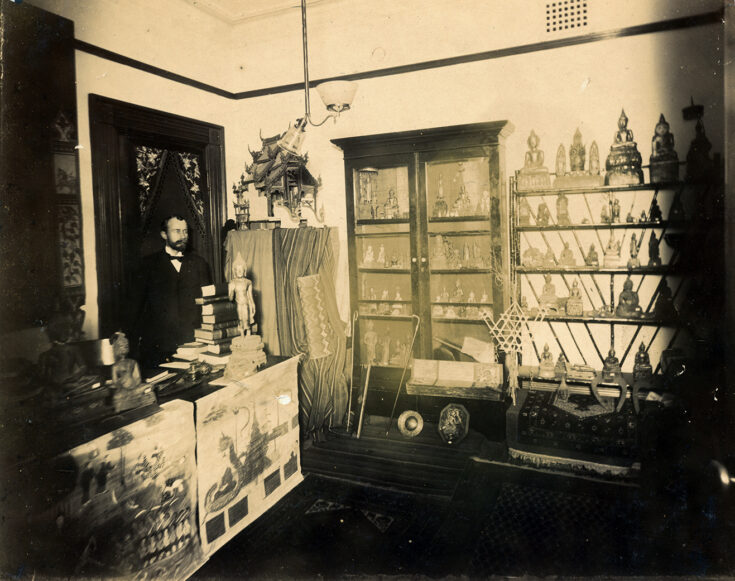
Sometime before his death at age 67, he retired from the legation to his pharmacy, the Lotus Dispensary, where he kept his collection of Oriental art objects, but he continued to visit the consulate daily and to receive official invitations. Some invitations from 1926 and 1927 are accompanied by notes from the legation requesting the pleasure of picking him up to attend such occasions as the Minister’s Christmas dinner, the Queen’s garden party, and the Ministry of Interior’s ball.
He saved many invitations from 1909 through 1928, sometimes accompanied by papers with an English translation. He also saved “programmes” in English for the 1911 coronation of his Majesty, Maha Vajiravudh, and a booklet in Thai with the caption for the cover photograph in English, The last Photograph of His Majesty the late Phra Chula Chom Klow.
In addition, he saved numerous calling cards from members of other legations, from business men including Louis Leonowens, and from individuals. Over the years, he gave or sent mementos from his collection to those leaving “the service” and to other friends, and he kept letters thanking him. His papers provide excellent documentation about diplomatic life in Siam. Notebooks attest to his study of Buddhism and the Thai language.
According to the article and to what his daughter Lillian remembered being told, he attended King Chulalongkorn as a doctor. A letter from the Presbyterian ministry calls him to task for discussions with the king about Buddhism as a necessary religion for the Siamese people.
The collection
The 1929 “Bangkok Daily Mail” article calls him “a well-known curio collector” and states that “both the rear portion and second floor of his dispensary were packed to capacity with objets d’art, some of them of great value, because of their rarity and indisputable authenticity. There were very few tourists to the capitol who, during their stay, did not pay a visit to the Lotus Dispensary to see the late doctor’s collection. . .
On several occasions during the past years, collectors in America and Europe had made overtures to buy the collection en bloc, one party offering as high as $50,000.“ The writer speculates that “the reason Dr. Hansen never entered seriously into negotiations was that he was reluctant to part with what he had taken some 25 years to acquire.”
After a special dispensation from the Siamese government allowed a ship to carry the collection to San Francisco, it was sold in 1931 by Butterfield Studios, now Bonhams and Butterfield (final accounting of sales: $33,411).
However, the family was able to keep things such as blue and white porcelain vases, blanc de chine figures, Thai porcelains, furniture, etc.
Lillian remembered that although there was no chance to go through items before the auction, bidding was stopped when her mother raised her card.
Carl Hansen loved Thailand and loved art. In the front of one of the many notebooks and files he kept, he wrote, “These things of art which have been the joy of my life.”

If we had seen the original grave, we would have restored it like that. But we didn’t know how it looked. The foundation on which the original headstones were placed is probably down in the ground, if we went back to dig for it!