



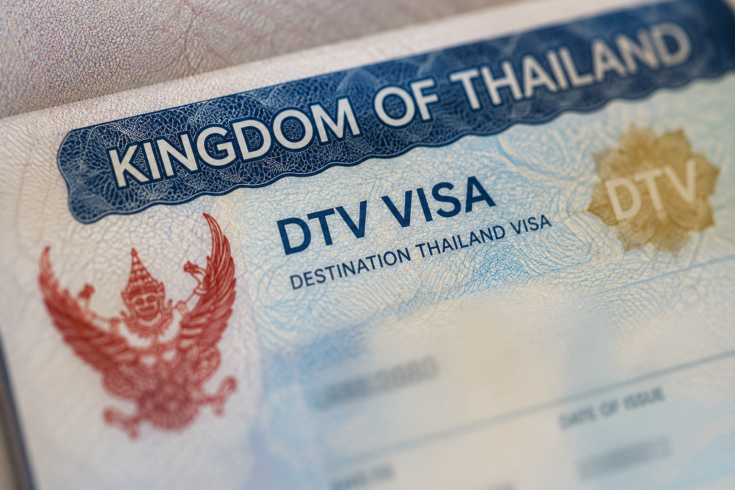
When Thailand rolled out its Destination Thailand Visa in July 2024, it didn’t take long for people to start calling it the country’s answer to the global remote-work boom. The visa lets eligible remote workers, freelancers and people involved in approved “soft power” activities settle in for extended stretches, as long as they can meet the financial and paperwork requirements. In practice, that means a valid passport, proof of income earned abroad (or evidence of a qualifying activity), the right financial documents, and a photo that meets the visa’s specifications.
Two years on, though, the picture around DTV looks different.
Official figures suggest Thailand’s tourism market is heading into a slower stretch in 2026. But dig into the same data, and a more interesting story emerges: DTV may be settling into something more durable than anyone initially expected.
Tourism growth is slowing
Thailand remains one of Asia’s most visited destinations, but 2026 has brought clear signs of a slowdown.
According to the Bank of Thailand, international arrivals have been trending downward for months:
- January: 3.278 million
- February: 3.264 million
- March: 2.775 million
- April: 2.369 million
- May: 2.347 million
The central bank pointed to a split in performance. Long-haul markets kept recovering, while several short-haul markets softened on weaker demand and thinner flight capacity. Whatever growth there was in May came mostly from Chinese and Malaysian visitors.
The government’s own outlook has shifted too. Officials had projected around 35 million arrivals for 2026 as recently as late 2025; that figure has since been revised down to roughly 33 million, with policymakers now framing 2026 as a year of stabilisation rather than continued rapid growth.
None of this points to a crisis. It looks more like the tail end of the post-pandemic rebound giving way to a steadier, more mature phase of tourism.
The travel market itself is changing
Tourism demand is only half the story.
Industry data shows Thailand was among the Southeast Asian countries hit hardest by capacity cuts, with airlines pulling more than one million scheduled seats from the market between May and July 2026. The Bank of Thailand has tied weaker demand in some markets directly to that reduced connectivity, along with rising energy costs.
There’s a second, quieter shift happening, outside Thailand altogether.
The days of unrestricted remote work are fading. In their place, a more regulated model is taking hold, as employers roll out return-to-office mandates or tighten compliance around tax residency, employment law and cross-border work.
Remote work itself isn’t going anywhere. But the spontaneous, pack-a-bag-and-go relocation has become rarer. Staying long-term now takes planning, paperwork, and legal certainty, not just a laptop and a Wi-Fi connection.
Why DTV may actually benefit from this shift
At first glance, a softer tourism outlook might look like bad news for Thailand’s long-stay visa strategy.
It could be the opposite.
Several structural factors still work in DTV’s favour.
Remote work hasn’t lost its pull globally, corporate pushback or not. MBO Partners estimated that 18.5 million Americans identified as digital nomads in 2025, a number that’s kept climbing among both freelancers and traditional employees.
Currency is playing in Thailand’s favour too. After strengthening earlier in the year, the baht weakened through the second quarter of 2026 – by 9 July, the reference rate sat around 33.5 to the US dollar, making Thailand a bit cheaper for anyone earning in dollars or several European currencies.
At the same time, as authorities tighten parts of the visa-exemption programme, DTV starts to look like the more sensible legal route for people planning genuine long stays.
Instead of explosive growth, the programme may end up drawing a smaller, more qualified pool: people with stable overseas income and a clearer sense of how long they intend to stay.
The strongest potential demand comes from established international markets
Thailand doesn’t publish official statistics breaking down DTV applications or approvals by nationality, so there’s no clean way to say who’s actually applying for the visa.
The closest thing to a proxy is inbound tourism.
According to Thailand’s Ministry of Tourism and Sports, the largest source markets in the first quarter of 2026 were:
| Country | Q1 2026 arrivals | Year-on-year |
| China | 1,488,713 | +11.8% |
| Malaysia | 959,023 | –16.9% |
| Russia | 725,958 | +0.5% |
| India | 625,598 | +15.0% |
| South Korea | 412,151 | –17.2% |
| United Kingdom | 353,527 | +5.5% |
| Germany | 346,016 | +1.4% |
| United States | 320,071 | –0.2% |
| Japan | 307,580 | –2.9% |
| France | 305,448 | –3.1% |
These figures do not represent DTV applicants.
However, they highlight markets where long-stay demand may be strongest when tourism trends are combined with remote work adoption and purchasing power. Countries such as the United States, the United Kingdom, Germany, France, Japan, India and Russia appear particularly relevant because they combine sizeable outbound travel with established communities of remote professionals.
What successful DTV applicants are doing differently
In May 2026, the Cabinet signed off on significant changes to visa exemptions and visa-on-arrival arrangements. That was followed in June by another review from the Visa Policy Review Committee, this time weighing the balance between tourism, security and labour concerns.
As scrutiny tightens, documentation matters more than ever. Embassies have repeatedly warned applicants against vague financial records, screenshots masquerading as official statements, or applications filed in the wrong jurisdiction. Even a minor mismatch in passport details can be enough to trigger delays or even rejection.
Thailand Destination Visa (DTV) application guide
A strong application package typically combines multiple forms of evidence for the same claim, including employment certificates, employer letters confirming remote work arrangements, several months of bank statements, payslips, tax documents and supporting business or portfolio information where appropriate.
The biggest unknown remains the data
Despite the growing buzz around it, one gap keeps getting in the way of a full picture.
Thailand hasn’t published comprehensive national statistics on DTV approvals, refusal rates, applicant demographics, or country-by-country breakdowns.
So any read on real DTV demand has to lean on indirect signals: tourism flows, embassy guidance, macroeconomic conditions, labour market shifts, remote work research. It’s a patchwork, not a dataset.
But that patchwork keeps pointing in the same direction.
Thailand’s tourism industry may be sliding into a slower growth phase, but its long-stay strategy looks like it’s entering a more mature one. Rather than chasing the largest possible number of visitors, the country increasingly seems to be betting on people who stay longer, spend more, and fit a more deliberate, structured model of international mobility.