


Indonesia and the European Union have reached a political agreement to finalise their long-awaited free trade deal, the Comprehensive Economic Partnership Agreement (CEPA), by September 2025.
The breakthrough was announced after Indonesian President Prabowo Subianto met with European Commission President Ursula von der Leyen in Brussels over the weekend.
“The partnership between Europe and Indonesia, as a large part of ASEAN, will contribute significantly to global economic and geopolitical stability,” said Prabowo at a joint press conference.
The announcement follows nearly a decade of negotiations and comes at a time when both Indonesia and the EU are facing looming tariffs from the United States under renewed trade measures by President Donald Trump. Indonesia is set to face a 32% US tariff starting 1 August, while the EU could be hit with 30% unless it secures a resolution with Washington.
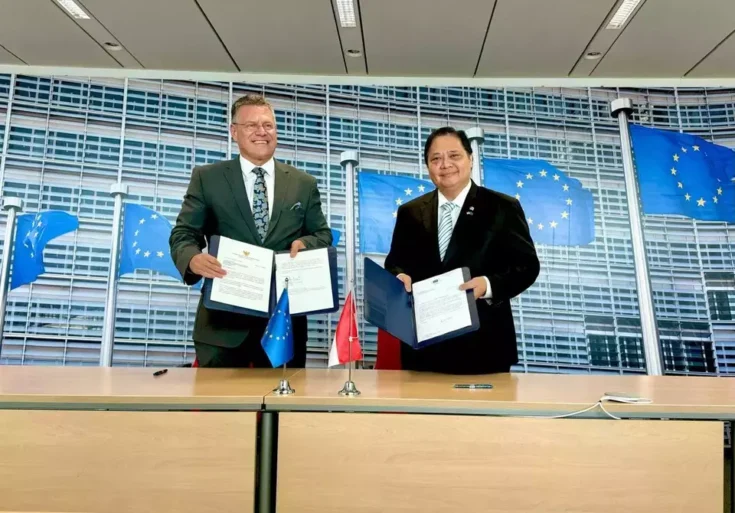
Observers note that this external pressure may have accelerated progress in the Indonesia-EU negotiations. Indonesia’s Chief Economic Affairs Minister Airlangga Hartarto, who joined the Brussels visit, met with EU Commissioner for Trade and Economic Security Maroš Šefčovič. The two signed an exchange letter to expedite the deal’s technical completion.
“Indonesia welcomes the political agreement that has been reached. This marks an important milestone towards the completion of the Indonesia-EU CEPA,” said Airlangga.
According to Palm Oil Monitor, a policy commentary organisation closely tracking Southeast Asian-European trade relations, Indonesian officials say the EU has recently shown increased flexibility on key sticking points — notably the EU Deforestation Regulation (EUDR), which Jakarta has strongly opposed. Trade Minister Budi Santoso was quoted as saying the EU is now adopting a “more flexible position,” possibly in pursuit of a long-term partnership with Indonesia.
The EUDR, which seeks to bar imports linked to deforestation, has been criticised by Indonesia and other palm oil-producing nations as a unilateral policy threatening millions of smallholder farmers. Palm Oil Monitor argues that geopolitical urgency may be softening Brussels’ stance. The group suggests that, faced with the potential fallout from US tariffs, the EU may be prioritising economic resilience over regulatory strictness.
Šefčovič acknowledged a “new sense of urgency” in finalising the CEPA, warning that if US tariffs go into effect, maintaining the current level of EU-US trade “will be almost impossible,” Palm Oil Monitor notes.
The Indonesia-EU CEPA negotiations, launched in 2016, have spanned 19 formal rounds. If signed as expected in September, the agreement will remove trade barriers and offer greater legal certainty for investors and exporters on both sides.
As Brussels looks to strengthen its presence in Southeast Asia, an agreement with Indonesia — the region’s largest economy — is seen as a strategic anchor. Talks with Malaysia remain stalled, while negotiations with Thailand and the Philippines are still at an early stage.
The deal is still being finalised, and a last-minute change in Brussels could impact the signing timeline. However, for now, the CEPA appears on track — and potentially reshaped by global trade tensions beyond the negotiating table.