


Children sit around a long table in a covered outdoor classroom surrounded by cherry trees on the outskirts of Beijing – trees that will be ready for harvest in just a few weeks.
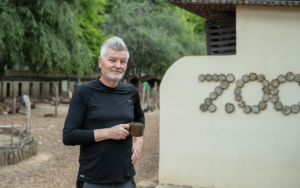
Mandarin and English blend together as teachers gather the five- and six-year-olds before lunch. Instructions are first shouted in Mandarin. Then repeated in English by Danish architect and FunFarmFam founder Morten Holm.
Nearby, lunch is being prepared using vegetables grown directly on the farm.
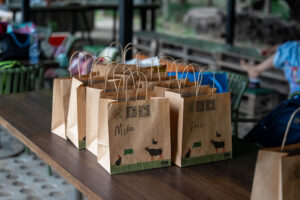
The children quickly line up after the teachers’ instructions and begin walking toward the lunch area – until everything suddenly stops for a group photo in front of a large FunFarmFam sign.
And instead of yelling “Cheese!”, the children excitedly shout:
“Butterfly!”
“An extension of the classroom”
The scene plays out at FunFarmFam Ecology Plantation outside Beijing – a Danish-Chinese project where children swap classrooms for farm life.
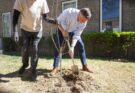
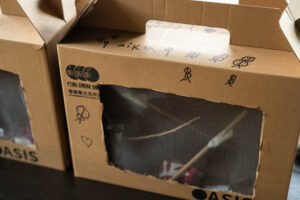
Instead of sitting indoors reading about nature, the children feed animals, grow vegetables, cook food and spend their days outdoors.
Danish founder Morten Holm describes the project as “an extension of the classroom”.
For Morten, the idea was never simply to create a farm.
“Here they get much more practical and real-time learning,” he says. “It’s much more authentic because it’s happening in a real environment.”
Sustainability built into the farm
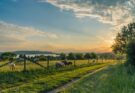
The farm covers around 12 hectares filled with fruit trees, greenhouses, playgrounds and outdoor classrooms.
“There are cherries, apples, walnuts, pepper trees and Chinese sea hawhorn,” Morten says while pointing across the farm.
Much of the project has been built by retrofitting older structures already found on the property.
“That’s also a form of sustainability,” he says.
Old farm buildings have been renovated instead of torn down, while furniture and covered teaching areas have been built using recycled materials.
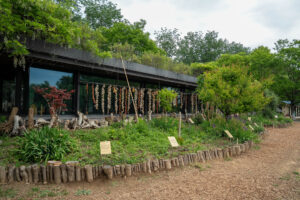
The farm mainly welcomes kindergarten and school children from Beijing, and some of the playgrounds and shelters were even designed together with the children themselves.
“The older kids helped create some of the shelters and playground structures,” Morten explains.
Swapping architecture for farm life
Morten originally came to China through architecture work and later settled permanently in Beijing.
For years, he worked as a partner in a Danish-Chinese architecture company before gradually shifting more of his focus toward FunFarmFam.
“The distance between starting something and seeing the payoff is much shorter here than in architecture,” he says.
“With buildings, it can easily take five or ten years.”
At the farm, ideas can instead quickly become physical projects involving children, teachers and families.
“It’s probably the most fun when you don’t completely know what you’re doing,” he says about throwing himself into something completely different from architecture and figuring things out along the way.
COVID forced the farm to evolve
The project originally began when Morten’s mother-in-law asked for help upgrading the family farm outside Beijing.
At the time, the area mainly functioned as a traditional fruit and vegetable farm selling produce locally.
“What was here before was basically just a very practical farm,” he says.
Together with his wife, he gradually began transforming the area into what has now become FunFarmFam.
Then came COVID-19.
“For three years, China kept opening and closing again and again,” Morten says.
“We had to figure out what kind of business this actually was and where the demand really existed.”
Outdoor classrooms remain rare
Since opening in 2022, the farm has welcomed children from schools and kindergartens across Beijing for outdoor learning activities on the farm.
Most visitors come from international or bilingual schools around the Chinese capital.
According to Morten, many local Chinese schools simply do not have the budget for these kinds of trips.
“A lot of local schools maybe only have 20 or 30 yuan per student for excursions like this,” he says.
“It’s very different from Scandinavia where much of this is publicly supported.”
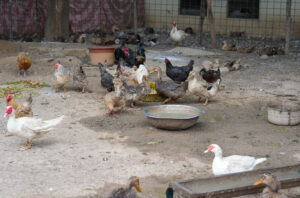
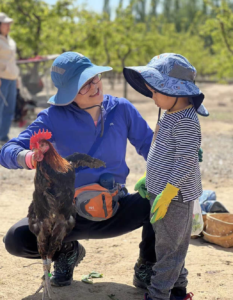
Feeding chickens instead of sitting in class
After lunch, the children gather in a large circle near the animal area, quietly mixing garlic, corn and feed together in metal bowls for the farm’s chickens and ducks.
British kindergarten teacher Matt watches from the side.
He regularly brings his students to the farm and says the children behave very differently outdoors compared to inside a normal classroom.
“They really engage with this activity,” he says.
“There’s not a lot of access to nature or farms in Beijing. So this is really unique.”
Schools keep coming back
Morten believes outdoor learning is especially important in Asia’s often highly academic school systems, where children can face heavy pressure to perform from an early age.
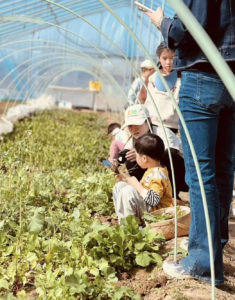
According to him, spending time outdoors offers many children something they otherwise rarely experience.
Today, Morten says the demand from schools has become much clearer.
“The difficult part now is actually getting through the doors of the schools,” he says.
“Once schools come once, they usually come back.”