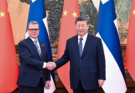



Finnish ambassador to Beijing still sees value in talks with China despite Russia tensions – even if concrete results remain limited.

When Finnish Prime Minister Petteri Orpo travelled to Beijing earlier this year, the trip was officially described as “fruitful”. But more than three months later, the results remain difficult to measure.
Still, Finland’s ambassador to China, Mikko Kinnunen, insists the meetings mattered.
During the January visit, Prime Minister Petteri Orpo held talks with both Chinese President Xi Jinping and Premier Li Qiang in Beijing.
“Meeting with the Chinese officials or the Chinese leadership gives the possibility to impact or to try to impact on those things that are important. Managing a relationship and achieving results is a long process,” Kinnunen told ScandAsia.
And at the very top of Finland’s agenda: Russia’s illegal war in Ukraine.
Russia remains key issue
According to Kinnunen, China’s perceived support for Russia’s war remains “the most problematic issue in Finnish-Chinese relations.”
The comments come shortly after Finnish Foreign Minister Elina Valtonen warned that China’s relationship with Russia could make future trade agreements between the EU and China more difficult.
Despite this, Kinnunen does not believe isolating China is realistic.
Wants to keep raising concerns
According to Kinnunen, meetings between top political leaders carry particular importance in China, where high-level political relations play a bigger role than in many European countries.
Finland therefore still sees value in maintaining direct contact with China’s leadership – even as relations between Europe and China become increasingly strained over trade, security and Russia’s war in Ukraine.
“It is important to have solid functioning relations so that you have a possibility to engage,” Kinnunen said.

Maintaining direct dialogue with Beijing gives Finland an opportunity to directly raise concerns about Russia, trade disputes and broader political tensions.
Few concrete breakthroughs so far
Still, despite the growing tensions surrounding Russia and broader EU-China relations, the January visit also resulted in several new agreements between Finland and China.
During the January visit, Finland and China signed six agreements on areas including sustainable building and green energy. A further 11 agreements were signed between Finnish and Chinese companies.
But many of the deals were Memorandums of Understanding (MOUs) – broad cooperation deals rather than concrete investments or projects right away.
“These agreements build a framework for cooperation, and then it is the companies that would benefit from this framework,” Kinnunen said.
Asked whether the January visit had created better opportunities for Finnish businesses in China, Kinnunen replied:
“At least the opportunities did not worsen.”