




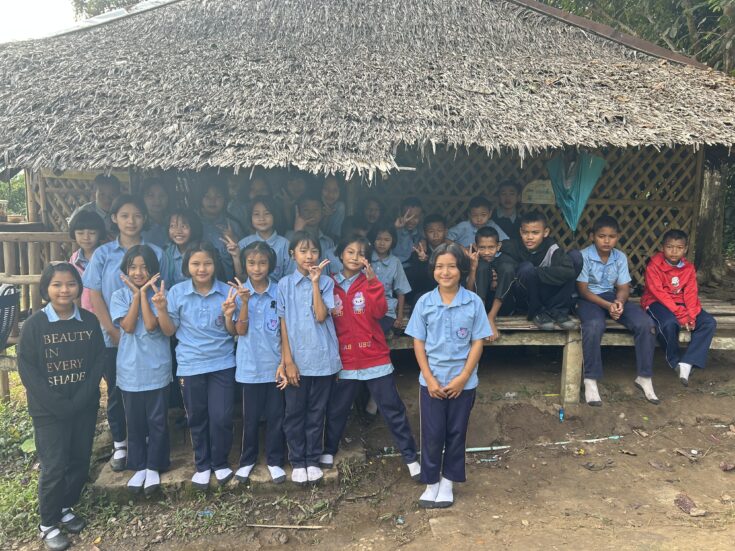
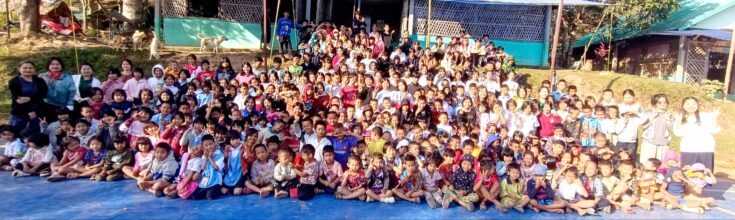
It’s 8am, and the morning sun warms up the hillside by Lake Vajiralongkorn in Thailand’s Sangkhla Buri district. The chirps from myna birds in the treetops blend with the patter of hundreds of small sandals hurrying over dirt roads. A collection of squared bamboo huts stands on the otherwise jungle-covered hillside — these are the classrooms of Children of the Forest School. A school bus arrives and unloads a new batch of excited passengers. A young teacher, Poraetoo, or as the kids call her, “Teacher Jhaa,” rings a big bell, and the kids scurry into lines. The principal starts reading the morning announcements, but the youngest kids, the kindergartners, don’t pay her much attention. Multiple teachers calmly try to keep them in line, but the kindergartners are impatient. Today is special. Instead of rice porridge, today’s breakfast is noodles with vegetables — their favorite — and it’s waiting in the lunch building. But first, they stand for the national anthem, as is customary in all Thai schools. Yet these kids are unlike most Thai students — these kids are stateless.
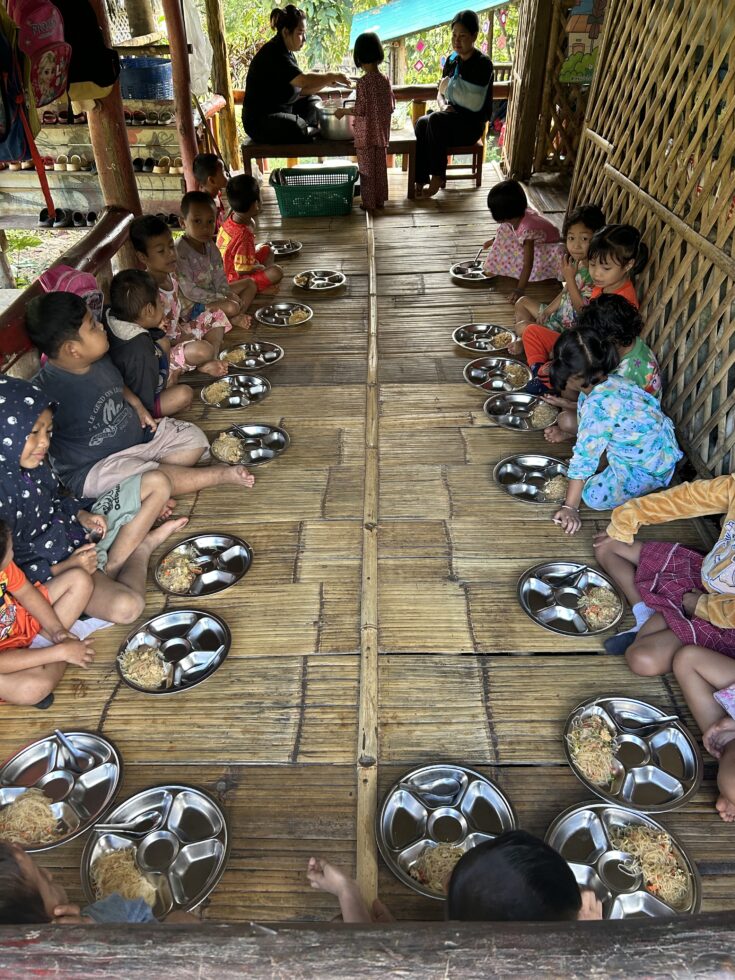
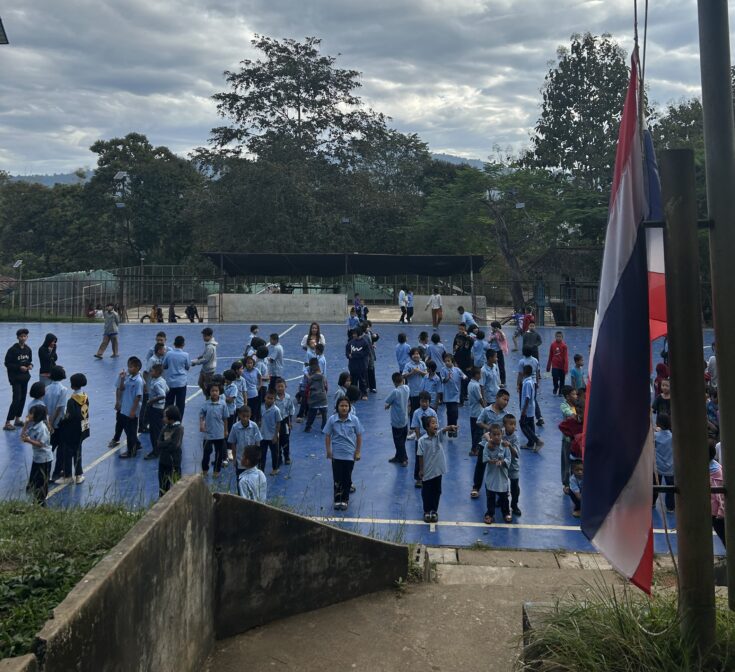
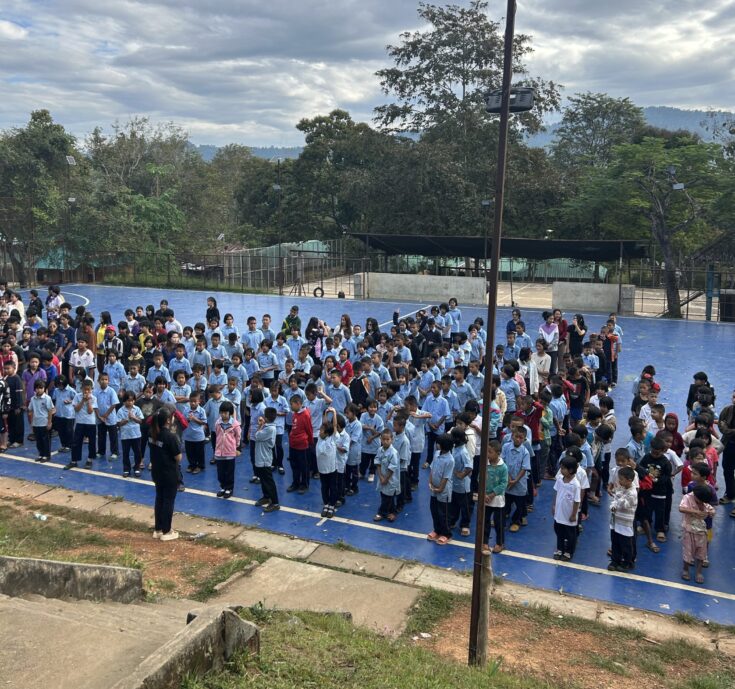
Sangkhla Buri district is home to three distinct peoples: Thai, Karen, and Mon. Each group has its own language and culture. Among these three, only the Thai population are Thai citizens, with access to government-funded healthcare and education. Because their families lack access to government healthcare, most Karen and Mon kids are born at home in their villages, with no Thai official present to sign their birth certificates, leaving the newborns effectively stateless. New policies have recently been implemented to improve the status of newborns in the district, and even though they have helped, statelessness for kids remains a serious issue.
It’s an issue Daniel Hopson, founder of Children of the Forest (COF), wants to help solve. COF School enrolls Karen and Mon kids in Sangkhla Buri. The school is free to attend, as many of the families would otherwise be unable to pay school fees. COF started two decades ago when Daniel Hopson first visited Sangkhla Buri.
“I was walking around the rubber plantation and saw a lot of kids at work. I asked why they weren’t at school. They don’t have ID cards, I learned. I struggled to make sense of the answer. Not having the right paperwork meant no school, no fun, no opportunity, no future,” he says.
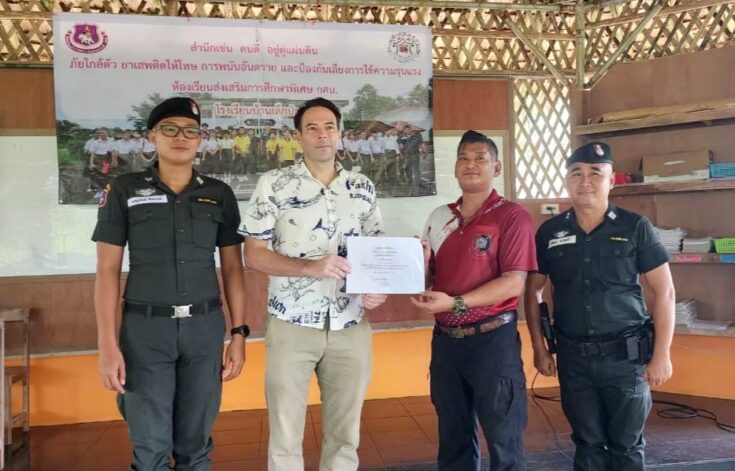
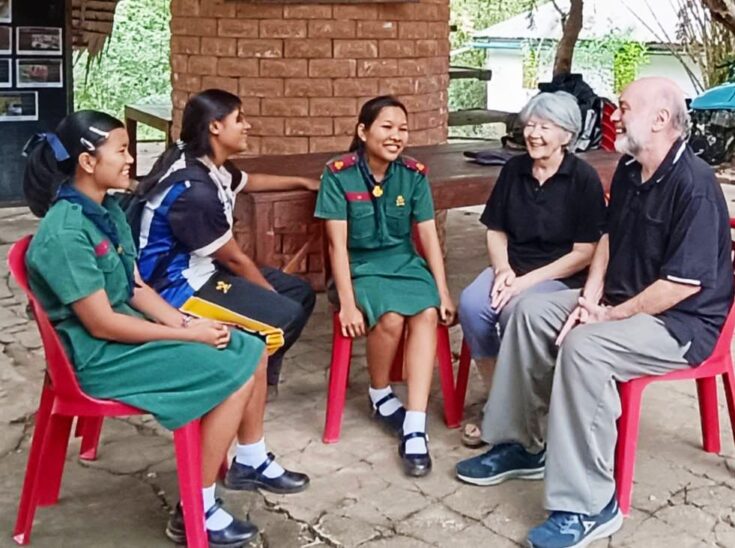
That’s when Daniel decided he wanted to help out. Together with his friend Mark Curragh, he opened COF in 2005 as a school. COF has since grown and now encompasses a free medical clinic run by Mark’s wife, Talaitow and a women’s shelter for single mothers. In 2010, Daniel brought his parents, Tom and Lynda, from the UK to help out. Tom helps out at the school and Lynda helps in the women’s shelter.
“Children of the Forest aims to address the injustice and inequality faced by stateless children and mothers. Through various programs, we ensure access to the basic services citizens take for granted, such as protection, education, and healthcare.”
The school accepts new students all year-round. The kids are taught math, Thai, English, and Art. Thai is the language of the national school system, but for most stateless kids, it is their second or third language. This language barrier further excludes them from attending regular schools. At COF, the kids are taught Thai so that when they graduate, they can join official Thai elementary and high schools.
COF School has been granted official status by Thai education authorities. An important component, since it means students are officially registered and receive a student number.
“Their student number is the first time they are registered in the Thai education system. That can, eventually lead to ID cards, which gives them protection against exploitation and provides them with rights. Even further down the line, it can lead to full citizenship — but it all starts with the student number.” Tom Hopson explains.
“A is for a-a-apple, B is for bird b-b-bird.” The song continues as the kids sing along in Ms. Saranee’s classroom. She is one of two English teachers at COF, and like most teachers, she cares deeply for her students. Saranee also relates to her students on a personal level. 20 years ago, she was sitting in their exact place. She was among the first generation of kids to study at COF back in 2005. Since then, she has gone on to graduate high school, study English language and teacher training at university in Kanchanaburi. After graduating, she returned to COF, where she now works as an English language teacher.
“I chose to come back because I wanted to help. I know what these kids are going through — I’ve been there. I want to give back. I want to be a role model for them,” she says.
Today’s lesson is on word families: sun, fun, run, bun. Saranee likes to incorporate games into her classes to motivate the kids. She has spread papers with words across a table. She gathers the kids in a circle and starts playing music. A pen is passed around, and when the music stops, the holder must find a specific word. The kids laugh — some cling to the pen, excited to play, while others pass it quickly. The music stops, and the boy holding the pen is asked to find the word “sun.” He jumps onto the table, giggling with determination, as his classmates shout encouragement and Saranee smiles.
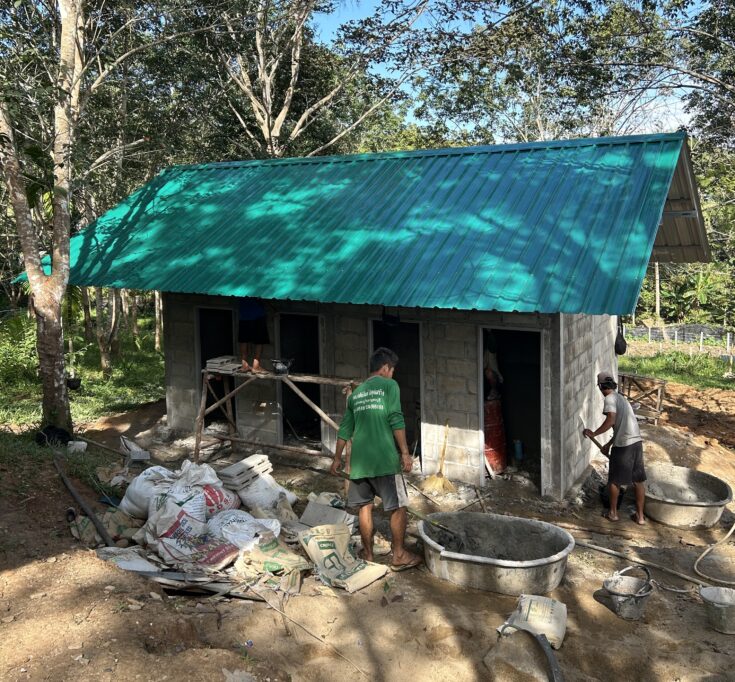
The game is briefly interrupted by the noise of construction outside the classroom. It’s loud and distracting, but Saranee welcomes it. The school is building a new toilet block — something she has wanted for some time and that they’ve now secured funding for.
COF relies entirely on donations and sponsors for its funding. One of the long-time supporters of the organization is the Danish Women’s Network, Bangkok (DWN). DWN has worked with and supported COF for 15 years.
“We wish to support good organizations and causes, especially those focused on women and children,” says Kit Daniel, chairwoman of DWN.
“Over the years, we’ve gotten to know the people at Children of the Forest, and we’ve built mutual trust. I and others from DWN have personally visited them in Sangkhla Buri, and we know they do phenomenal work. We are very happy to support them and see the children there flourish.”
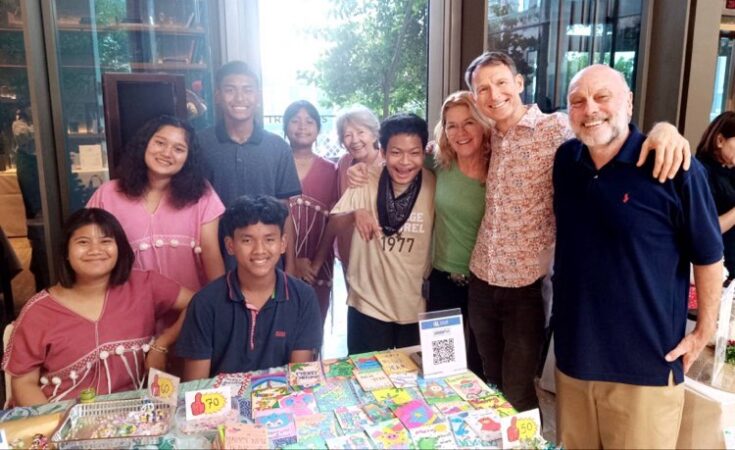
One of the ways DWN supports COF is by raising money through their annual Christmas Bazaar, held in collaboration with the Danish Church in Bangkok. The two groups share the costs and proceeds equally. All of DWN’s portion goes directly to COF. The Christmas Bazaar 2024 was the most successful yet, attracting around 1,000 visitors and raising a record amount of money. The money raised helped COF buy new classroom supplies, sports equipment, and support outreach programs for local families and at-risk kids.
“We are really grateful for the support from the Christmas Bazaar and the Danish Women’s Network,” says Tom Hopson. “As we take in more and more students, events like these are crucial for our funding.”
The Christmas Bazaar isn’t the only way DWN supports COF. DWN has also run a sponsorship program where families or individuals cover education-related costs for students.
Teacher Poraetoo, “Teacher Jhaa,” was one of those students, receiving financial support for her education from DWN members.
Poraetoo is Karen and grew up in Sangkhla Buri. Like her friend and fellow English teacher Saranee, she was among the first students when she started at COF in 2005 at the age of eight. With DWN’s help, she went on to study at a university in Kanchanaburi and earned a degree in English Language Business Studies. She has since returned to Sangkhla Buri, where she now teaches English at COF School.
“At first, I started work here because I wanted to help out a little,” Poraetoo explains. “But I quickly fell in love with teaching and the kids. I feel like I can truly make a difference in their lives — just like this school made in mine.”
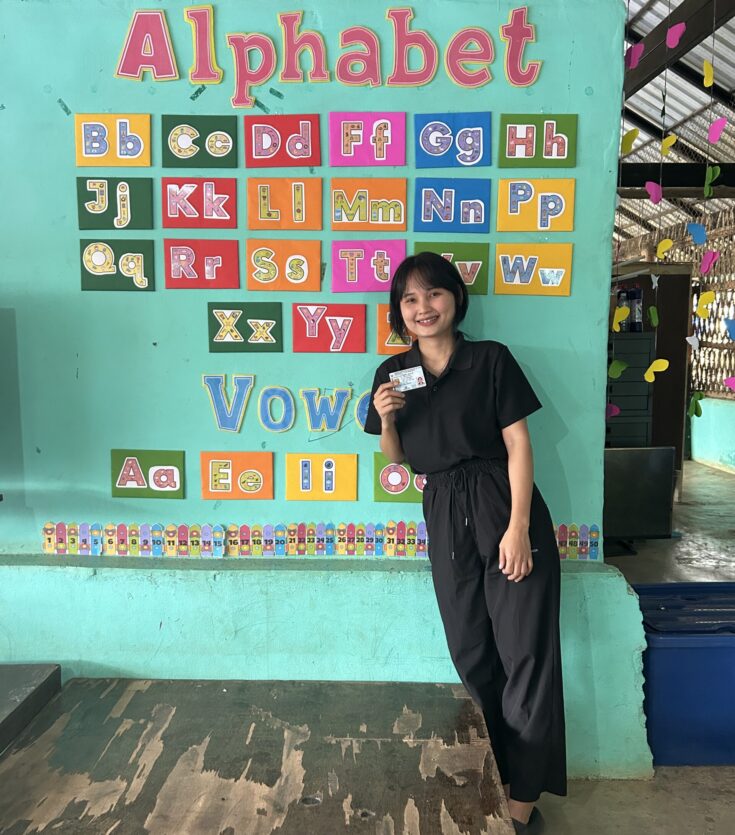
The biggest change in Poraetoo’s life came two years ago when, after years of applications and paperwork, she finally received Thai citizenship, granting her full access to healthcare and voting rights.
“I am really happy,” she says, proudly showing her blue ID card. She explains that her university degree was the tipping point that helped her obtain citizenship — a degree made possible in large part thanks to DWN support.
“I feel so grateful for the people who helped me come this far and reach a point where I can now give back.”
A football is kicked across the blue sports field, and several boys run after it. A little girl slides down to her friends, while others play tag nearby. On the hill above, Saranee and Tom stand watching the kids play. There are many of them now. COF School started with three teachers and 2 classrooms back in 2005. Today, it employs 18 teachers plus another 8 staff, for admin duties, school bus drivers, cooks, maintenance staff and 380 students, and the number keeps growing. Some stateless kids in Sangkhla Buri still don’t go to school, and although COF does all it can, there is always more to do. Despite the challenges, the people at COF remain determined to keep going.
“Every day, when I come to the school, the kids give me a big smile and want to high-five me,” Tom says. “It just fills me with joy”.



[…] Organised by the Danish Women’s Network and the Danish Church in Thailand, the bazaar transformed the 19th floor of Gaysorn into a lively holiday market with Danish hotdogs, waffles, gløgg, handmade ornaments, and a wide selection of gifts from local vendors. Proceeds from the event support charitable initiatives in Thailand, including Children of the Forest. […]