



The smooth bump shakes the aircraft as Thai Vietjet Air flight VZ722 touches ground for the first time at Phnom Penh’s new Techo International Airport on the evening of 9 September 2025. The runway is smooth, unburdened by reparations. Green lights guide the plane to the gate like routine but today is different. The plane reaches the gate, and the passengers are let out.
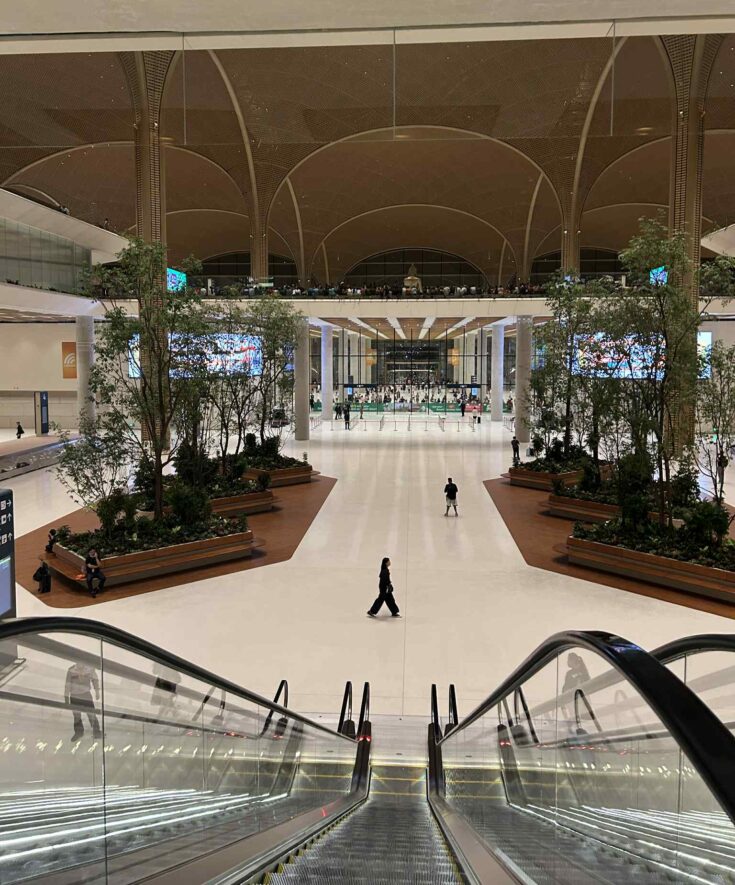
At first sight nothing looks out of the ordinary, it’s like every other airport, long hallways with gates on each side and hundreds of meters of moving sideways that shoot busy travelers off like bullets. But something is unlike other airports. Every surface is shining, no dirt in the corners or floormarks of thousands of footsteps, the whole hangar is extraordinarily clean – and empty.
This day, 9 September 2025, marks a historic day for Cambodia. It is the opening of the new bigger international airport: Phnom Penh Techo International Airport.
The old Phnom Penh International Airport (PNH) located closer to the city center had just one 3,000-meter runway and handled around 5 million passengers annually on a site of about 450 hectares.
By contrast, the Techo International Airport (KTI) is built with three parallel 4,000-meter runways on a vast 2,600-hectare site. In terms of capacity, Techo is built to handle 13 million passengers in its first phase, with expansion plans targeting 30 million by 2030 and up to 50 million by 2050. This major increase in size and capability reflects Cambodia’s ambition to reduce congestion, attract more long-haul flights, and position Phnom Penh as a stronger aviation hub in the region.
The airport is named Techo International Airport after Cambodia’s Prime Minister Hun Sen, who is often referred to by his honorary title “Samdech Techo” (which roughly translates to “Grand Duke of the Brave” or “Mighty Commander”). A naming that has drawn a bit of critism among Cambodians for liking a politician directly by name to vital infrastructure.
The official inauguration is said to be on 20 October 2025, but from 9 September 2025 the airport will function as the main way in and out of Phnom Penh by air, while the old airport has been taken over by the military.
The occasion has been marked by a small ceremony, which is why, when the passengers from Thai Vietjet Air flight VZ722 enter, everything looks prim and proper.
Beige, gold and black color the hallways and will give off a sophisticated first impression for the millions of travelers to come. The immigration is placed in a big room lined off with strikingly misfitting orange lines in front of a row of cubes-shaped immigrationscontrols. An overflow of personal dressed in military like uniforms are ready to welcome the tired visitors, but all systems and functions are brand new and even the workers don’t seem sure of to how to best guide the travelers. Travelers are pacing back and forth in the big room in between immigration officers, arrival forms and visa-checks with no distinct pattern.
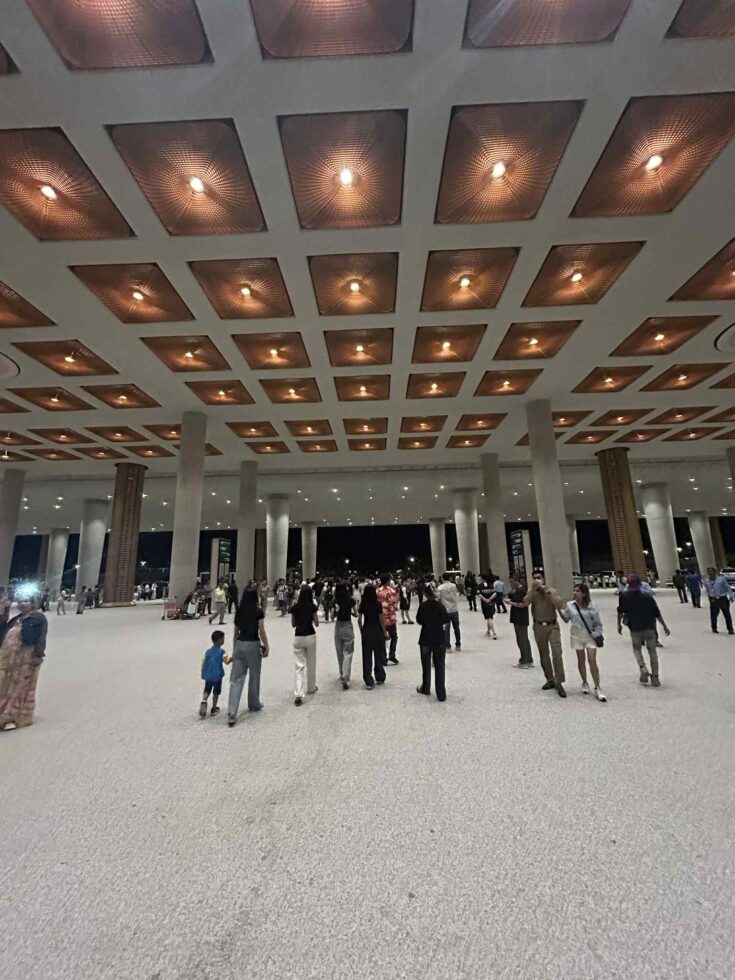
The immigration sector, the luggage and the arrival hall are huge and follows the same golden, beige and black color pallet as the inside of the airport. It looks like if Wes Anderson were told to create a movie set in the future. Toned colors gives a relaxed feeling, possibly to calm down stressed travelers. Plants and trees are strategically placed to be all in sight. Enormous concrete pillars holds up a roof that looks to be woven like a basket, where the hot southeast Asian sun shines through bathing luggage pick-up in a natural light welcoming visitors to Cambodia.
The design of Techo International Airport was led by the British architectural firm Foster + Partners. The firm created a modern, efficient layout with three passenger terminals, reflecting Cambodia’s ambition to establish a world-class aviation hub.