




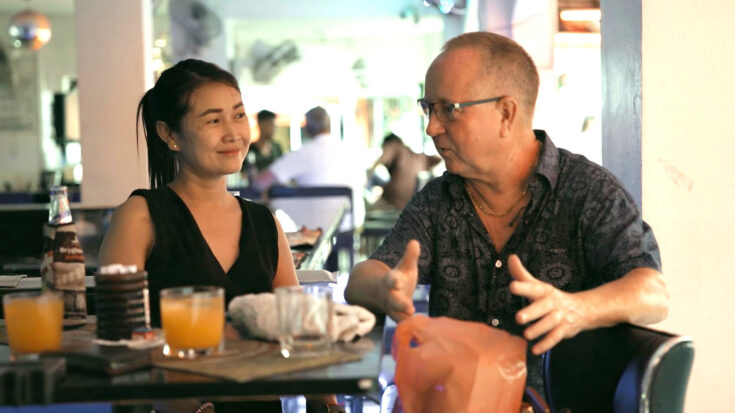
Following the premiere of season two of Paradise for Men on DR1, viewers were invited to an online chat with Henning Hedegaard — one of the main participants in the documentary series — and Gregers Møller, a long-time Danish resident of Thailand and editor at ScandAsia.
The documentary follows Danish men seeking relationships in Thailand and explores the cultural, emotional, and practical challenges they face. During the live Q&A, both Henning and Gregers shared personal reflections and responded to dozens of viewer questions ranging from cultural differences to love, language, and financial dynamics in cross-cultural relationships.
Henning, who splits his life between Struer and Southeast Asia, said:
“She seeks security, and I seek love. So it’s a deal you make,” when asked whether Thai women might be driven by economic motives. He added that despite language barriers, feelings and warmth often transcend words.
Gregers mentioned language berrier as a key concern:
“In the beginning, many Danes try to learn Thai, but after a while they give up and settle for the reduced English they can speak together.”
Both agreed that mixed-culture relationships can work but require more conscious effort.
“In a cross-cultural relationship you can’t take your assumptions for granted, you are forced to ask eachother how you feel about this or that,” said Gregers.
Henning noted that despite misconceptions in Denmark, most of the Danish men in Thailand are not “barfly types” but retirees or adventurers seeking companionship and a sense of meaning.
The conversation, hosted by DR, lasted several hours and touched on topics such as loneliness, respect, humor, and social integration. Gregers, who has lived in Thailand for 37 years, shared insights on how foreign men are perceived and how integration often falters due to language barriers.
The full chat transcript is available here (PDF, in Danish), featuring honest, sometimes provocative questions from Danish viewers and equally candid answers from both men.

One could also talk about the Paradise of the Elderly.
Many elderly people who are entitled to state pension supplements are prevented from leaving permanently to Thailand when they lose their once granted pension supplements.
The basic amount of the national pension minus tax to Denmark is not enough for survival, health insurance and income documentation to obtain a residence permit in Thailand.
Many are therefore content to stay outside Denmark for less than 6 months within 12 months. A change in the rules so that one does not lose their accumulated right to pension supplements based on geographical residence will benefit the quality of life for elderly people who have a spouse from a non-EU country, with whom they have not achieved family reunification in Denmark, and who therefore want to leave permanently.
The rest of society will also save no less than DKK 125,000 annually per pensioner who chooses to leave permanently, by getting rid of the elderly burden, which can be used to benefit the elderly in nursing homes in Denmark, who are suffering from drastic cuts and a lack of warm hands.
Man kunne også tale om De Ældres Paradis.
Mange ældre, der er berettiget til statens pensionstillæg, er forhindret i at udrejse permanent til Thailand, når de mister deres en gang bevilgede pensionstillæg.
Folkepensionens grundbeløb minus skat til Danmark er ikke nok til overlevlse, sygesikring og indtægtsdokumentation til opnåelse af opholdstilladelse i Thailand.
Mange nøjes derfor med at opholde sig udenfor Danmark under 6 mdr . indenfor 12 mdr.
En ændring af reglerne, så man ikke mister sin opsparede ret til pensionstillæg udfra geografisk bosted, vil gavne livskvaliteten for de ældre, der har en ægtefælle fra ikke EU land, med hvem de ikke har opnået familiesammenføring med i Danmark, og som derfor ønsker at udrejse permanent.
Det øvrige Samfund vil samtidig spare ikke under 125.000 DKK årligt pr pensionist, der vælger at udrejse permanent, ved at slippe af med ældrebyrden, som vil kunne bruges til gavn for De Ældre på plejehjemmene i Danmark, der lider under drastiske nedskæringer og mangel på varme hænder.
[…] Read more… […]