




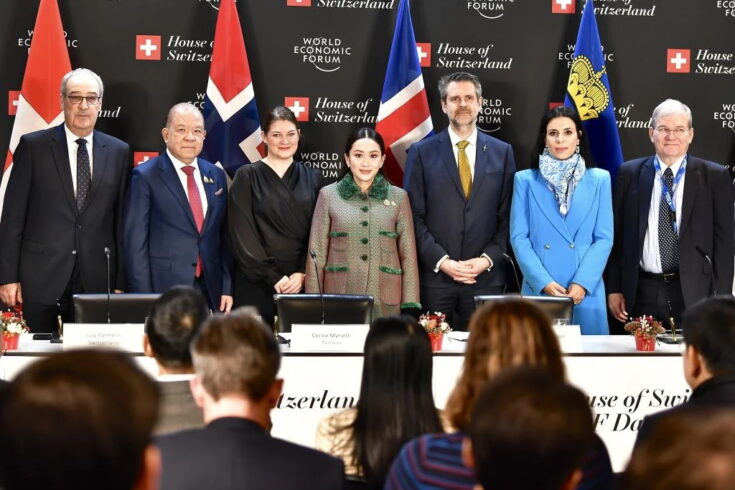
Thailand has officially signed a historic Free Trade Agreement (FTA) with the European Free Trade Association (EFTA), comprising Norway, Iceland, Switzerland and Liechtenstein. The agreement, signed on January 23 during the 2025 World Economic Forum in Davos, marks Thailand’s first-ever FTA with European nations. It represents a significant step in enhancing Thailand’s global trade prospects while also offering substantial benefits to Norway and the other EFTA member states.
The signing ceremony was attended by Thai Prime Minister Paetongtarn Shinawatra, Commerce Minister Phichai Naripthaphan, Swiss Economics Minister Guy Parmelin, Norwegian Trade and Industry Minister Cecilie Myrseth, and other high-ranking officials. For both Thailand and Norway, the agreement is expected to open up new opportunities and boost bilateral trade, which has seen robust growth in recent years.
Benefits for Norwegian Business and Trade
Norwegian Trade and Industry Minister Cecilie Myrseth hailed the agreement as a breakthrough for Norwegian businesses.
“This is great news for Norwegian industries. Almost all goods we export to Thailand will now enjoy zero tariffs,” she said. Myrseth emphasized that the FTA would strengthen the competitiveness of Norwegian goods and services in one of Southeast Asia’s fastest-growing economies.
Norway views Thailand as a key trading partner in the region. According to Thailand’s import statistics, Norway exported NOK 5.6 billion worth of goods to Thailand in 2023. Under the new FTA, 83% of Norwegian exports to Thailand will be tariff-free upon implementation, rising to 99.8% over the next 15 years.
“This is an excellent result for Norway! Over half of our exports to Thailand consist of seafood, and the agreement provides better terms than those enjoyed by our main competitors in the Thai market. This will be a major advantage for Norwegian exporters,” noted Fisheries and Oceans Minister Marianne Sivertsen Næss.
The agreement also ensures increased predictability and improved market access for Norwegian businesses in Thailand. Myrseth added, “This FTA joins a series of important trade agreements we’ve secured this year. Such agreements are vital for a small, open economy like Norway, especially at a time when many countries are building trade barriers.”

Strengthening Thailand’s Global Role
From Thailand’s perspective, the FTA signals the country’s re-emergence as a global trade leader. Commerce Minister Phichai Naripthaphan expressed confidence that the agreement would attract increased investment and position Thailand as a competitive trading partner on the global stage.
In 2024, total trade between Thailand and the EFTA nations amounted to USD 11.79 billion, accounting for 1.94% of Thailand’s global trade and representing a 19.22% increase from the previous year. Key Thai exports to EFTA countries include gems, jewelry, steel products, seafood, and cosmetics. Norway, meanwhile, primarily exports seafood, fertilizer, pulp, and steel products to Thailand.
The Thai Commerce Ministry anticipates that the agreement will boost foreign investment, particularly in emerging sectors like data centers and artificial intelligence, while strengthening Thailand’s position in global trade networks.
Focus on Sustainability and Mutual Benefits
The FTA includes a robust chapter on trade and sustainable development, adhering closely to EFTA’s most ambitious sustainability commitments to date in a free trade agreement with an Asian country. This reflects a growing emphasis on addressing social and environmental concerns while promoting economic growth.
A sustainability impact assessment conducted by the London School of Economics (LSE) Trade Policy Hub highlighted that the agreement would foster economic growth and increase trade and investments in both Thailand and EFTA nations. However, it also identified potential challenges related to climate, labor rights, and environmental sustainability.
While the report projects a slight increase in CO2 emissions in both EFTA countries and Thailand due to increased trade, it suggests that global emissions may decrease slightly as Thai imports from EFTA replace higher-emission goods from other countries. The report emphasizes the importance of robust provisions on sustainability and monitoring mechanisms to ensure long-term benefits for all parties involved.
A Milestone in EFTA-Asia Relations
For Norway and its EFTA partners, the FTA with Thailand represents a significant advancement in strengthening ties with a key Southeast Asian economy. It underscores EFTA’s commitment to pursuing open trade and sustainable development in an increasingly protectionist global environment.
In the coming months, the agreement will undergo ratification processes in Thailand, including public hearings and parliamentary approval. Once implemented, it is expected to dramatically enhance trade relations between Thailand and EFTA countries, offering new opportunities for businesses on both sides.
As Phichai remarked, “This agreement not only opens doors for Thailand but also demonstrates our readiness to engage with the global community at a higher standard.” For Norway, it’s a step toward securing better trade terms and ensuring its industries remain competitive in a dynamic global market. The Thailand-EFTA FTA promises to be a win-win, strengthening economic ties and creating sustainable growth for all involved.
Source: Regjeringen.no, The Nation and The Standard.


[…] Read more… […]