


Denmark has just held a general election, deciding the composition of its 179-seat parliament.
With all votes now counted, Nordic expatriates in Asia follow developments closely, as Denmark’s foreign policy and trade priorities may shape future engagement with the region.
The result marks a significant shift in Danish politics, with major losses for the traditional governing parties and gains for both left- and right-leaning challengers, TV2 reports.
The red bloc holds 84 seats against 77 for the blue bloc, while the Moderates hold 14 seats. However, this does not secure power for the red bloc.
First, how does the Danish election system work?
Denmark uses proportional representation, where seats in the 179-member parliament are distributed according to each party’s share of the national vote. Voters can choose either a party or an individual candidate.
To enter parliament, a party must win at least 2 percent of the national vote or secure a constituency seat.
There is no single winner of the election. A government is formed by the party or group of parties that can gather a majority in parliament, typically at least 90 seats. This means the largest party does not automatically take power.
Instead, parties negotiate to form alliances and agree on a prime minister.
Smaller parties can play a decisive role in this process. If no bloc has a majority, they can support one side and help form a government. In doing so, they often gain influence over political priorities and legislation.
Historic losses for governing parties
Voter turnout fell to 84 percent in the 2026 election, the lowest level in more than 35 years. The last time turnout was lower was in 1990, at 82.9 percent. While still high by international standards, it marks a historically low level in a Danish context.
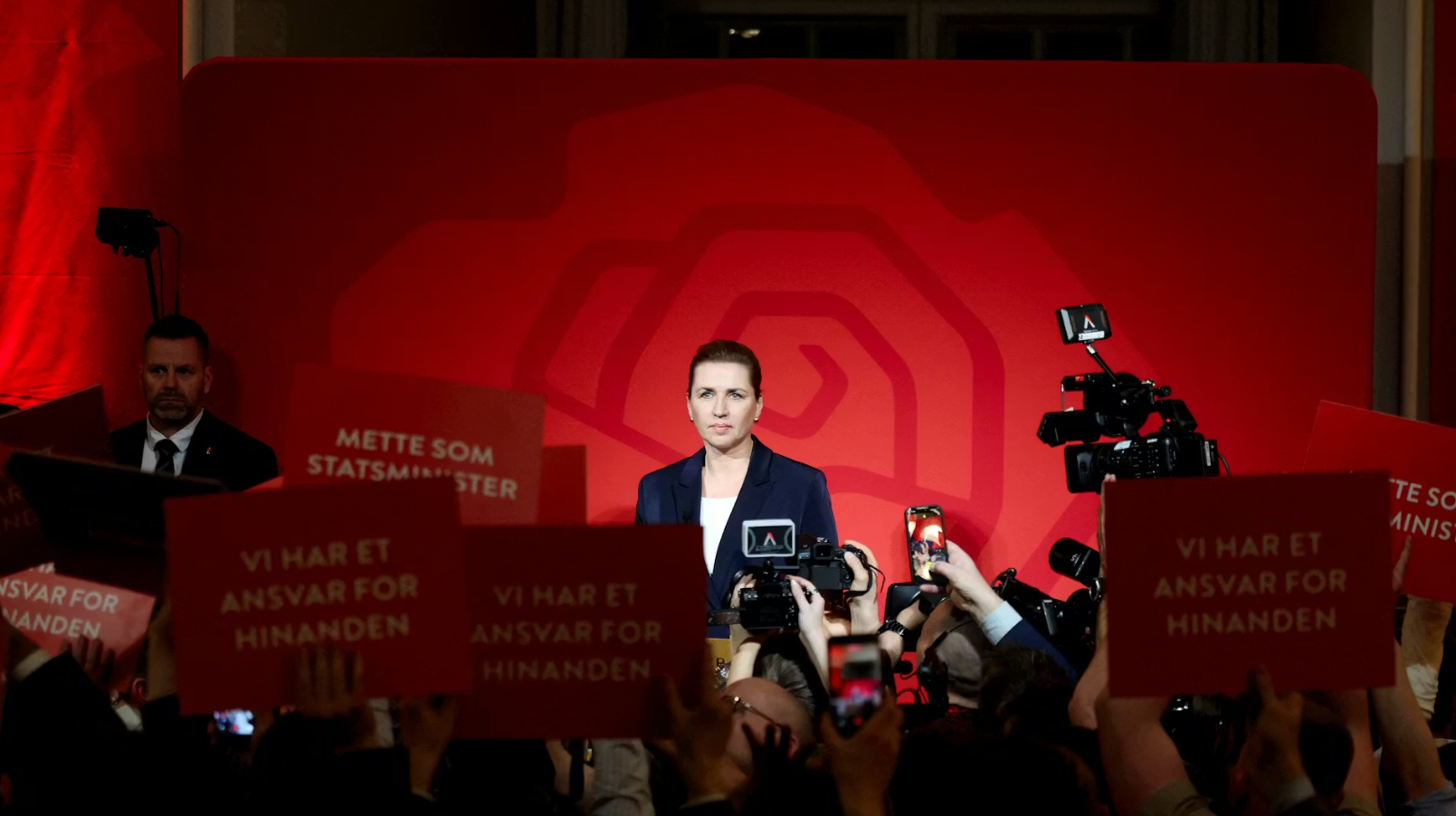
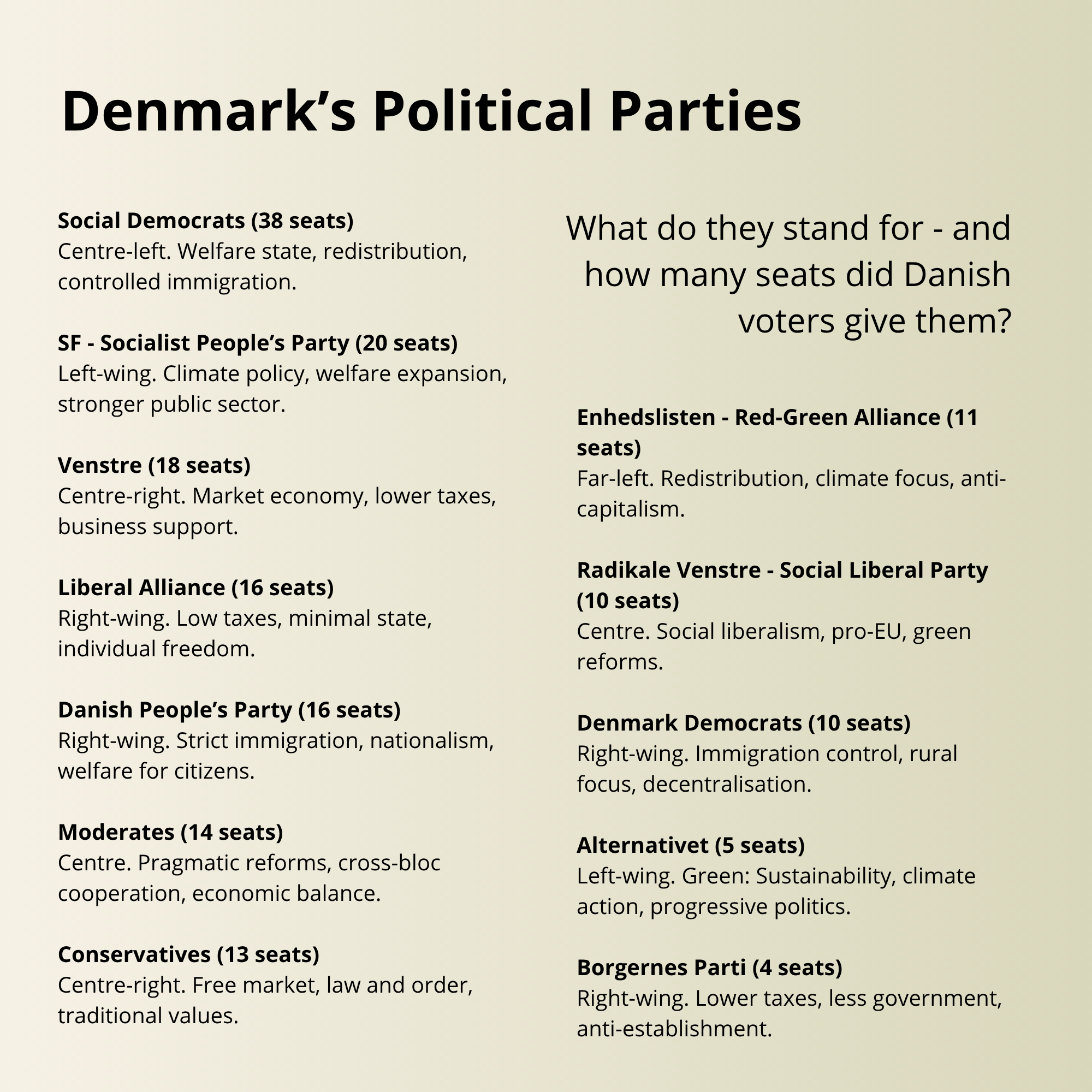
Socialdemokratiet (the Social Democratic Party) remains the largest party with 38 seats and 21.9 percent of the vote, down from 50 seats in 2022. This is its lowest result since 1903.
Venstre recorded its worst election since 1910, securing 18 seats and 10.1 percent, down from 23 seats.
Moderaterne, also part of the outgoing government, declined from 16 to 14 seats.
Gains for other parties
SF increased its support from 15 to 20 seats, becoming the second-largest party in parliament. Dansk Folkeparti saw a significant rise, moving from 5 to 16 seats.
Liberal Alliance grew from 14 to 16 seats, marking its best result to date. De Konservative increased from 10 to 13 seats, Enhedslisten from 9 to 11, and De Radikale from 7 to 10.
Danmarksdemokraterne lost support, dropping from 14 to 10 seats. Alternativet went from 6 to 5 seats but remained in parliament, while Borgernes Parti entered for the first time with 4 seats.
Government negotiations begin
Although the red bloc holds the most seats, it does not have a majority and therefore cannot form a government on its own, making coalition negotiations necessary.
A ‘royal investigator’, a person appointed by the monarch to lead negotiations and explore which parties can form a government, is expected to be appointed to lead negotiations. Prime Minister Mette Frederiksen is expected to meet the King to initiate the formal process of government formation.
Party leaders will meet the monarch individually to indicate their preferred candidate to lead the process. The negotiations may require several rounds.
Moderaterne and its leader Lars Løkke Rasmussen are expected to play a central role, as neither the red nor blue bloc can form a government without support from the center.
At the same time, the allocation of personal votes is still being finalized, determining which candidates will take the 179 seats in parliament.