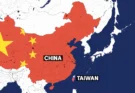




While Europe remains laser-focused on the stalemate in Ukraine — and rightly determined not to let Vladimir Putin get away with annexing parts of an independent state — another drama is building in Asia. And it is happening almost entirely under Europe’s radar. The signals from Beijing are not new, but their consistency is becoming impossible to ignore. China repeatedly declares that Taiwan will be “reunited,” voluntarily or otherwise. What has changed is the clarity with which Beijing seems to be preparing the ground for an actual military operation — one that, unlike Putin’s miserable and piecemeal approach in Ukraine, would not begin with half-measures. If China moves, it will move with everything it has.
Putin launched his invasion with only a fraction of Russia’s available force, assuming Kyiv would collapse in days. The result has been a grinding war, a humiliated military, and a sanctions-ravaged economy. Beijing has studied every second of this and has taken away a very different lesson. If China decides to attack Taiwan — and internal PLA planning has long targeted readiness for 2027 — it will not nibble around the edges or attempt a symbolic strike. It will seek to present the world with a fait accompli: a full air and sea lockdown, missile saturation across key targets, cyber paralysis of Taiwanese infrastructure, and a comprehensive blockade designed to prevent Japan, the United States, Australia, or Europe from even getting close to the island. For Taiwan, the window for serious defensive preparation is closing rapidly.
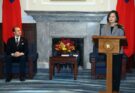
Perhaps this explains why President Lai Ching-te has now proposed a special USD 40 billion defense budget, intended to push Taiwan’s total military spending above 3% of GDP next year and eventually to 5% by 2030. It is the largest sustained buildup in Taiwan’s modern history. Lai framed the urgency bluntly, declaring that “peace must depend on strength,” and that investing in national defense is synonymous with investing in security and stability. The package, running from 2026 to 2033, would fund advanced air-defense and interception systems, the expansion of asymmetric capabilities like sea drones, the development of AI-driven battlefield systems, and deeper cooperation with the United States. The explicit target — high combat readiness by 2027 — mirrors the timeline frequently referenced in China’s own military preparation.
Yet Taiwan must pursue this at home amid a sharply divided parliament. The KMT and the Taiwan People’s Party have expressed skepticism about such a rapid increase, calling it too steep and too fast. Their resistance risks slowing reforms that Taiwan may not have the luxury to postpone.
Events in the region underline the urgency. China has reacted with fury to the comments of Japan’s new Prime Minister Sanae Takaichi, who warned that a Chinese attack on Taiwan could create a “survival-threatening situation” for Japan. Beijing has responded with diplomatic condemnation, travel discouragement, economic retaliation, and open threats to “crush” any foreign interference. This reaction is telling. China views even the discussion of Taiwan’s defense by foreign leaders as a provocation — not because the words themselves are remarkable, but because Beijing knows time is slipping away, and that Taiwan’s international support is becoming more vocal.
Meanwhile, Europe’s political bandwidth is consumed almost entirely by the war in Ukraine. While the United States, Japan, and Australia are, to varying degrees, actively preparing for a Taiwan scenario, many European governments have not yet internalized the scale of the risk. A conflict over Taiwan would be economically catastrophic for Europe, which relies heavily on the island’s production of semiconductors — roughly 60% of the world’s supply and nearly 90% of advanced chips. It would be strategically destabilizing across the Indo-Pacific, collapsing shipping routes and disrupting global trade. And it would be militarily complex, since Europe has no direct ability to penetrate a PLA-enforced blockade. Europe’s stance on Ukraine — that borders cannot be changed by force — becomes hollow if an even larger annexation unfolds in Asia without a meaningful European response.
The uncomfortable truth is that the world is sleepwalking into the possibility of a second major war. Taiwan is scrambling to accelerate its preparations. The United States is urging speed. Japan is warning openly about the threat. China is reacting aggressively to any foreign comment. And yet Europe barely registers the urgency. If Beijing decides to act, it will not resemble Crimea or eastern Ukraine. It will be a total, multi-domain operation designed to overwhelm Taiwan before the world can react.
Taiwan’s defensive buildup may be late — perhaps very late — but it is still essential. The alternative is a regional conflict that would reshape the world far more profoundly than the war in Ukraine. For Europe — and for Asia — ignoring the signals is no longer an option.
Previously on ScandAsia
Nordic engagement with Taiwan has surfaced repeatedly in ScandAsia’s coverage, reflecting both political concern and a growing awareness of Taiwan’s strategic importance in Asia. In April 2021, former Danish Prime Minister and ex-NATO Secretary-General Anders Fogh Rasmussen argued that democracies must be prepared to respond if China threatens Taiwan, calling the island’s security inseparable from the international rules-based order.
https://scandasia.com/former-danish-prime-minister-if-china-threatens-taiwan-we-should-be-ready-for-war/
In Denmark, the Taiwan issue has also emerged at a civil-society level. Earlier this year, Taiwanese residents protested a decision to list their birthplace as “China” on official documents, demonstrating how identity, democratic values, and the cross-Strait conflict resonate beyond Asia.
https://scandasia.com/taiwanese-protest-in-denmark-over-new-china-label-on-official-documents/
Nordic political support has been especially visible in Norway. At Taiwan’s National Day reception in Oslo in September 2025, Norwegian parliamentarians underscored their backing for Taiwan’s democracy and its participation in the international community, framing the island as a partner that shares Nordic commitments to openness, stability and democratic governance.
https://scandasia.com/taiwan-marks-114th-national-day-with-reception-in-oslo/
ScandAsia also explored the broader Nordic strategic calculus in a 2023 editorial, outlining why the region increasingly views Taiwan’s security as linked to global trade, semiconductor supply, and the defense of democratic norms. That article highlighted the quiet but growing shift in Nordic foreign-policy thinking as tensions in the Taiwan Strait intensified.
https://scandasia.com/why-nordic-countries-focus-on-taiwan/