



Nordic companies are preparing to increase investments in the Philippines, but Nordic business leaders and ambassadors say future growth will depend on the government’s ability to enforce reforms and tackle corruption in public projects.
The statements came during the Nordic Ambassadors’ Forum 2025 on Thursday 13 November in Manila, a high-level diplomatic and business gathering organised by NordCham Philippines. The event brought together the ambassadors of Denmark, Finland, Norway and Sweden to share insights on how trust and transparency have shaped Nordic societies and business ecosystems.
The first Business Climate Survey for Swedish Companies in the Philippines, published by Team Sweden, shows that 55 percent of Swedish firms plan to increase investments in the coming 12 months, while 58 percent expect industry turnover to grow. The survey gathered responses from 31 firms operating across energy, industrial equipment, consumer goods and professional services.
Team Sweden’s survey was presented at the Nordic Ambassadors’ Forum, hosted by NordCham Philippines.
While the survey focused on Swedish firms, the findings reflect wider Nordic sentiment in the Philippines, where companies from Denmark, Finland and Norway have also expanded their presence in recent years.
Swedish Ambassador Anna Ferry said confidence in the Philippine market remains strong.
“We’re very bullish when it comes to the Philippines. We’re quite positive of the business climate here,” says Ferry.
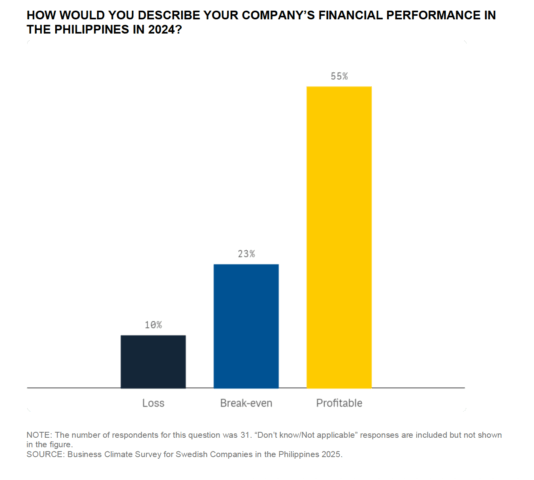
Team Sweden reported that the Philippines has outpaced several regional and Southeast Asian growth averages in 2024 and is projected to maintain momentum through 2027. More than half of the surveyed firms recorded profits in 2024, with professional services and industrial companies performing particularly well.
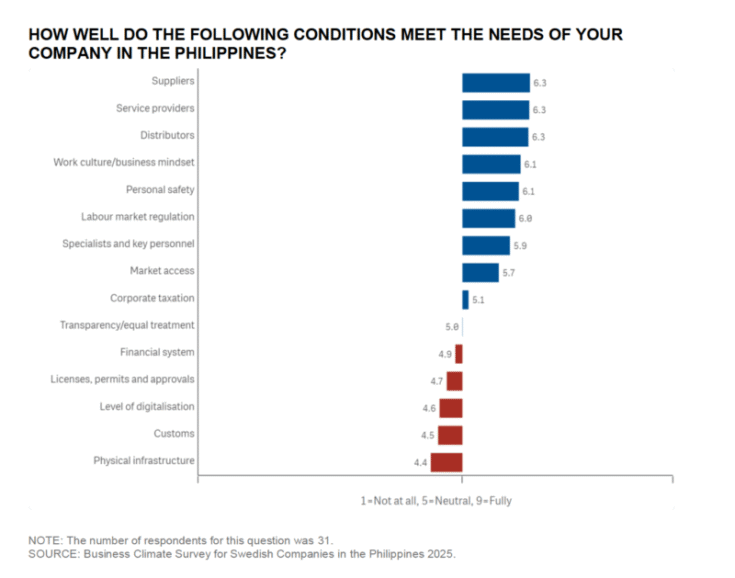 However, regulatory complexity, infrastructure gaps and inconsistent enforcement continue to challenge operations. Nearly six out of ten firms identified customs procedures as the most significant obstacle, citing long processing times, complex documentation and variable interpretation of rules between offices. The report also noted that about one-third of companies had encountered bribery or fraud when dealing with public bodies.
As the survey was presented in Manila, Nordic ambassadors issued a joint call for stronger enforcement against corruption, particularly in light of recent irregularities in government flood-control projects involving senior officials and contractors.
Denmark’s Ambassador Franz-Michael Mellbin said accountability will be crucial for restoring investor confidence.
“It will be an important signal to see people actually starting to end up in jail for theft of public property,” says Mellbin.
NordCham Philippines President Bo Lundqvist said the scandal has affected the country’s reputation in the Nordic business community.
“It is troublesome. The only way to convince the business community to invest is to put people to account to the fullest, to put people in jail if need be,” says Lundqvist.
Finland’s Ambassador Saija Nurminen emphasised that laws must be consistently applied.
“If there is no consistent implementation and accountability, perfect law is useless,” says Nurminen.
Norway’s Ambassador Christian Lyster highlighted the role of independent oversight.
“A vibrant civil society and a critical media are very important in making sure that laws are actually implemented on the ground,” says Lyster.
Swedish Ambassador Ferry added that digitalising government services and records would help strengthen transparency and reduce opportunities for corruption.
Despite operational challenges, Nordic companies continue to expand. Seventeen Swedish firms alone increased their investments in 2024, opening new regional offices, warehouses and service hubs across the country.
Major Nordic companies operating in the Philippines include IKEA, Volvo, Electrolux, Ericsson, ABB, Sandvik, Atlas Copco, SKF, Scania, TietoEVRY and several Danish and Norwegian maritime, logistics and renewable-energy firms.
Team Sweden said continued reforms in customs, taxation, government digitalisation and infrastructure will be essential to sustaining Nordic investment as companies look to expand their footprint in the Philippine market.

Sources: Nordcham.com.ph, GMA News Online, Business Mirror
Previous ScandAsia coverage
Nordic business perspectives on governance and the investment climate in the Philippines have appeared regularly on ScandAsia over the years. These earlier reports highlight recurring themes such as transparency, red tape, and the conditions needed for Nordic companies to expand in the country.
In 2022, Denmark’s ambassador emphasised that the Philippines must reduce bureaucracy and address long-standing regulatory bottlenecks to attract more foreign investors. The statement pointed to difficulties faced by both new and established Nordic firms operating in the country.
https://scandasia.com/denmark-suggests-philippines-should-cut-red-tape-to-get-more-investors/
NordCham Philippines has also contributed to broader discussions on how Nordic companies navigate the Philippine market. A 2022 feature presented the “Nordic-Philippines Sustainability Book,” which outlined Nordic corporate principles on governance, responsible business conduct, and long-term investment standards.
https://scandasia.com/nordcham-releases-nordic-philippines-sustainability-book/
Earlier coverage from 2018 highlighted the growing footprint of Nordic companies in the Philippines, describing how firms from Denmark, Finland, Norway, and Sweden were expanding across manufacturing, infrastructure, IT services, and consumer sectors as confidence in the market strengthened.
https://scandasia.com/the-nordics-seriously-back-in-business-in-the-philippines/
For broader regional context, ScandAsia has also reported on Nordic approaches to combating corruption and strengthening good governance. A 2022 article reviewed Nordic and Singaporean rankings as among the world’s least corrupt countries, noting the importance of trust and transparency as competitive advantages for Nordic businesses in Asia.
https://scandasia.com/the-nordic-region-and-singapore-again-ranks-among-the-worlds-least-corrupt-countries/
An earlier seminar report from 2012 explored concerns within the Nordic business community about corruption and unethical practices in Southeast Asia. Discussions at the event underlined how governance issues continue to influence investment decisions across the region.
https://scandasia.com/corruption-for-breakfast/
Taken together, these previous articles show a consistent Nordic message: strong rule of law, predictable governance, and transparent public administration remain essential for attracting long-term, high-quality investment from Nordic companies.